
Blue-tailed robber fly
Neoitamus cyanurus
Description
How to identify
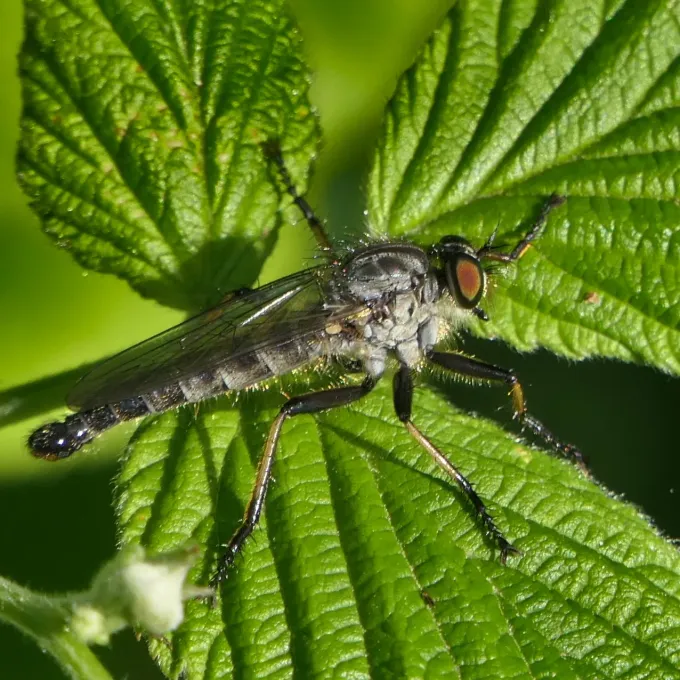
The blue-tailed robber fly Neoitamus cyanurus belongs to the Asilidae family (robber flies) within the order Diptera. These are robust, predatory insects with a slender body reaching 12-18 millimeters in length.
They are characterized by a dark coloration with dense hair. A notable feature is the abdomen, which in males often exhibits a distinct bluish sheen, leading to their common English name.
The head is highly mobile with large compound eyes, allowing the predator to spot prey during flight. The mouthparts are adapted into a hard, needle-like proboscis for piercing prey.
Larvae typically develop in the soil or decaying wood. They are cylindrical, whitish in color, and possess well-developed mouthparts for feeding on soil-dwelling organisms.
Adults are diurnal and prefer sunny, warm areas such as forest edges, meadows, and open fields, where they act as top predators in the insect world.
What it damages
It is crucial to clarify that the blue-tailed robber fly is not a crop pest. It is a strictly carnivorous predator that provides significant benefits to agricultural ecosystems.
Adult robber flies actively hunt other insects in flight, including beetles, grasshoppers, and other pests, effectively reducing their populations through direct predation.
The larval stage also contributes to biological control by living in the soil and feeding on the larvae of various ground-dwelling agricultural pests.
By consuming harmful insects, Neoitamus cyanurus acts as an essential ally for farmers, contributing to the natural suppression of pest outbreaks.
There are no known reports of this species causing any damage to crop tissues, making it a highly desirable resident in sustainable agricultural landscapes.
When it appears
Adult Neoitamus cyanurus activity is primarily concentrated in the summer months, specifically between June and August, when conditions are warm and sunny.
The life cycle is relatively long, often taking one to two years depending on the climatic conditions and the availability of food sources in the soil substrate.
Winter is usually spent in the larval stage. They remain in deeper layers of the soil or beneath dense organic debris to survive cold temperatures safely.
In spring, larvae resume activity as soil temperatures rise, continuing their growth and development before pupation and the emergence of the next adult generation.
Adult activity is highly dependent on light and heat; they are most visible on clear, sunny days when they hunt from elevated perches on plants or stones.
Signs of infestation
Observing large, swift-flying flies perching on plant stems or rocks is the primary indicator of their presence in an agricultural setting.
Since the species does not feed on plants, there are no specific signs of damage like leaf holes or wilting that are associated with this insect.
Watching the fly capture and subdue another insect in the air is the most reliable way to identify its role as an active predator in your field.
Larvae are rarely seen unless targeted soil investigations are conducted, but their absence from plant roots confirms they are not feeding on the crop.
A healthy population of blue-tailed robber flies is a positive bioindicator, suggesting that the local field ecosystem is diverse and self-regulating.
Control measures
Management strategies for the blue-tailed robber fly should focus exclusively on conservation and habitat protection rather than extermination.
Avoid the prophylactic use of broad-spectrum insecticides, which can decimate the populations of these beneficial predators and disrupt natural pest suppression.
Maintain field margins and wild grass areas to provide habitat and hunting grounds for adults, as well as safe sites for larval development.
Implementing minimal tillage practices can preserve the soil environment where larvae reside, ensuring a stable population from one season to the next.
- Restrict the use of non-selective pesticides.
- Establish refuge areas and hedgerows.
- Promote conservation biological control.
Taxonomy
- Latin name
- Neoitamus cyanurus
- Order
- Diptera (flies)
- Family
- Asilidae
- EPPO code
- NEITCY
Discussion
No discussions yet — be the first.