
Dasypogon diadema
Dasypogon diadema
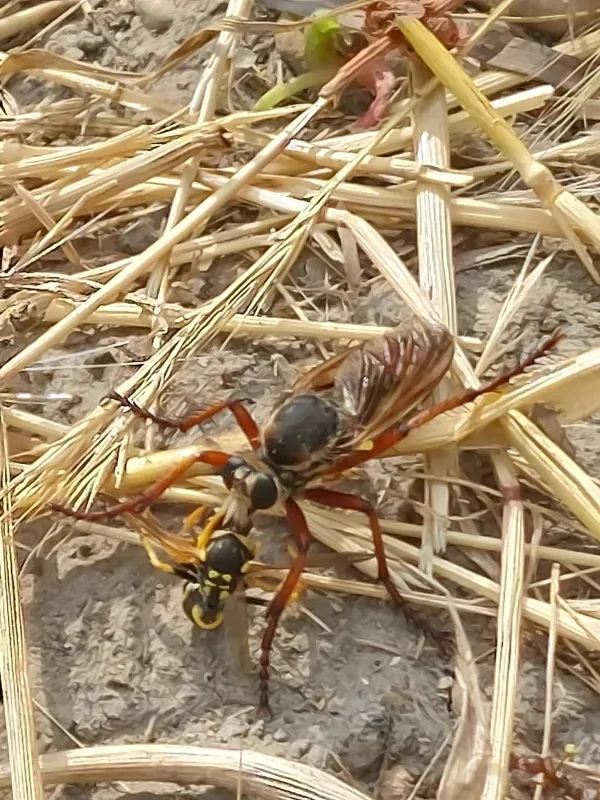
Description
How to identify
Dasypogon diadema is a large predatory fly belonging to the Asilidae family (robber flies) and the order Diptera. The insect is characterized by an elongated body, reaching 20–30 mm in length, and covered in dense, stiff hairs.
The coloration ranges from dark brown to almost black, providing effective camouflage in natural habitats. A key diagnostic feature is its powerful, sharp proboscis, specifically adapted for piercing the exoskeleton of its prey.
The eyes are very large and occupy a significant portion of the head, providing excellent vision and precision for mid-air hunting. The wings are transparent, sometimes with a faint smoky tint, and are highly developed for rapid maneuvers.
The larvae live in the soil and are yellowish-white with a cylindrical body shape. They are far less visible than the adults and undergo a long development period underground.
Unlike many other agricultural pests, this species is an active predator, making its classification as a pest complex, as it consumes both beneficial and harmful insects alike.
What it damages
The status of Dasypogon diadema as a pest is debatable, as it is a typical entomophagous predator. However, in apiculture, it is considered a threat because it frequently preys on honeybees.
In field conditions, these flies hunt bumblebees, various beetles, small hymenopterans, and other flies. This activity can lead to a localized decline in the population of essential plant pollinators.
The fly does not cause direct physical damage to plant tissues, such as leaves, stems, or roots. Its entire biological impact is centered on its predatory interactions with other fauna.
The primary agricultural concern is the non-selective destruction of beneficial entomofauna, including parasitic insects and pollinators, which may disrupt the biological balance within a field.
Larvae living in the soil primarily feed on organic matter, but they may occasionally damage plant roots when food sources are scarce, although this is considered secondary behavior.
When it appears
The active period for adult Dasypogon diadema occurs during the hot summer months, primarily June and July, when these flies are most agile and aggressive in their hunting behavior.
Adults prefer sunny, open areas, dry meadows, and field edges where prey activity is high. The optimal temperature for their activity exceeds 20–25 degrees Celsius.
The life cycle of the species is quite long and can span more than a year, as the larval stage occurs deep within the soil and is highly dependent on ground humidity and temperature.
Pupation typically occurs in the spring, followed by the emergence of adults ready for mating and reproduction.
By late summer, the population of adults begins to decline, and by early autumn, they have almost completely disappeared from the agricultural ecosystem.
Signs of infestation
The presence of robber flies can be identified by their behavior: the fly sits motionless on top of a plant stem or a stone, waiting to intercept prey in mid-air.
High concentrations of these predatory flies often correlate with high insect activity, which suggests a rich, albeit vulnerable, ecosystem subject to predation pressure.
If mass disappearance of bees is observed near apiaries in the presence of these flies, it serves as indirect evidence of their negative impact on local beekeeping operations.
There are no mechanical marks on plants, as the fly does not feed on plant sap or foliage, making visual identification of "bites" or tissue damage impossible.
The primary monitoring strategy involves observing the flight patterns of these predators during warm, sunny days near flowering crops that require pollination.
Control measures
Specialized control measures against Dasypogon diadema are usually unnecessary, as they are part of the natural biocenosis and rarely cause critical economic damage.
In cases where they threaten apiaries, it is recommended to implement temporary hive isolation or use protective netting to restrict predator access to the bees' flight paths.
Chemical control against this species is ill-advised, as it would destroy beneficial entomofauna and cause an ecological imbalance, potentially triggering outbreaks of other, more destructive pests.
Mechanical destruction of adult flies on a large scale is impossible. The best management strategy is the preservation of biodiversity, which naturally regulates the concentration of predators.
Avoid the use of broad-spectrum insecticides, as these predators, being high-level consumers, may accumulate toxins, which negatively impacts the overall resilience of the ecosystem.
Taxonomy
- Latin name
- Dasypogon diadema
- Order
- Diptera (flies)
- Family
- Asilidae
- EPPO code
- DSPGDI
Discussion
No discussions yet — be the first.