
Robber fly
Asilus
Description
How to identify
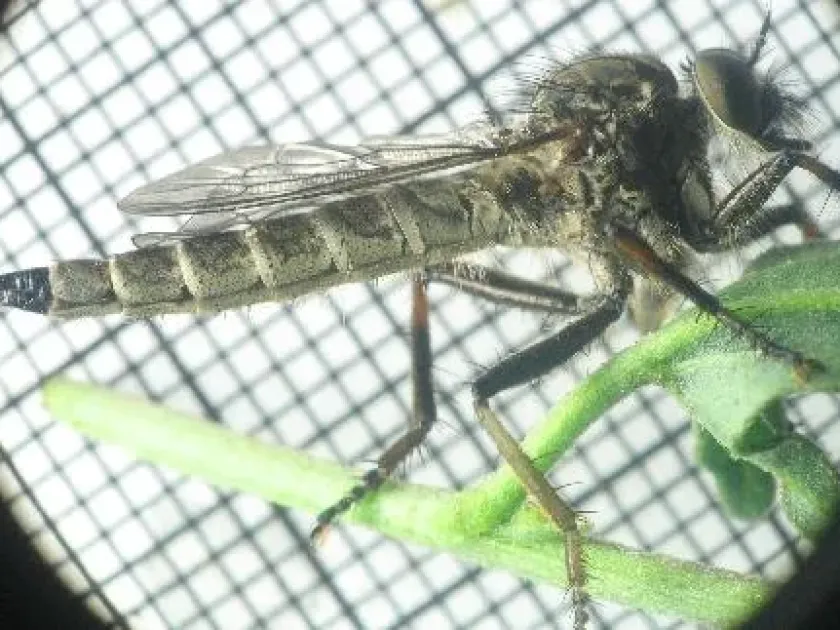
Robber flies (Asilidae) are a family of dipteran insects easily recognized by their robust, elongated bodies covered in dense bristles and a powerful proboscis.
Adults possess large compound eyes providing excellent vision for aerial hunting, and long, strong legs equipped with sharp claws for grasping prey.
The coloration of robber flies varies from grey and brown to black, sometimes with a metallic sheen, which assists in camouflage within their environment.
Adult sizes can reach 4-5 centimeters in length, making them some of the largest members of the Diptera order in many temperate regions.
The larvae of robber flies live in the soil or decaying wood; they have an elongated form, a creamy white color, and well-developed mouthparts for feeding within the substrate.
What it damages
It is crucial to understand that robber flies are not phytophagous and do not damage crops directly, as they are predatory insects.
The adult diet consists mainly of other insects, including flies, beetles, bees, and grasshoppers, which they catch in flight by piercing the prey with their proboscis.
Robber fly larvae also live a predatory lifestyle in the soil, feeding on the larvae of other insects, including potential agricultural pest species.
Therefore, from an agronomic perspective, the robber fly is a beneficial entomophagous insect that contributes to the natural regulation of pest populations.
The only negative aspect is that robber flies may occasionally prey on beneficial pollinators, such as honey bees, which can be an issue under specific agricultural conditions.
When it appears
Mass emergence of adult robber flies occurs during the warmest months of the growing season, typically from June through August, when their activity peaks.
The development cycle of a robber fly is lengthy and can take anywhere from one to three years, depending on the specific species and local climate conditions.
Most of their life cycle is spent in the larval stage, dwelling in the top layers of the soil where they develop and feed actively.
Pupation occurs within the soil or substrate, after which the adults emerge to the surface for mating and searching for prey during sunny weather.
The activity of adults is strictly tied to daylight hours; they prefer open, well-warmed field areas, edges of woods, and dry meadows.
Signs of infestation
The presence of robber flies in a field can be identified by their behavior: the insect often sits motionless on protruding parts of plants or on the ground, waiting for prey.
When an observer approaches, a robber fly makes a sudden, swift flight accompanied by a characteristic buzzing sound, before landing quickly in a new spot.
Under field conditions, there are no visible signs of their activity on crops, as they do not feed on plant tissues.
A high density of robber flies can indirectly indicate an abundance of prey insects in the ecosystem, confirming high biological activity within the soil.
They are most often spotted along roadsides and near shelterbelts, where the concentration of insects for hunting is highest.
Control measures
Specific control measures against robber flies are unnecessary, as they are recognized as beneficial natural enemies that destroy various pest species.
The use of broad-spectrum insecticides in fields leads to the destruction of robber fly populations, which subsequently triggers outbreaks of actual crop pests.
It is recommended to preserve natural habitats, such as field margins and undisturbed vegetation, where robber flies can breed and sustain their populations.
In the event of mass honey bee mortality near fields, it is necessary to assess the composition of predators, but direct eradication of robber flies is rarely advisable.
Integrated Pest Management (IPM) strategies emphasize the use of biological agents, and thus the robber fly should be viewed as a valuable ally to the agronomist.
Taxonomy
- Latin name
- Asilus
- Order
- Diptera (flies)
- Family
- Asilidae
- EPPO code
- ASILSP
Discussion
No discussions yet — be the first.