
Dioctria rufipes
Dioctria rufipes
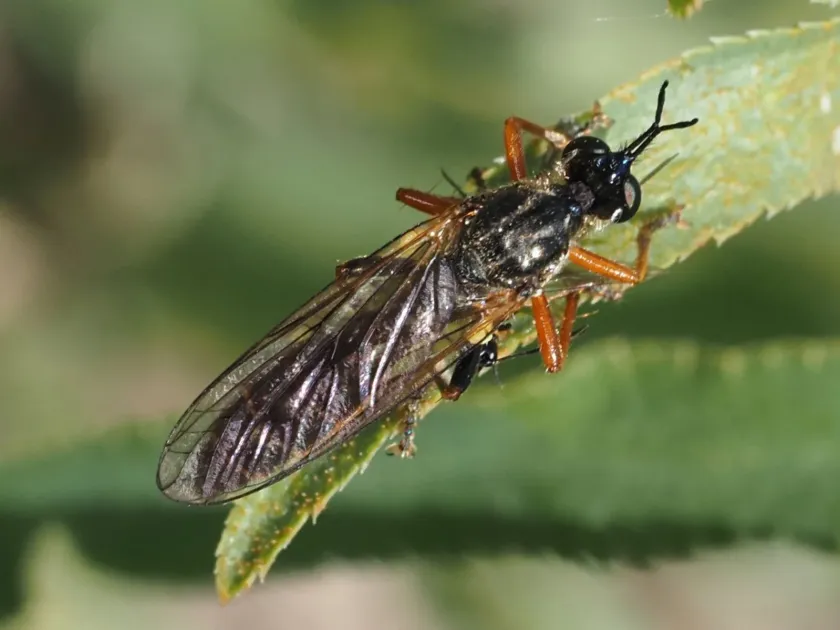
Description
How to identify
Dioctria rufipes belongs to the family Asilidae, known as robber flies. These insects are easily identified by their elongated bodies, prominent eyes, and a rigid, needle-like proboscis used for piercing their prey.
The name rufipes refers to its characteristic reddish-orange legs, which contrast with the generally dark, hairy body. Like other robber flies, they are expert hunters that catch their prey while in flight.
The larvae of this species develop within the soil, where they live as subterranean predators or scavengers. They are generally cylindrical and yellowish-white, typical of the family's immature stages.
The life cycle follows complete metamorphosis: egg, larva, pupa, and adult. The total development time is heavily influenced by soil temperature and moisture levels throughout the season.
Adults are most active during the daylight hours, using their excellent vision to scan the environment for smaller insects like flies, aphids, and midges.
What it damages
From an agricultural standpoint, Dioctria rufipes is not a direct pest. It does not consume plant tissues, stems, or fruits, as it is strictly a carnivorous insect.
The main concern for farmers is that they are opportunistic predators. They may capture beneficial insects, such as wild bees or hoverflies, which are essential for crop pollination.
While they can impact the population of beneficial insects, they also prey on various small agricultural pests, providing a natural form of biological pest regulation in the field.
In well-balanced ecosystems, the presence of these robber flies is usually considered neutral or beneficial, as they help maintain the stability of insect populations.
Significant damage to crop productivity due to this species is rarely documented and usually occurs only if an ecological imbalance encourages an unnatural explosion in their population.
When it appears
Adults of Dioctria rufipes are typically observed in the late spring and early summer months, usually peaking in May and June depending on the latitude and local climate.
This species is diurnal and highly active during sunny, warm days. They are often found on stems of low-growing plants, waiting to launch an attack on passing insects.
The mating and egg-laying period is relatively short, occurring shortly after the adults emerge from their pupal stage. Eggs are usually deposited in the soil or decaying organic matter.
Once the season progresses into late summer, the number of active adults drops significantly as they complete their reproductive cycle and die off.
Overwintering occurs in the larval stage, buried deep within the soil profile, which provides protection from extreme winter temperatures.
Control measures
No specific control measures are typically recommended for Dioctria rufipes, as it does not pose a direct threat to crop yield in standard agricultural practice.
The most effective strategy is to avoid the unnecessary use of non-selective broad-spectrum insecticides, which would kill both pests and beneficial predatory insects alike.
Enhancing habitat diversity by maintaining field margins and hedgerows allows for a stable predator-prey relationship to thrive without human intervention.
Proper soil management practices can help reduce the suitability of soil conditions for the development of larval stages if necessary.
- Minimize the use of broad-spectrum pesticides.
- Maintain hedgerows and wildflower borders to support ecosystem stability.
- Encourage biological control programs for specific crop pests.
- Monitor insect activity levels during the peak spring emergence.
Taxonomy
- Latin name
- Dioctria rufipes
- Order
- Diptera (flies)
- Family
- Asilidae
- EPPO code
- DCTRRU
Discussion
No discussions yet — be the first.