
Andrenosoma robber fly
Andrenosoma
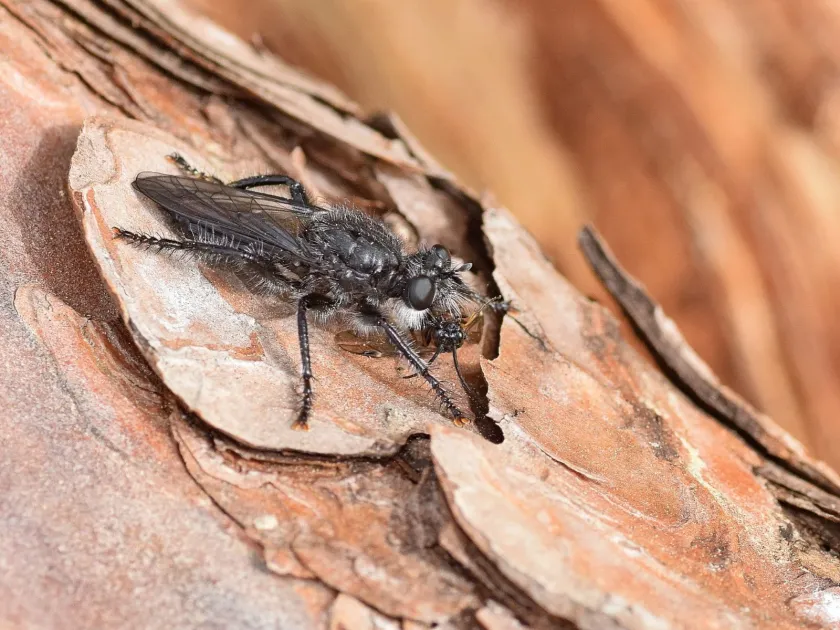
Description
How to identify
Andrenosoma is a genus of the robber fly family (Asilidae) in the order Diptera. These flies are recognized by their robust, hair-covered bodies that often mimic the appearance of bees or wasps, a phenomenon known as Batesian mimicry.
Adult robber flies are equipped with a strong, piercing proboscis designed to inject saliva into prey. Their large compound eyes provide excellent vision, which is essential for capturing other insects during flight.
The larval stage of Andrenosoma species typically develops in decaying wood or soil. These larvae are predatory, feeding on other soil-dwelling invertebrates, and are rarely seen in standard agricultural scouting.
Systematically, they are classified as opportunistic predators. Their morphological identification is often complex, requiring a detailed analysis of male genitalia to distinguish specific species within the genus.
They are highly agile insects, capable of rapid acceleration, which allows them to effectively hunt a wide variety of small to medium-sized insects in open fields and woodland edges.
What it damages
The Andrenosoma genus does not feed on plant tissues. They do not damage leaves, roots, stems, or fruits of crops, and therefore do not cause direct economic loss in typical agricultural systems.
However, their status as generalist predators means they can occasionally feed on beneficial insects, including pollinators like honeybees, which might lead to localized, indirect impacts on crop yields.
In most agronomic contexts, they are considered beneficial insects. They play a significant role in reducing the populations of various harmful insects that could otherwise cause significant damage to the crops.
Any negative impact on farming is generally negligible compared to the ecosystem services they provide by consuming pests. Consequently, they are rarely the subject of direct pest management programs.
There is no evidence of direct damage to plant physiology or yield attributable to the feeding habits of these robber flies.
When it appears
The flight activity of Andrenosoma adults is typically concentrated in the summer months, peaking from June through August when temperatures are optimal for their high-energy hunting style.
They are most frequently encountered in warm, sunny habitats, including crop borders, hedgerows, and orchards, where there is an abundance of prey and suitable spots for egg-laying.
The life cycle involves a metamorphosis through egg, larva, pupa, and adult stages. The larval development period can span multiple seasons, particularly in cooler climates where growth is slower.
Adults exhibit diurnal activity, hunting primarily during the warmest hours of the day. As autumn approaches and temperatures drop, their presence decreases significantly.
The spatial distribution of these flies is often linked to the availability of decaying wood, which serves as a critical substrate for the development of the next generation.
Signs of infestation
Visible signs of their presence include the observation of large, hairy flies performing rapid, darting flight patterns around fields or resting on elevated perches like fence posts or tall weeds.
Because they are not plant feeders, there are no characteristic bite marks, galleries, or necrotic spots on crops associated with their activity.
A decline in pollinator numbers might be mistakenly attributed to robber flies, though this usually requires careful ecological assessment to differentiate from the impacts of agrochemicals.
Larval signs are mostly undetectable during routine field operations, as they occupy cryptic microhabitats below the soil surface or within wood tissues.
Expert entomologists identify them by their typical behavior: sitting motionless on a vantage point to survey the area before launching into a precise aerial attack.
Control measures
Specific management measures against Andrenosoma are usually unnecessary, as they are not crop pests and often contribute to biological pest control by suppressing other insect populations.
Integrated Pest Management (IPM) strategies favor the preservation of these predators. Over-application of broad-spectrum insecticides can unintentionally kill these beneficial flies, leading to pest outbreaks.
For operations concerned with protecting apiaries, physical exclusion methods or hive management are preferred over attempts to reduce robber fly populations through chemical intervention.
- Promote biodiversity to maintain natural pest control.
- Avoid spraying during peak flowering to protect beneficials.
- Monitor field populations to distinguish between pests and predators.
In professional agronomy, maintaining a balanced environment that supports natural predatory fauna is more effective than attempting to eliminate generalist predators like Andrenosoma.
Taxonomy
- Latin name
- Andrenosoma
- Order
- Diptera (flies)
- Family
- Asilidae
- EPPO code
- ANDNSP
Discussion
No discussions yet — be the first.