
Robber fly
Neoitamus
Description
How to identify
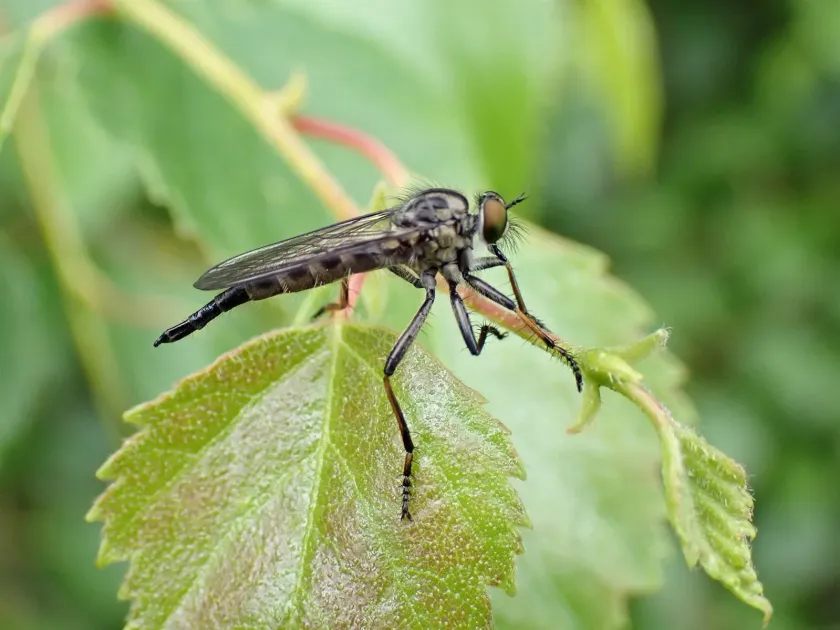
Robber flies of the genus Neoitamus belong to the Asilidae family, characterized by their predatory nature and agile flying capabilities. These flies are easily identifiable by their elongated bodies, dense bristles, and a rigid, sharp proboscis used for piercing prey.
Their head is highly mobile and equipped with large compound eyes, providing a wide field of vision necessary for tracking and capturing other flying insects mid-air.
The coloration of the adults is typically cryptic, featuring shades of brown, grey, or black, which allows them to remain camouflaged on tree trunks or plant stems while they wait for unsuspecting prey.
The larvae are soil-dwellers with a cylindrical body shape. They are well-adapted for burrowing and possess strong mandibles, which they use to feed on decaying organic matter or small soil-dwelling invertebrates.
The life cycle involves complete metamorphosis, including egg, larva, pupa, and adult stages. This process can take up to two years to complete, depending on environmental factors.
What it damages
Neoitamus robber flies are generally considered beneficial predators because they hunt numerous insect pests that would otherwise damage crops and ornamental plants.
However, they are not selective predators, which means they may occasionally prey upon beneficial insects like bees, hoverflies, and pollinators, potentially causing indirect harm in specific agroecosystems.
Adults do not feed on plant tissues, so they cause no direct structural damage to crops. Their impact on plants is strictly neutral or beneficial due to their predatory habits.
In rare instances, larvae residing in the soil may damage the root systems of young seedlings if their primary food source is scarce, though this is not a common issue for healthy plants.
Agronomically, they are regarded as natural enemies of pests rather than pests themselves, and they serve as an important indicator of a healthy, biodiverse environment.
When it appears
Adult robber flies are most active during the warmer summer months, typically ranging from June through August, when temperatures are optimal for flight and hunting.
The larval stage persists year-round within the soil. Larval growth accelerates during the spring and autumn when soil moisture levels are adequate for development.
Emergence of adult flies usually occurs in late spring or early summer, timed with the peak population of their prey insects, ensuring a steady supply of food.
The lifespan of an adult is relatively short, usually lasting only a few weeks, which is sufficient for mating and laying eggs in the soil or organic debris.
Population density is highly sensitive to climatic patterns, specifically rainfall and soil temperature, which significantly impact the survival rate of the larvae.
Control measures
Specific control measures for robber flies are rarely necessary as they perform a vital function in maintaining ecological balance and controlling other insect pests.
In cases where they negatively impact honeybee populations, it is best to avoid the use of broad-spectrum insecticides that could inadvertently harm the entire local pollinator community.
Mechanical soil cultivation, such as tilling or harrowing, can help manage larval populations if they reach levels that become problematic in sensitive areas.
Maintaining a diverse landscape with varied vegetation can help distribute the population of robber flies, reducing pressure on specific areas such as apiaries.
- Utilizing fine mesh protective covers for hives during peak robber fly activity periods.
- Preserving natural habitat corridors to support a balanced population of natural predators.
- Regular monitoring of insect activity to assess the ecological impact before considering any intervention.
Taxonomy
- Latin name
- Neoitamus
- Order
- Diptera (flies)
- Family
- Asilidae
- EPPO code
- NEITSP
Discussion
No discussions yet — be the first.