
Reeve's muntjac
Muntiacus reevesi
Description
How to identify
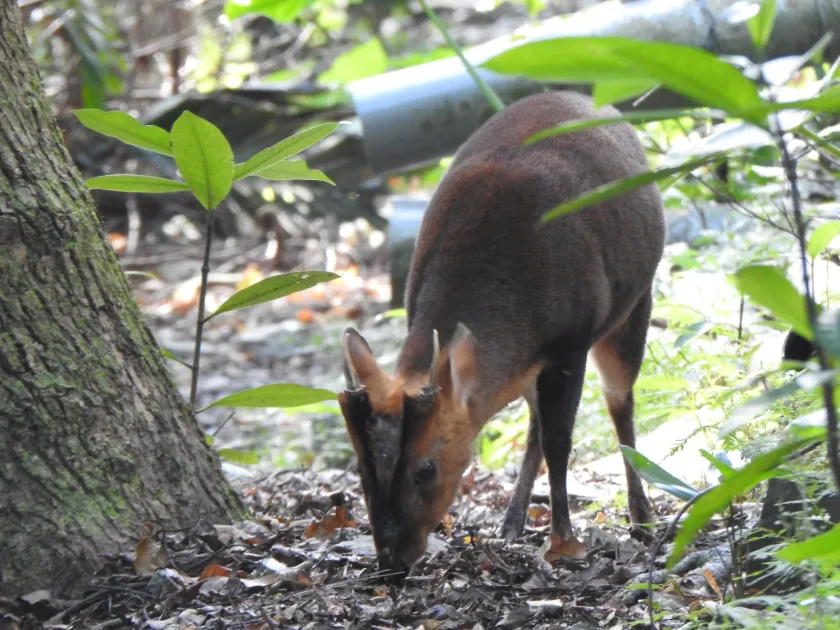
The Reeve's muntjac (Muntiacus reevesi) is a small deer species belonging to the Cervidae family and the Artiodactyla order. They are relatively compact animals, standing about 50 cm tall at the shoulder.
These animals possess a characteristic russet-brown coat and a rhomboid-shaped dark marking on their forehead. Males are distinguished by small, simple antlers and prominent canine teeth.
Muntjacs are highly adaptive and secretive animals, favoring dense undergrowth, hedgerows, and forests. Their ability to remain hidden makes early detection of their presence quite difficult.
As an invasive species in many parts of Europe, they have thrived due to the absence of natural predators and a high reproductive rate across diverse environments.
Their small size and agility allow them to traverse terrain that is impassable for larger deer species, enabling them to reach hidden parts of gardens and nurseries.
What it damages
Reeve's muntjacs are notorious for the extensive damage they cause to ornamental plants and shrubs. They frequently browse on buds, new shoots, and leaves, stunting the growth of vegetation.
In nursery settings, they cause significant losses by stripping the bark off young trees, which leads to tissue death and eventually kills the saplings if not caught early.
Vegetable gardens are particularly susceptible. Muntjacs often consume a wide variety of crops, including brassicas, peas, and leafy greens, leaving little behind for harvest.
Ecologically, they threaten biodiversity by overgrazing the forest understory, which prevents the natural regeneration of native tree species and affects local flora.
Trampling damage occurs during their movement across cultivated fields, which compacts the soil and ruins root systems of delicate vegetable crops.
Signs of infestation
The most reliable sign of a muntjac presence is their distinct track patterns. Their hooves are small, oval, and often show imprints of lateral dewclaws, which is a key identification feature.
Browsing damage is distinct due to the lack of upper incisors; instead of a clean cut, the plant stems show ragged, torn edges as the muntjac pulls the vegetation off.
Auditory signs are common, particularly a loud barking call that sounds like a dog. This is typically heard when the animal feels threatened or is traversing its territory.
Droppings are frequently found in "latrine" areas. They are small, dark, and pelleted, usually deposited in clusters along the paths the animals use to navigate.
Rubbing damage on the stems of saplings, often caused by males marking their territory with scent glands located on their faces, is a clear indicator of long-term presence.
Control measures
Physical fencing is the primary defense. A heavy-duty, deer-proof fence at least 1.5 meters high is necessary, and the bottom should be buried to prevent the animal from squeezing underneath.
Olfactory repellents can be used to deter muntjacs from specific ornamental beds. However, these require frequent reapplication, especially after rain or heavy dew.
Integrated pest management strategies often include the use of motion-activated deterrents, such as lights or sound emitters, which can startle the animals and encourage them to move elsewhere.
Cultivating resistant plant varieties that are unpalatable to muntjacs, such as those with thorns or strong scents, can significantly reduce the attractiveness of the garden.
- Installation of wire-mesh exclusion fencing.
- Regular application of scent-based repellents.
- Strategic selection of deer-resistant plant species.
- Monitoring tracks and droppings to assess population levels.
Taxonomy
- Latin name
- Muntiacus reevesi
- Family
- Cervidae
- EPPO code
- MUNTRE
Discussion
No discussions yet — be the first.