
Muntjac
Muntiacus
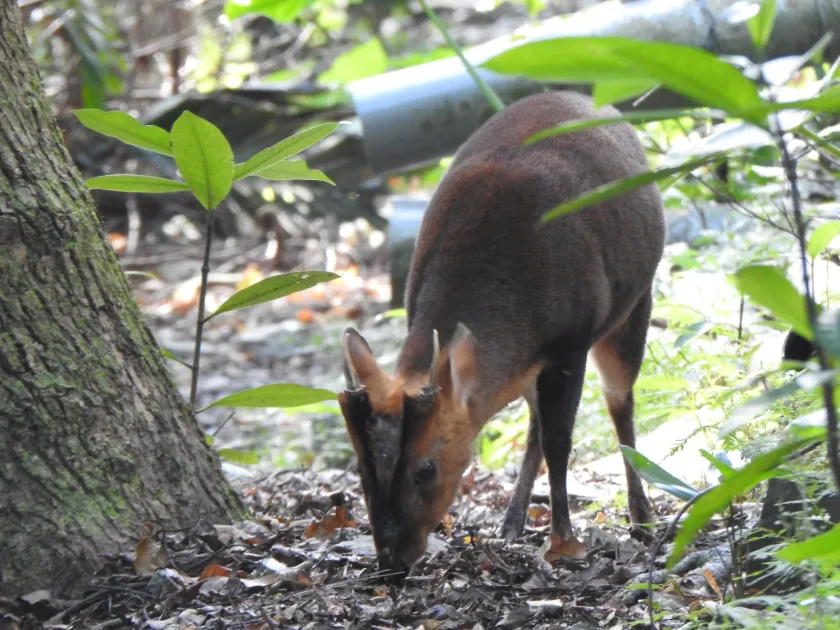
Description
How to identify
The muntjac (Muntiacus) is a small deer belonging to the Cervidae family, known for its adaptability and solitary behavior in various environments.
Adults stand approximately 40 to 65 cm tall at the shoulder. They have a characteristic hunched appearance and short antlers, with males sporting prominent canine teeth.
As an invasive species in many regions, they have proliferated due to their ability to breed year-round, making them a significant agricultural concern.
They are primarily nocturnal or crepuscular, meaning they are active during dawn and dusk, often remaining unseen until damage to plants is discovered.
Their small stature allows them to navigate dense brush and undergrowth, where they remain hidden from predators and human observers alike.
What it damages
Muntjacs are opportunistic browsers that target a wide range of plants, including ornamental flowers, shrubs, and fruit-bearing trees.
Young trees are especially vulnerable as muntjacs often strip the bark, which can ring-bark the stem and lead to the death of the specimen.
Gardeners frequently report losses of roses, hostas, and other popular garden plants that are consumed completely by these small deer.
They can also cause significant destruction to vegetable gardens, trampling seedlings and feeding on leafy greens during the growing season.
- Bark stripping on young saplings.
- Complete consumption of flower buds.
- Severing of new green shoots.
- Trampling of garden beds.
When it appears
Muntjacs are active throughout the entire year, as they do not hibernate and occupy the same territory regardless of the change in seasons.
Spring is a critical time for damage prevention, as the abundance of succulent new growth makes gardens highly attractive to these animals.
During the winter months, when natural food sources in the wild become scarce, muntjacs are more likely to encroach into private gardens.
Because they are not migratory, their impact on a specific area can be chronic if protective measures are not implemented immediately.
Continuous presence means that plant protection strategies must be maintained consistently across all four seasons to be truly effective.
Signs of infestation
Identifying a muntjac presence often starts with finding their small, two-toed hoof prints in soft soil or muddy areas near damaged plants.
A tell-tale sign is the frayed, ragged appearance of bark stripped at a low height, which is typically found within the reach of a muntjac.
Droppings, often found in small piles along well-trodden trails in thickets, are another strong indicator of an established territory.
The barking call, which sounds surprisingly like a dog's bark, is a distinct vocalization that warns other muntjacs of perceived danger.
Widespread grazing patterns that leave plants cleanly nipped at a 30-50 cm height are indicative of muntjac browsing activity.
Control measures
Physical fencing is the only truly effective deterrent. A fence of at least 1.5 meters, reinforced at the base, is necessary to keep them out.
Individual tree guards or sturdy mesh sleeves placed around young saplings are essential for preventing bark damage during the critical growth phase.
While chemical repellents exist, their effectiveness is short-lived, especially during rainy weather, and they should only be used as supplementary measures.
Maintaining a clear perimeter and reducing dense cover around the garden can make the property less appealing for muntjac to shelter in.
Where muntjac populations are extremely dense, local government advice should be sought to discuss population control options.
Taxonomy
- Latin name
- Muntiacus
- Family
- Cervidae
- EPPO code
- MUNTSP
Discussion
No discussions yet — be the first.