
Lime hawk-moth
Mimas tiliae
Description
How to identify
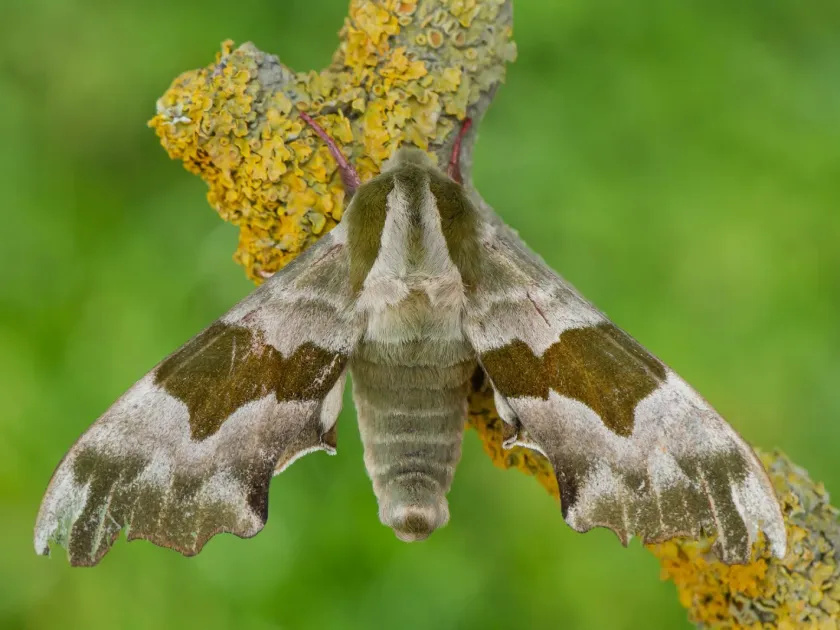
The adult lime hawk-moth is a large moth with a wingspan of up to 80 mm. Its forewings are jagged and colored in various shades of brown, olive, and gray, providing excellent camouflage against tree bark.
The caterpillars reach 60–70 mm in length. They are vibrant green with light diagonal stripes on their sides and a distinctive blue or yellowish horn at the rear end of the abdomen, typical of the Sphingidae family.
The pupa of the lime hawk-moth is dark brown, smooth, and hard. It develops underground in a small chamber created by the caterpillar in the soil at a depth of several centimeters.
The eggs are oval and smooth, usually pale green or yellowish in color. Females typically deposit them singly or in small groups on the underside of the leaves of the host tree.
A key biological trait of this species is that the adults do not feed, as their mouthparts are reduced, meaning they rely entirely on energy reserves stored during the larval stage.
What it damages
The primary host plant for the larvae is the lime tree (Tilia), from which the moth derives its common name. Caterpillars actively graze on the foliage, skeletonizing leaves or consuming them entirely.
In addition to lime trees, this pest may attack other deciduous trees, including birch, elm, alder, and occasionally plants from the Rosaceae family if they are nearby.
During mass outbreaks, the caterpillars can cause significant defoliation, which severely reduces the ornamental value of park landscapes and the overall health of the trees.
Extensive loss of leaf mass disrupts photosynthesis, making the tree weaker and more susceptible to secondary infections or boring insect infestations.
For young seedlings, damage caused by the lime hawk-moth can stunt shoot growth and negatively impact the development of the tree canopy, which is a major concern in nurseries.
When it appears
Adult moths are active in late spring and early summer, typically between May and June. In warmer climates, a partial second generation may occur, though the cycle is usually univoltine.
Egg-laying and larval emergence coincide with the period of active leaf growth on trees, ensuring that the larvae have an optimal supply of soft food for rapid weight gain.
The feeding period of the caterpillars spans the summer months, from June to August. During this time, the pest is most visible on the tree canopy as it feeds and grows rapidly.
Pupation occurs in late summer or early autumn, after which the pupa enters diapause in the soil, spending the cold winter months there until the next spring.
Environmental factors such as prolonged rain or extreme heat can slightly alter the phenological phases of the lime hawk-moth development in specific regions.
Signs of infestation
The first sign of infestation is the presence of large larval droppings on the ground or on foliage beneath the canopy where the pest is feeding.
Visual inspection of the canopy reveals the caterpillars, though their green coloration and habit of resting along leaf midribs make them difficult to spot at first glance.
Characteristic damage includes ragged leaf edges or entirely destroyed leaf blades, often with only the central vein remaining, especially in the upper crown.
Infested trees may look thin or sparse in the canopy, and in severe cases, significant portions of the crown can become transparent due to foliage loss.
Nocturnal attraction to artificial light sources is a reliable method for entomologists and arborists to monitor the local population density of the moth.
Control measures
For small, individual trees, manual removal of the caterpillars during evening inspections is an effective and safe way to manage the population without chemicals.
In cases of heavy infestation, biological insecticides based on Bacillus thuringiensis are recommended as they are effective against larvae while being safe for beneficial insects.
Chemical control involving systemic or contact insecticides can be used during the peak larval emergence phase if the health of valuable trees is at risk.
Agricultural measures include autumn cultivation of the soil under the tree canopy to disrupt the hibernation of pupae, which helps reduce the next year's population.
- Regular monitoring of tree health and canopy density.
- Encouraging natural predators such as birds that prey on caterpillars.
- Using light traps to monitor adult moth activity.
Taxonomy
- Latin name
- Mimas tiliae
- Order
- Lepidoptera (butterflies)
- Family
- Sphingidae
- EPPO code
- MIMATI
Discussion
No discussions yet — be the first.