
Lime hawk-moth
Mimas
Description
How to identify
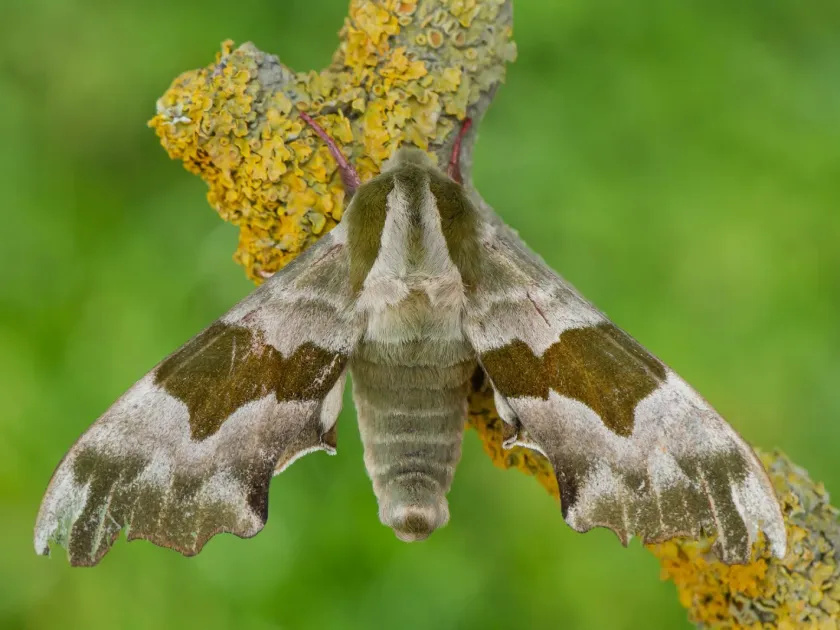
The lime hawk-moth (Mimas tiliae) is a prominent member of the Sphingidae family. The adult moths are characterized by their jagged wing edges and olive-green or brown patterns, which provide exceptional camouflage against tree bark.
The larvae are typically bright green with diagonal red or yellow stripes on their sides. A distinctive feature is the blue or yellow horn on the posterior end, which is a classic indicator of this species.
The life cycle undergoes complete metamorphosis, consisting of four distinct stages: egg, larva, pupa, and adult. The pupae overwinter in the soil at the base of the host tree, protected by a dark, resilient shell.
Adult moths possess vestigial mouthparts, meaning they do not feed during their short lifespan. Their primary focus after emerging in the spring is reproduction and finding suitable host plants for their eggs.
These moths are widely distributed across the Palearctic realm, commonly found in deciduous forests, woodlands, and urban areas where lime trees are abundant.
What it damages
The primary host plant for Mimas tiliae is the lime tree (Tilia). The larvae feed voraciously on the foliage, often consuming entire leaves except for the tougher central veins.
While lime trees are the preferred host, larvae can also thrive on other deciduous trees such as birch, alder, and elm. In orchard environments, they have been known to feed on apple and cherry tree leaves.
Massive infestations can lead to significant defoliation, which severely hampers the tree's ability to photosynthesize and store energy for the winter months.
Repeated annual damage stresses the trees, making them highly susceptible to secondary attacks by wood-boring insects, bark beetles, and various fungal diseases that thrive on weakened plant tissues.
Young trees are at particular risk; severe defoliation can lead to stunted growth or complete plant mortality if the energy reserves of the sapling are exhausted.
When it appears
Adult moths typically emerge in late spring, primarily from May to June. They are nocturnal and rarely seen during the day, as they remain camouflaged on tree trunks or branches.
Following mating, females deposit their eggs singly or in small clusters on the underside of host plant leaves, where they remain until the larvae hatch about two weeks later.
Larval activity begins in mid-summer and continues through August. During this time, they feed heavily, molting several times as they grow toward their final larval stage.
By September, the larvae descend to the ground to pupate. They bury themselves in the soil to form a protective chamber, where they will remain dormant throughout the winter.
The peak season for larval damage occurs during July and August, when the moths' ravenous appetite is at its height, requiring vigilant monitoring of tree health.
Signs of infestation
The most noticeable sign of an infestation is unevenly eaten leaf edges or stripped leaves where only the midrib remains, leaving the tree canopy looking sparse and skeletal.
Large quantities of dark, cylindrical frass (droppings) accumulate beneath the canopy, serving as a clear indicator of active feeding by a group of hawk-moth larvae.
Closer inspection of branches during the evening may reveal the presence of larvae, which often remain motionless to avoid detection, blending in with the leaf petioles.
Early leaf yellowing or premature leaf drop in mid-summer can indicate that the tree is struggling to cope with the damage inflicted by the pest population.
Secondary signs include an increased presence of ants or other insects attracted to the wounded leaves or the frass left by the hawk-moth larvae in the lower branches.
Control measures
In garden settings, hand-picking the larvae is an effective control method. Conducting inspections at night with a flashlight makes the larvae much easier to spot against the foliage.
Biological control methods, specifically using Bacillus thuringiensis sprays, are highly effective against these larvae while remaining safe for beneficial insects, birds, and pets.
If the infestation is severe and threatening large stands of trees, professional arboricultural services may use targeted insecticides, following local environmental regulations.
Cultivating the soil around the base of the trees in late autumn can destroy overwintering pupae by exposing them to freezing temperatures or natural predators like birds.
Maintaining a healthy garden ecosystem by encouraging insectivorous birds and parasitic wasps helps keep the lime hawk-moth population within natural, non-damaging limits.
Taxonomy
- Latin name
- Mimas
- Order
- Lepidoptera (butterflies)
- Family
- Sphingidae
- EPPO code
- MIMASP
Discussion
No discussions yet — be the first.