
Tasmanian brown lacewing
Micromus tasmaniae
Description
How to identify
The Tasmanian brown lacewing (Micromus tasmaniae) belongs to the order Neuroptera and the family Hemerobiidae. It is a well-known beneficial insect used in biological control programs.
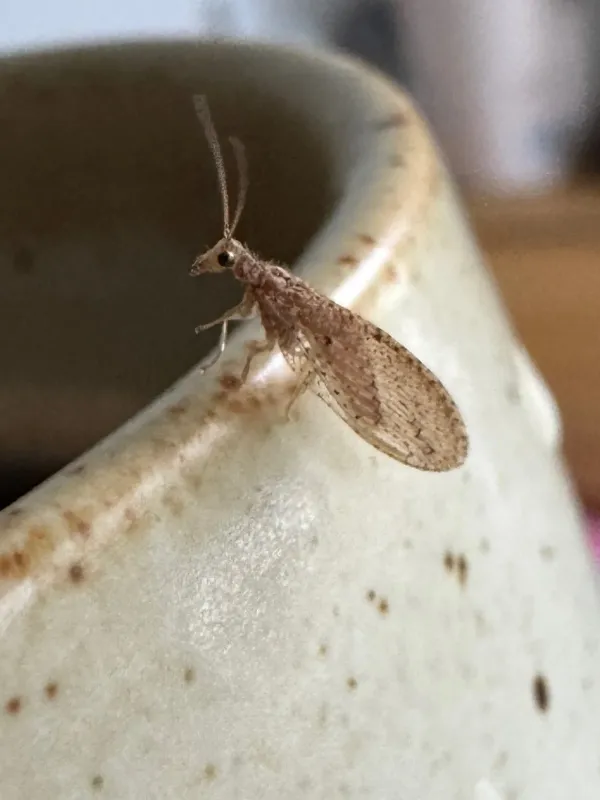
Adults are small, brownish insects with intricate, net-like wing patterns, which help them blend into tree bark and foliage. They are significantly different from the bright green lacewings.
The larvae are specialized predators with elongated bodies and prominent, curved mandibles used for grasping and consuming soft-bodied prey like aphids.
Development involves a complete metamorphosis: egg, three larval instars, pupa, and adult. Each stage is adapted for efficient hunting and survival in diverse environments.
They are widely recognized in agricultural entomology for their high voracity and ability to rapidly reduce pest populations in various field crops and orchards.
What it damages
The Tasmanian brown lacewing is not a plant pest. It is a highly beneficial predator that feeds exclusively on other small arthropods and has no negative impact on plant tissue.
Their primary diet consists of aphids, spider mites, mealybugs, and insect eggs. By consuming these pests, they provide a valuable ecosystem service to farmers and gardeners.
Economic impact is positive; by controlling aphid populations, Micromus tasmaniae helps maintain crop health and yield quality without the need for synthetic chemical intervention.
They do not consume plant sap, nor do they cause any physical damage to the leaves, stems, flowers, or fruits of the plants they inhabit.
Presence of this species indicates a balanced agroecosystem where natural enemies are successfully managing pest pressures in an organic or integrated manner.
When it appears
The activity of Micromus tasmaniae spans the entire growing season, aligning closely with the availability of its prey populations in the field.
Populations tend to peak during the spring and summer months when aphid infestations become more frequent and widespread across various crops.
They are active under various climatic conditions but perform best in temperate environments where food sources for larvae are consistently available.
As the season progresses toward autumn, adults seek shelter in bark crevices, leaf litter, or other protected areas to enter diapause and survive the winter.
Successful management of the species involves ensuring habitat continuity so that they can re-emerge and colonize new crops early in the following season.
Control measures
No control measures against Micromus tasmaniae are required, as they are essential allies in agricultural pest management. Conservation strategies are the preferred approach.
To promote their numbers, growers should avoid broad-spectrum insecticides that harm non-target beneficial species and instead opt for selective pest management.
Planting flowering borders, such as dill, buckwheat, or sweet alyssum, provides essential nectar for adult lacewings, significantly boosting their survival and reproductive rates.
Integrated Pest Management (IPM) practices focus on monitoring lacewing levels to leverage their natural control potential before applying any secondary treatments.
- Minimize pesticide applications.
- Maintain hedgerows and wildflower strips.
- Implement selective biological control agents.
Taxonomy
- Latin name
- Micromus tasmaniae
- Family
- Hemerobiidae
- EPPO code
- MICUTA
Discussion
No discussions yet — be the first.