
Brown lacewing
Micromus
Description
How to identify
The brown lacewing (genus Micromus) belongs to the order Neuroptera and the family Hemerobiidae. Unlike many other insects, it is considered highly beneficial in agricultural and horticultural settings.
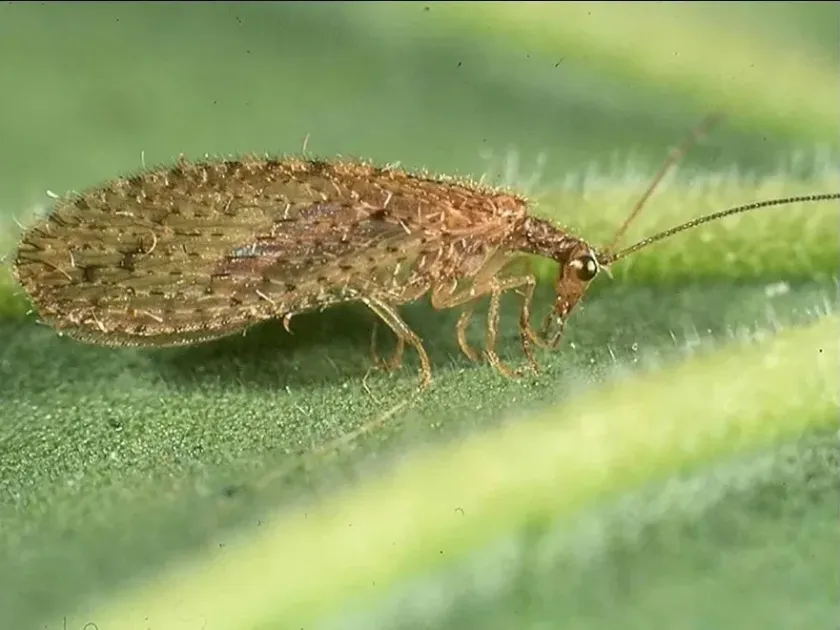
Adults typically feature brown, lace-like wings that are held roof-like over their bodies when at rest. They are generally small, often overlooked due to their excellent camouflage against tree bark.
The larvae are specialized predators with elongated, spindle-shaped bodies and prominent, curved mandibles. These mouthparts are perfectly adapted for piercing and consuming soft-bodied prey.
Development follows a complete metamorphosis: egg, larva, pupa, and adult. Each lifecycle stage is characterized by high activity, contributing to the biological regulation of prey populations.
Identification in the field often requires careful observation, as they prefer to hunt during the twilight hours or in the protected canopy of the foliage.
What it damages
It is crucial to clarify that the brown lacewing is not a pest. It performs a vital ecological service by predating on insects that damage various agricultural crops, ornamental plants, and trees.
The primary food source for both larvae and adults is the aphid. They actively seek out colonies of aphids, significantly reducing their population density in both greenhouses and open fields.
In addition to aphids, brown lacewing larvae are known to feed on spider mites, whiteflies, scale insects, and the eggs of various lepidopteran pests.
Their efficiency as predators is due to their voracious appetite; a single larva can consume hundreds of individual prey items throughout its development cycle.
By naturally suppressing pest populations, these insects help maintain the health and vigor of plants, reducing the economic impact of infestations.
When it appears
The activity of brown lacewings is strongly correlated with the availability of prey and favorable climatic conditions. They emerge in early spring once temperatures are consistently warm.
Throughout the growing season, multiple generations may occur, ensuring a persistent presence of predators as long as the pest populations remain active.
Peak activity typically coincides with the spring and summer aphid blooms, when food sources for the lacewing larvae are most abundant.
As temperatures decline in late autumn, the adults seek protected overwintering sites, such as the rough bark of trees, leaf litter, or sheltered structures.
Conserving the population during the winter months is essential for the natural control of pests in the following season, emphasizing the need for maintaining diverse garden habitats.
Control measures
The management of brown lacewing populations focuses on conservation and habitat enhancement. Protective measures are aimed at fostering their natural presence rather than eradication.
The most important control strategy is the restricted use of broad-spectrum insecticides, which are lethal to beneficial lacewings and can lead to secondary pest outbreaks.
Integrated Pest Management (IPM) practices should be adopted, prioritizing biological control and selective pesticides that specifically target pests while sparing the lacewings.
Creating refuges and providing nectar sources by planting a variety of flowers can attract adults, providing them with necessary alternative food sources when prey is scarce.
- Minimize the application of chemical pesticides.
- Preserve diverse vegetation to provide natural overwintering sites.
- Utilize selective biological agents instead of broad-spectrum toxins.
Taxonomy
- Latin name
- Micromus
- Family
- Hemerobiidae
- EPPO code
- MICUSP
Discussion
No discussions yet — be the first.