
Meadow spittlebug
Mesoptyelus
Description
How to identify
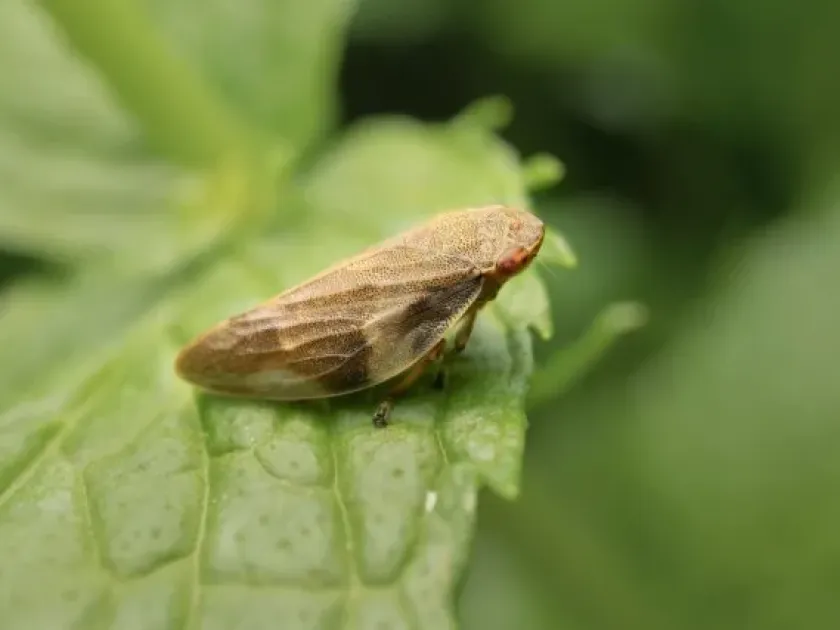
The meadow spittlebug (scientific name Philaenus spumarius) belongs to the family Aphrophoridae, order Hemiptera. Adults are typically 5–7 mm long and exhibit high variation in color, ranging from plain brown to striped or spotted patterns.
The name comes from the characteristic white, frothy foam produced by the nymphs. This "spittle" acts as a protective shield against predators and desiccation. Finding this substance on stems and leaf axils is the definitive way to identify the pest.
Adults, often called froghoppers, are powerful jumpers. They possess strong hind legs that allow them to leap away quickly when disturbed. Unlike the nymphs, they do not produce foam and spend their time actively moving between host plants.
The life cycle is univoltine, meaning there is only one generation per year. They overwinter as eggs, which are inserted into the tissues of plant stems or hidden under plant debris. Nymphs emerge in the spring and immediately start feeding.
After several molts, the nymph transitions into the adult stage. At this point, the insect develops wings and leaves its foam-covered feeding site to search for mates and new food sources throughout the garden.
What it damages
This insect is highly polyphagous, meaning it feeds on a vast range of plant species. Common garden victims include strawberries, raspberries, currants, lettuce, and many ornamental flowers like roses and chrysanthemums.
Both nymphs and adults extract plant sap by piercing the epidermal tissues. This feeding process deprives the plant of essential nutrients and disrupts the transport of water and carbohydrates to the growing tips.
Visual damage often manifests as stunted growth, curled leaves, and yellowish spotting. In severe cases, the entire shoot may wilt and become deformed, which significantly diminishes the plant's aesthetic value and health.
Beyond direct feeding damage, spittlebugs are known vectors for various plant pathogens. They can transmit phytoplasmas and viruses, which can lead to diseases that are far more destructive than the insect feeding itself.
On berry bushes, high infestation levels can reduce fruit yields significantly. The overall stress on the plant makes it more susceptible to opportunistic secondary infections, such as powdery mildew or various fungal leaf spots.
Signs of infestation
The most diagnostic sign is the presence of white, bubbly foam masses in the crotches of leaves or on the growing tips of stems. This is the hallmark of nymphal activity.
Deformed or curled leaves at the plant apex. When nymphs feed on developing tissue, the plant’s growth pattern becomes irregular, resulting in twisted and stunted foliage that looks unhealthy.
The appearance of chlorotic, whitish spots on leaves where the insects have inserted their stylets to suck sap. Over time, these spots can necrosis and leave small holes in the leaf blades.
A sudden decline in flower bud development. If you notice buds failing to open or appearing withered without an obvious reason, it is likely that spittlebugs have drained the sap necessary for flower maturation.
Active adults hopping around when you shake the plant foliage. A high concentration of these jumping insects in your garden during late spring and summer is a clear indicator of a population outbreak.
Control measures
Cultural control is essential. Regularly weeding your garden beds and removing nearby wild host plants will drastically reduce the available egg-laying sites for the insects to overwinter.
On a small scale, a strong blast of water from a garden hose is often sufficient to dislodge the nymphs and destroy their foam. Once the foam is gone, the exposed nymphs are highly vulnerable to drying out and predators.
Biological control, using entomopathogenic fungi or introducing natural predators like lacewings and ladybirds, can help manage populations in an eco-friendly manner without disrupting the garden ecosystem.
If the infestation is severe, contact or systemic insecticides can be used. It is best to apply these treatments early in the season before the nymphs transition into the adult stage to prevent widespread damage.
Promote plant health by providing balanced fertilization and proper irrigation. Strong, vigorous plants are inherently more resilient to sap-sucking pests and can withstand higher levels of pressure compared to stressed specimens.
Taxonomy
- Latin name
- Mesoptyelus
- Order
- Hemiptera (bugs, aphids, leafhoppers)
- Family
- Aphrophoridae
- EPPO code
- MESTSP
Discussion
No discussions yet — be the first.