
Spotted pine borer
Melanophila fulvoguttata
Description
How to identify
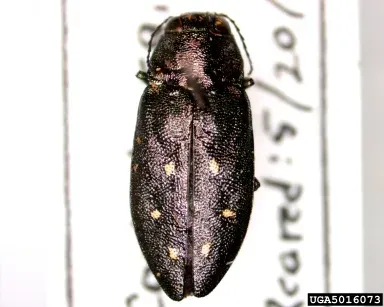
The spotted pine borer (Melanophila fulvoguttata) is a member of the Buprestidae family, also commonly known as metallic wood-boring beetles. Adults typically measure between 8 and 11 mm in length.
The body is characterized by a dark bronze or nearly black color with a metallic sheen. The most recognizable feature is the presence of three pairs of orange or yellow spots on the elytra.
Larvae are legless and flattened, typical of the Buprestidae family, with a head partially retracted into the prothorax. Their anatomy is perfectly adapted for carving galleries through thick bark and sapwood.
Pupation occurs within a specially constructed chamber inside the tree’s inner bark or outer sapwood. The transformation process follows a phase where the larva prepares a secure site to avoid environmental threats.
These beetles are heliophilic, meaning they are attracted to sunlight. They are most commonly found in open stands, forest edges, or on trees exposed to direct solar radiation.
What it damages
The primary hosts of this pest include coniferous tree species, most notably spruce (Picea) and fir (Abies). Occasionally, they may infest other conifers if the trees are under physiological stress.
The beetle specifically targets stressed trees, particularly those weakened by drought, wildfire, mechanical damage, or previous pathogen infestations. Healthy, vigorous trees are usually capable of resisting initial attacks.
Larval feeding causes the most severe damage as they mine the cambium and phloem layers. This disrupts the tree's vascular system, preventing the transport of water and nutrients throughout the trunk.
Adult beetles may feed on needles and young twigs, but their primary threat is the female's habit of laying eggs on the bark of stressed trees, leading to eventual infestation by the larvae.
Severe infestations effectively girdle the tree, causing rapid decline and death. The galleries also introduce secondary fungal pathogens that accelerate wood decay and the tree's final collapse.
When it appears
Adult flight typically occurs during the summer months, spanning from June through August. Their activity levels are strongly correlated with ambient temperature and solar intensity.
Females deposit their eggs into bark fissures. They often choose locations on the sunny side of the tree, where temperatures are optimal for the rapid development of the developing embryos.
Larvae hatch in the summer and begin feeding immediately, boring into the inner bark layers. Depending on the local climate and temperature, their developmental stage may last one or two years.
Overwintering occurs at the larval stage within the tree's protected inner layers. This allows the pest to survive freezing winter temperatures that would otherwise be lethal to the adults.
Emergence of the new adult generation occurs in late spring or early summer, through characteristic D-shaped or oval exit holes carved by the beetles as they transition from the pupal stage.
Signs of infestation
The most visible sign of infestation is the presence of small, oval-shaped exit holes on the bark of the trunk or larger branches. Resin bleeding or "pitch tubes" may also be observed near these sites.
Crown dieback is a key indicator, starting with the yellowing and subsequent browning of needles at the top of the tree. This reflects the disruption of the nutrient supply to the canopy.
Removing a small portion of the bark reveals meandering, winding galleries packed with frass (larval excrement and wood particles). These galleries often overlap, covering extensive areas.
Peeling bark or sections of bark that have become loose are common symptoms in heavily infested trees. The cambium layer underneath usually shows dark, necrotic patches caused by larval feeding.
- Increased presence of woodpeckers on the trunk.
- Premature needle drop and thinning crown.
- Cracks and lesions visible on the surface of the bark.
Control measures
The most effective management strategy is maintaining forest hygiene by removing and destroying infested trees before the next generation of adults can emerge.
Promoting tree health is crucial; providing adequate irrigation during drought periods significantly increases the tree's resistance to boring beetle colonization.
In landscape or ornamental settings, systemic insecticides can be applied as trunk injections or soil drenches to provide a protective barrier against larval establishment.
Monitoring using pheromone-baited traps allows managers to detect the arrival of the beetles early, facilitating the timely application of contact insecticides if necessary.
Prompt processing of infested timber or slash (burning or chipping) is a critical step in preventing the spread of the population to healthy adjacent trees.
Taxonomy
- Latin name
- Melanophila fulvoguttata
- Order
- Coleoptera (beetles)
- Family
- Buprestidae
- EPPO code
- MELPFU
Discussion
No discussions yet — be the first.