
Drummond's Flatheaded Borer
Melanophila drummondi
Description
How to identify
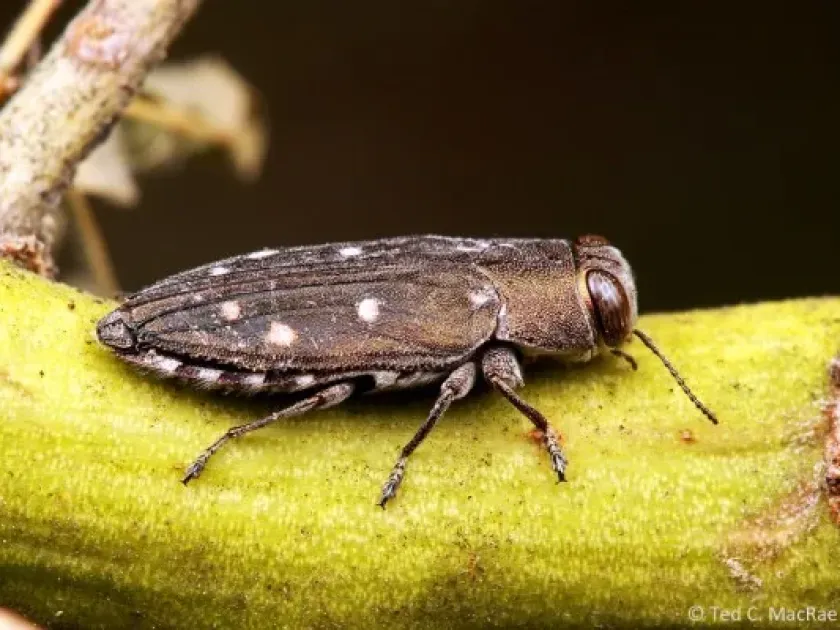
Drummond's Flatheaded Borer (Melanophila drummondi) is a species of beetle belonging to the family Buprestidae. Adult beetles are typically 7 to 12 mm in length with a flattened body shape.
The appearance of the adult is dark bronze or black with a metallic sheen, and many specimens feature distinct pale spots on their elytra arranged in rows.
Larvae are legless, white in color, and characterized by a widened thoracic segment, which helps them move efficiently within the narrow spaces beneath the bark.
These insects are highly sun-loving and are most active during the warmest parts of the day, which makes them easier to spot on sun-exposed tree trunks.
Proper identification is often based on the observation of the specific gallery patterns they leave behind in the cambium layer of the tree.
What it damages
The primary hosts for this pest include various conifer species, such as Douglas-fir, hemlock, spruce, and larch trees across its native range.
The borer primarily targets stressed, injured, or weakened trees. Forest fires, drought, or mechanical damage make trees highly susceptible to infestation.
In forest environments, the beetle frequently colonizes downed logs and dying timber, which allows the population to build up rapidly in a given area.
While they prefer weakened hosts, high population densities can lead the beetles to attack and eventually kill seemingly healthy trees.
Young trees in nurseries are at particularly high risk, as the larval feeding activities can girdle the tree, cutting off nutrient flow and causing rapid death.
When it appears
Adult beetles typically emerge and are active from late spring through mid-summer, depending on local temperature and elevation.
Egg-laying occurs on the bark of susceptible trees, with the larvae hatching shortly after and beginning their inward boring process.
The larval stage is the most destructive, as they feed extensively on the inner bark and cambium throughout the summer and early autumn months.
The insects spend the winter as mature larvae within protective chambers excavated in the outer wood or thick bark.
Pupation takes place in early spring, followed by the emergence of new adults that will continue the life cycle for the next generation.
Signs of infestation
Visible signs of infestation include small, D-shaped or oval exit holes on the tree trunk, left behind by emerging adult beetles.
Stripping away a section of bark often reveals wide, serpentine galleries packed with frass (fine wood powder), which are tell-tale signs of larval activity.
Top-down crown yellowing and gradual thinning of needles are common indications that the tree's vascular system has been compromised by the borer.
Heavy pitch streaks on the bark are often observed as the tree attempts to push out invading larvae, which is a frequent response in coniferous hosts.
- Presence of D-shaped exit holes on bark.
- Serpentine galleries filled with frass.
- Premature browning or needle drop.
Control measures
Effective management begins with strict sanitation practices, including the prompt removal and destruction of infested or recently felled trees.
Maintaining tree vigor through proper watering and soil health is essential, as healthy trees are naturally more resistant to borer attacks.
Natural enemies, including various parasitic wasps, play a significant role in limiting the population growth of the borer in diverse forest ecosystems.
For high-value ornamental trees, protective insecticide sprays applied during the adult flight period can help prevent the beetles from laying eggs.
Reducing the availability of breeding material by clearing forest debris and slash helps prevent local outbreaks from turning into larger infestations.
Taxonomy
- Latin name
- Melanophila drummondi
- Order
- Coleoptera (beetles)
- Family
- Buprestidae
- EPPO code
- MELPDR
Discussion
No discussions yet — be the first.