
Charcoal beetle
Melanophila acuminata
Description
How to identify
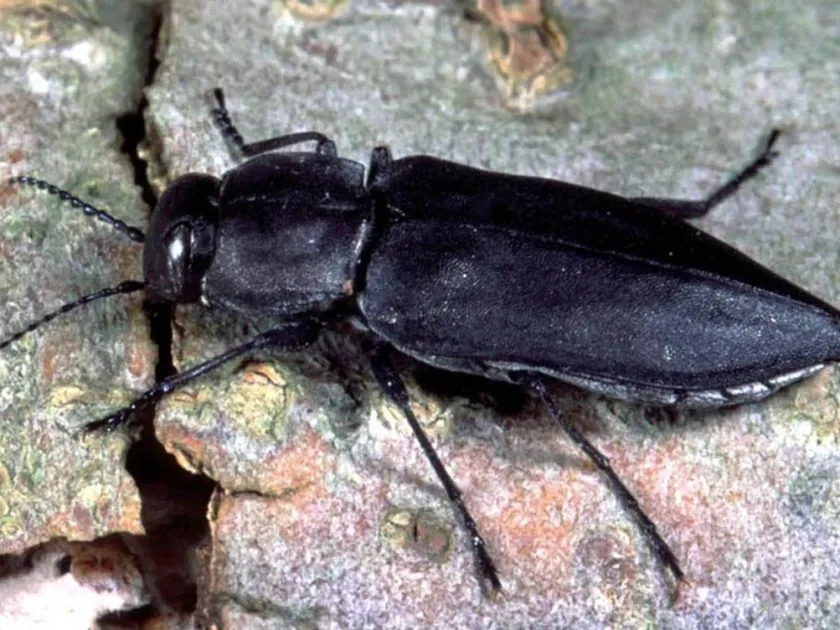
The charcoal beetle (Melanophila acuminata) is a small wood-boring insect belonging to the family Buprestidae, order Coleoptera. Adult beetles typically range from 6 to 11 millimeters in length and possess a flattened, elongated body shape.
The coloration of the adult is predominantly black, often exhibiting a noticeable bronze or metallic sheen. The wing covers (elytra) are densely pitted, and each wing usually features three faint yellowish or orange spots, which may sometimes be indistinct.
The beetle's head is broad with large eyes covering a significant portion of its lateral surface. The larvae are legless, flattened at the anterior end, and cream-colored, which is typical for many wood-boring insect larvae.
This species possesses a unique chemo-receptive ability, enabling it to detect forest fires from great distances. They have specialized sensory organs — infrared photoreceptors — highly sensitive to thermal radiation emitted by fire sources.
Charcoal beetles are diurnal and most active during hot, sunny weather. In their natural habitat, they are pioneer colonizers of burnt forest areas, infesting heat-stressed trees almost immediately after a fire event.
What it damages
The primary hosts are coniferous tree species, including Scots pine, spruce, fir, and larch. They preferentially infest trees that have been heat-stressed or damaged by ground or crown fires.
The beetle cannot successfully colonize healthy, fully vigorous trees because the internal resin pressure effectively kills the larvae during their attempt to bore into the wood. However, fire-weakened or dying trees provide an ideal food source for the population.
In forestry, the charcoal beetle is classified as a secondary pest that accelerates the mortality of trees in burnt areas. Mass outbreaks lead to a rapid loss of wood quality and create breeding grounds for other wood-boring insect species.
Larvae excavate winding galleries beneath the bark, feeding on the phloem and cambium layers, which disrupts nutrient and water transport within the tree. Extensive cambium damage causes inevitable death of the host tree within one or two seasons.
A high density of infestation is particularly dangerous, as dozens or hundreds of larvae can develop simultaneously on a single trunk, completely severing all vital supply channels of the tree.
When it appears
Adult flight typically begins in late spring and continues throughout the warm summer months. Peak activity is most commonly observed in June and July when air temperatures are consistently high.
Following mating, females lay eggs directly into bark crevices or onto the surface of weakened wood, specifically targeting fire-scorched areas. Depending on regional climate conditions, the lifecycle from egg to adult may take one to two years.
Larvae overwinter beneath the bark or within the outer sapwood, resuming feeding in early spring as temperatures rise. Pupation occurs in specialized chambers under the bark, followed by adult emergence through exit holes.
In warmer climates, development proceeds more rapidly, allowing the population to increase exponentially following large-scale forest fires. Favorable conditions for the pest include large areas of deadwood remaining after fire events.
The biological cycle is tightly linked to the phenological phases of conifers and ambient temperature, which explains why the pest's impact often spikes in dry, hot years when tree resistance is generally lower.
Signs of infestation
The primary sign of infestation is the presence of distinctive entry and exit holes in the bark. Beetle exit holes are elliptical, which differentiates them from the perfectly circular holes created by other types of wood-boring insects.
Underneath the bark of infested trees, one can find flat, wide galleries tightly packed with frass (wood dust). Larvae leave winding tunnels that are clearly visible to the naked eye once the bark is removed.
Gradually, the tree's crown begins to yellow and wither, serving as a secondary indicator of impaired trunk circulation. Needles often drop prematurely, and the tree assumes a dull grayish or brownish hue.
The presence of charcoal beetles on burnt sites can be identified visually by their activity on heated tree trunks. They move actively across the bark, particularly in areas damaged by fire, drawn by the residual heat.
- presence of elliptical exit holes on the trunk;
- flat, wide galleries packed with frass beneath the bark;
- premature needle yellowing and shedding;
- visible movement of bronze-colored beetles on fire-damaged trunks;
- rapid deterioration of stand health after a fire event.
Control measures
The primary management strategy is the prompt salvage logging of fire-damaged trees. Removing potential breeding sites before the emergence of new adult beetles is essential to drastically reduce population numbers within the stand.
In forest management, it is recommended to retain specific control trees to monitor pest status, while selectively harvesting infested specimens. Using "trap trees" to attract and then dispose of the insects is also an effective cultural method.
For protecting ornamental conifers in park settings, stem treatments with systemic insecticides may be used, though this is highly limited and reserved only for high-value specimens.
Natural enemies, such as parasitic wasps and woodpeckers, play a significant role in reducing larval populations beneath the bark. Maintaining high biodiversity in forest ecosystems helps naturally suppress pest outbreaks.
Prevention is centered on fire risk mitigation and rapid forest restoration efforts. Preventing the accumulation of weakened wood is the most effective way to prevent mass outbreaks of the charcoal beetle.
Taxonomy
- Latin name
- Melanophila acuminata
- Order
- Coleoptera (beetles)
- Family
- Buprestidae
- EPPO code
- MELPAC
Discussion
No discussions yet — be the first.