
Black Buprestid
Melanophila
Description
How to identify
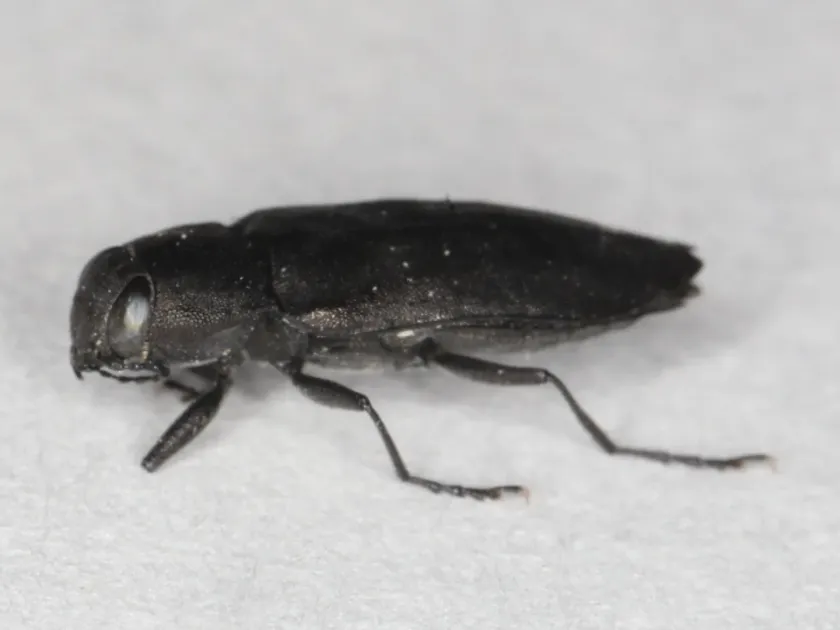
The Black Buprestid (Melanophila) is a small beetle typically measuring between 6 and 12 millimeters in length. It belongs to the Buprestidae family, characterized by its elongated and slightly flattened body shape.
The insect possesses a striking black coloration with a subtle metallic or bronze sheen. This coloration provides excellent camouflage against the dark, charred, or textured bark of host trees.
A unique biological feature of this species is its specialized sensory organs capable of detecting infrared radiation. This adaptation allows the beetles to locate fire-damaged or stressed trees from long distances.
The larvae are typically legless and creamy-white, featuring a significantly enlarged thorax. They spend their entire life cycle hidden deep within the wood, which makes them resilient to external threats.
Adult beetles are diurnal and highly active during hot, sunny weather. They rely on thermal cues to optimize their egg-laying process, ensuring offspring have access to suitable food sources.
What it damages
The Black Buprestid primarily targets coniferous tree species, including pine, spruce, fir, and larch. Occasionally, it can also infest weakened deciduous trees if conditions are favorable.
The pest demonstrates a strong preference for stressed, fire-damaged, or dying trees. These weakened hosts are unable to produce enough resin to defend against the invading larvae.
As the larvae bore galleries beneath the bark, they disrupt the cambium layer. This mechanical damage prevents the transport of water and nutrients, eventually causing the tree to wilt and die.
Mass outbreaks can lead to significant ecological and economic damage, especially in forest areas prone to drought or fires. An infested tree rapidly becomes a breeding ground for future generations.
In ornamental gardens or park settings, the presence of these beetles can be devastating. Early detection is crucial, as the damage caused by larvae is often irreversible once they have entered the deeper sapwood.
When it appears
Adult flight typically begins in late spring or early summer, following the first occurrences of sustained warm temperatures. This is the period when beetles are most visible to observers.
Activity peaks during the hottest hours of the day, as the beetles require heat for optimal metabolic function. During this time, they are frequently found basking on sun-exposed tree trunks.
The egg-laying period spans across the summer months. Females seek out cracks or damaged patches on the bark, using their infrared sensors to locate trees that are physiologically stressed.
The larval stage is prolonged and can last from one to two years depending on regional climate conditions. During this time, the larvae grow continuously, consuming wood tissues beneath the bark.
Emergence of new adult beetles usually occurs in the summer. They chew characteristic oval exit holes through the bark, which serve as a clear indicator that the cycle is beginning again.
Signs of infestation
One of the primary signs of an infestation is the presence of small, oval-shaped exit holes on the tree trunk. These holes are typically scattered across the bark surface.
The accumulation of "frass" or boring dust at the base of the tree is a strong indicator of larval activity. This fine, wood-colored powder is pushed out of the galleries as the larvae feed.
Dying branches, premature needle drop, or a shift in needle color to a rusty brown are common symptoms of an infested tree. These changes reflect the loss of cambium function.
Peeling back a piece of bark often reveals winding, flattened larval galleries packed with frass. These galleries disrupt the flow of sap and eventually girdle the tree.
Observing adult beetles resting on sun-warmed bark is another sign of an active population. Frequent presence during sunny days suggests that the tree has become a site for reproduction.
Control measures
The most effective method for controlling the Black Buprestid is the prompt removal and disposal of infested trees. This helps to reduce the local population and prevent further spread.
Preventive maintenance, such as proper irrigation during droughts and fertilization, increases a tree's natural resistance. Healthy trees are much better at defending against wood-boring pests.
Chemical control can be applied during the flight period by spraying insecticides onto the trunks. This targets the adults before they can lay their eggs on the host surface.
Biological control involves supporting natural predators, such as parasitic wasps, which can help regulate the beetle population in natural forest environments.
- Regular monitoring of tree health during the summer.
- Sanitation logging to remove dead or dying wood.
- Maintaining forest diversity to reduce host tree stress.
Taxonomy
- Latin name
- Melanophila
- Order
- Coleoptera (beetles)
- Family
- Buprestidae
- EPPO code
- MELPSP
Discussion
No discussions yet — be the first.