
Hispaniolan woodpecker
Melanerpes striatus
Description
How to identify
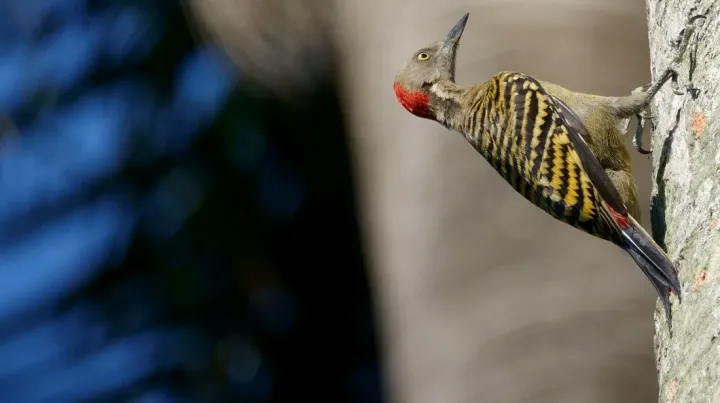
The Hispaniolan woodpecker (Melanerpes striatus) is a species of bird in the Picidae family, endemic to the island of Hispaniola. It belongs to the order Piciformes.
These birds are recognized by their striped backs and distinctive head coloration. Males possess a prominent red cap extending to the nape, while females have a less vibrant or absent red patch.
Typically 20–25 centimeters in length, they are highly social birds that often live in colonies, which increases their impact when they infest agricultural plantations.
Unlike many other woodpecker species, the Hispaniolan woodpecker is highly adaptable and thrives in agricultural environments, including citrus and mango orchards.
They have strong, sharp beaks adapted for both wood-boring to find insects and piercing the tough skins of fruits to feed on the sugary pulp inside.
What it damages
The primary agricultural damage caused by the Hispaniolan woodpecker involves the destruction of mature fruits, specifically citrus, mangoes, and papayas.
By pecking deep holes into the fruit, the birds expose the flesh to rot, fungal infections, and secondary infestation by insects such as fruit flies.
Such damage renders fruits unmarketable, leading to significant economic losses for farmers, particularly during the peak of the harvesting season.
The woodpeckers also damage the bark of young trees to create nesting cavities or access sap, which weakens the trees and makes them susceptible to diseases.
High population densities can lead to the total loss of marketable fruit within an orchard block, significantly reducing the overall yield per hectare.
When it appears
The woodpeckers' activity in orchards is most intense during the fruit maturation period, as they shift their diet from insects to fruit pulp for energy.
In tropical climates, where fruit production can be year-round, the birds may cause damage during multiple harvest cycles depending on the availability of food.
During the nesting and brood-rearing period, the demand for high-protein insect food increases, which might temporarily reduce their fruit-pecking activity.
During dry spells, when natural food sources are limited, the birds frequently congregate in irrigated orchards, where the fruit provides essential moisture.
They are most active during the early morning and late afternoon, utilizing these periods to maximize foraging efficiency throughout the orchard.
Signs of infestation
Presence of the bird is easily detected by jagged, deep holes or lacerations on the fruit skin, typically found on the most exposed parts of the tree canopy.
The accumulation of partially eaten, fallen fruits beneath the trees is a clear indicator of a woodpecker infestation within the orchard.
Characteristic beak marks on branches and trunks are signs that the birds are using the trees for foraging or potentially establishing nesting cavities.
Constant vocalizations, often described as loud, repetitive calls, are a reliable sign of their presence, especially when they move in groups between trees.
Damage marks often serve as entry points for secondary pathogens and pests, which accelerate the rapid decay of the fruit observed on the branches.
Control measures
Visual deterrents, including reflective tape, mirrors, and predatory bird decoys, are commonly used to discourage woodpeckers from entering the orchard.
The most reliable method for protecting high-value crops is the installation of fine-mesh netting to physically exclude the birds from the fruit.
Sanitation practices, such as the prompt removal of fallen or damaged fruit, are essential to prevent the attraction of additional birds to the site.
Acoustic deterrents that broadcast alarm calls or predator sounds can be effective in temporarily driving the flock away from the plantation area.
An integrated approach is recommended:
- regular monitoring of bird activity
- pruning of damaged branches
- early installation of netting
- use of various visual and acoustic deterrents
Taxonomy
- Latin name
- Melanerpes striatus
- Family
- Picidae
- EPPO code
- MLANST
Discussion
No discussions yet — be the first.