
Leafcutter bee sericans
Megachile sericans
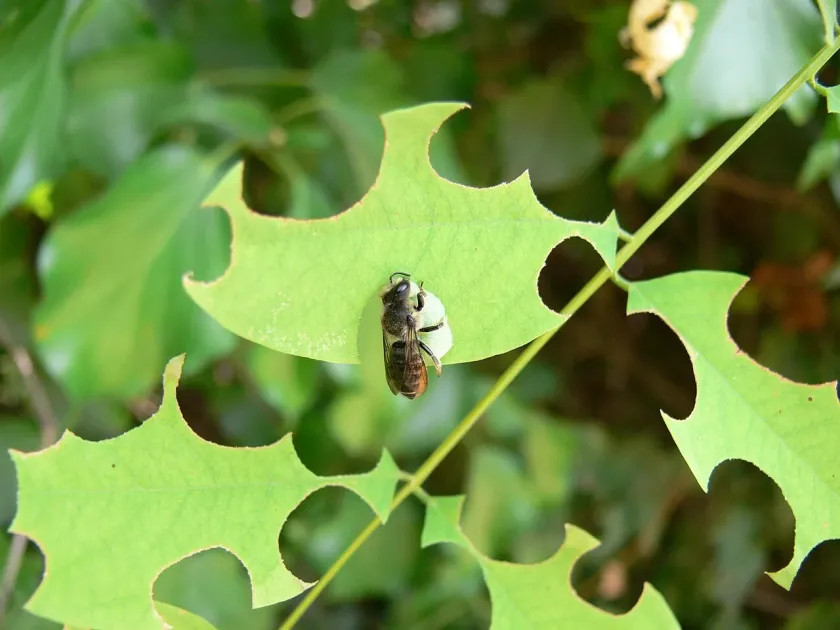
Description
How to identify
The leafcutter bee (Megachile sericans) belongs to the family Megachilidae, order Hymenoptera. Unlike honey bees, these are solitary insects that play a vital role in pollination but can cause aesthetic damage to ornamental gardens.
Females are characterized by their stout bodies and specialized pollen-carrying hairs on the underside of the abdomen. They possess strong mandibles designed for cutting plant foliage with remarkable precision.
These bees do not live in colonies. Instead, each female builds its own nest in existing cavities, such as hollow stems, cracks in wood, or even in the soil, lining them with cut leaf sections.
The species is active primarily during the warmest months of the year. Their life cycle is synchronized with the blooming and leaf development of host plants, which provide both food and nesting materials.
While they are considered beneficial pollinators in agricultural settings, their specialized nesting behavior makes them a nuisance for nurseries and horticulturalists dealing with high-value crops.
What it damages
Commonly targeted plants include roses, lilacs, grapes, and various broad-leaved trees. The bees are attracted to foliage with specific textures, often focusing their attention on certain plant varieties in a garden.
The damage consists of circular or oval holes cut cleanly along the edges of the leaves. This activity removes significant leaf area, which can hinder the photosynthetic capacity of the plant.
Young plants and seedlings in nursery environments are most at risk, as the loss of leaf tissue can significantly stunt their growth and reduce their overall vitality during the crucial establishment phase.
While the health of the plant is rarely permanently compromised by moderate damage, severe cases of leaf stripping can weaken the plant, making it more susceptible to environmental stressors and secondary infections.
The aesthetic value of ornamental plants is often heavily degraded by these bees, turning attractive foliage into a lace-like pattern that may be unacceptable for commercial gardening standards.
Signs of infestation
The most diagnostic sign of Megachile sericans is the presence of perfectly smooth, semi-circular cuts on the leaf margins. These cuts look precise, as if made by a mechanical tool.
There is an absence of necrotic tissue around the holes, which distinguishes this bee's work from pest attacks by beetles or caterpillars, which typically leave jagged and decaying edges.
Activity is most intense on sunny days when bees are actively collecting nesting material. Observers may notice them quickly flying from leaf to leaf, selecting specific plant species to harvest.
Nesting sites often show evidence of leaf usage. The bees plug cavities with layers of leaf discs, which can sometimes be spotted in old wooden furniture, hollow stems, or man-made crevices near the garden.
Large amounts of damage appear suddenly because a single female can harvest dozens of leaf sections in a short period to complete the construction of her egg-laying chambers.
Control measures
Physical barriers are the most effective way to protect valuable plants. Covering young shrubs with fine-mesh insect netting or horticultural fleece prevents the bees from reaching the leaves.
Avoid heavy use of broad-spectrum insecticides, as these bees are important pollinators. If chemical intervention is necessary, opt for targeted repellents or biological products that have minimal impact on non-target species.
Maintain plant vigor through proper fertilization and watering. Healthy plants can compensate for moderate leaf loss more easily than stressed specimens, allowing for better recovery during the growing season.
Seal cracks in wooden structures, sheds, or fencing near sensitive plants to reduce the number of available nesting cavities for the bees.
- Install protective screens over prized roses and ornamental trees.
- Remove or seal hollow reeds or branches that may attract nesting females.
- Use aromatic repellents to discourage bees from specific garden zones.
Taxonomy
- Latin name
- Megachile sericans
- Order
- Hymenoptera
- Family
- Megachilidae
- EPPO code
- MEGCSE
Discussion
No discussions yet — be the first.