
Alfalfa leafcutting bee
Megachile rotundata
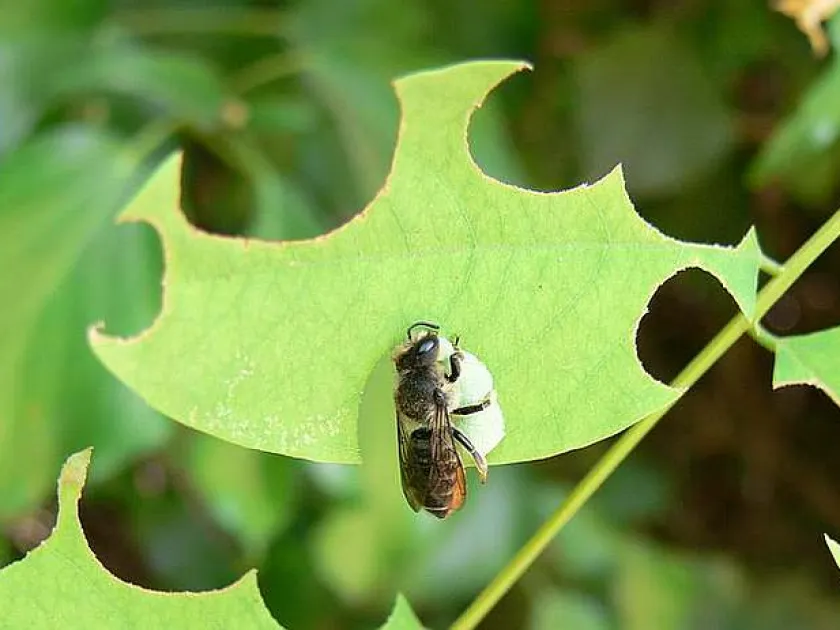
Description
How to identify
The alfalfa leafcutting bee (Megachile rotundata) is a member of the Megachilidae family. It is a solitary bee species known for its vital role as a pollinator, though it can cause physical damage to specific crops.
Adult bees are relatively small, characterized by a dark body with metallic reflections and dense, light-colored hair that covers much of their abdomen and thorax.
The lifecycle follows a complete metamorphosis: egg, larva, pupa, and adult. In moderate climates, they typically produce one or two generations per year, with adults emerging in late spring or summer.
Unlike social bees, these insects do not build communal hives. Instead, the female constructs individual nests in small cavities, hollow stems, or crevices, lining them with cut pieces of foliage.
While recognized as one of the most efficient pollinators for alfalfa production, their instinctive behavior of cutting leaves for nesting material causes concern in ornamental gardening and nurseries.
What it damages
The primary hosts for leafcutting bees include various broad-leaved plants, most notably alfalfa, roses, lilacs, ash trees, and numerous flowering shrubs.
The bees use their mandibles to cut precise, circular, or oval pieces from leaves, which are then carried to their nests to construct individual brood cells for their offspring.
While the bees do not consume the leaf tissue as food, the physical removal of foliage reduces the surface area available for photosynthesis, which can hamper the plant's overall vitality.
In ornamental plant nurseries, the primary economic impact is the degradation of the plant's aesthetic value, which renders commercial specimens unsuitable for retail sale.
Severe infestations can lead to significant defoliation, leaving plants stressed, weakening their immune systems, and potentially making them more susceptible to environmental stress and opportunistic pathogens.
Signs of infestation
The signature sign of leafcutting bee activity is the presence of clean-cut, semi-circular, or perfectly circular holes along the margins or within the blades of the leaves.
The edges of these cuts are typically very smooth, lacking the jagged or necrotic appearance associated with caterpillars or beetle feeding patterns.
Observation during sunny daylight hours will reveal the bees actively visiting plants, using their jaws to shear off sections of leaves with remarkable speed before flying off to their nests.
In sheltered areas or crevices nearby, one might locate small cylindrical nests constructed from the harvested leaf fragments, which often look like tightly rolled tubes or stacks of discs.
Since the bees do not leave frass (excrement) on the plant surface, the absence of droppings or webbing is a key diagnostic feature distinguishing their damage from that of chewing caterpillars.
Control measures
Management strategies should be carefully weighed because these bees are beneficial pollinators; therefore, total eradication is rarely recommended or desirable.
For highly valuable ornamental specimens, the use of physical barriers like fine mesh or row covers can effectively prevent bees from accessing the foliage during their peak activity season.
Proactive planting strategies, such as providing less valuable but attractive vegetation nearby, can often lure the bees away from prized nursery stock, acting as a natural trap crop.
The application of broad-spectrum insecticides is strongly discouraged as it causes indiscriminate mortality among beneficial pollinators, which can severely impact long-term crop yields.
If damage exceeds economic thresholds, sanitation by removing nesting materials from the immediate vicinity during the off-season or using deterrent scents can help manage their populations without causing mass ecological harm.
Taxonomy
- Latin name
- Megachile rotundata
- Order
- Hymenoptera
- Family
- Megachilidae
- EPPO code
- MEGCRO
Discussion
No discussions yet — be the first.