
Japanese leafcutter bee
Megachile nipponica
Description
How to identify
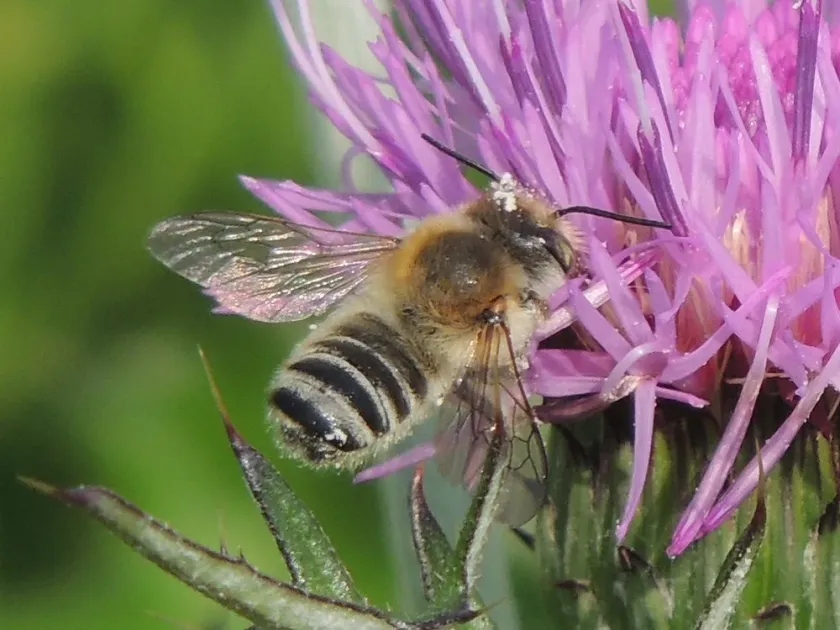
The Japanese leafcutter bee (Megachile nipponica) belongs to the order Hymenoptera, family Megachilidae. These are solitary bees known for their unique nesting habits and physical appearance.
Adult bees are characterized by their sturdy build, dense hairs for pollen collection, and specialized mandibles that function like shears to cut plant leaves.
Unlike honeybees or bumblebees, leafcutter bees do not build communal hives; each female independently constructs her own nest, typically in existing cavities.
They are generally non-aggressive, although they possess stingers, they will only use them if directly threatened or handled roughly by humans.
Visually, they are similar to other solitary bees but are highly distinguished by their specific behavior of hovering over foliage to harvest material.
What it damages
This species is known to affect a variety of plants, including roses, lilac, grapes, alfalfa, and various decorative shrubs, seeking soft, pliable leaf material.
The bees cut out circular or oval pieces from leaves to line their brood cells, which serves as a protective layer for the developing larvae.
The primary concern for gardeners is the aesthetic damage, as the perfect cutouts can mar the appearance of ornamental plants in nurseries and gardens.
While the physical removal of leaf tissue reduces photosynthetic surface area, it rarely causes significant physiological stress to healthy, mature woody plants.
It is important to emphasize that these bees are effective pollinators and provide significant ecosystem services, making indiscriminate extermination ill-advised.
When it appears
The activity of Megachile nipponica is strictly seasonal, occurring primarily from late spring to mid-summer when temperatures are optimal for flight.
During the peak of the season, females are exceptionally active, repeatedly visiting host plants to gather leaf fragments for their nest-building efforts.
The life cycle involves larval development within the constructed cocoons, followed by pupation, with the next generation usually overwintering in the prepupal stage.
The onset of their activity is temperature-dependent, usually coinciding with the bloom periods of their preferred host plants in the garden landscape.
Observations of active leaf cutting are most common during bright, sunny days when the insects are most energized for their nesting duties.
Signs of infestation
The most tell-tale sign of a leafcutter bee presence is the series of distinct, smooth-edged circular or semi-circular holes in the leaves of susceptible plants.
Unlike other pests that consume the foliage, the edges of these cutouts remain clean and healthy, showing no signs of necrosis, nibbling, or ragged margins.
Gardeners may observe the bee actively working, often flying with a piece of leaf held between its legs, which is a clear indicator of their nesting activity.
The nests themselves, while hard to find, consist of stacked leaf disks shaped like a cigar, usually tucked into hollow stems, wood borings, or crevices.
If numerous plants show identical cutting patterns simultaneously, it indicates that a nesting female is likely operating within a small radius of the area.
Control measures
Because leafcutter bees are valuable pollinators, management should focus on non-toxic, preventative methods rather than the use of broad-spectrum pesticides.
Physical protection is the most effective approach; covering high-value plants with fine garden netting during peak nesting months is highly recommended.
- Application of mild essential oil-based deterrents to leaves.
- Providing alternative nesting sites like 'bee hotels' in quiet garden corners.
- Hand-monitoring and removing accessible nest materials if they pose a problem.
- Maintaining robust plant health through proper fertilization and irrigation.
- Avoiding chemical insecticides that are lethal to all beneficial bee species.
In most residential garden settings, the damage is purely cosmetic and does not require active control, as it reflects a healthy, biodiverse garden environment.
Taxonomy
- Latin name
- Megachile nipponica
- Order
- Hymenoptera
- Family
- Megachilidae
- EPPO code
- MEGCNI
Discussion
No discussions yet — be the first.