
Leafcutter bee
Megachile centuncularis
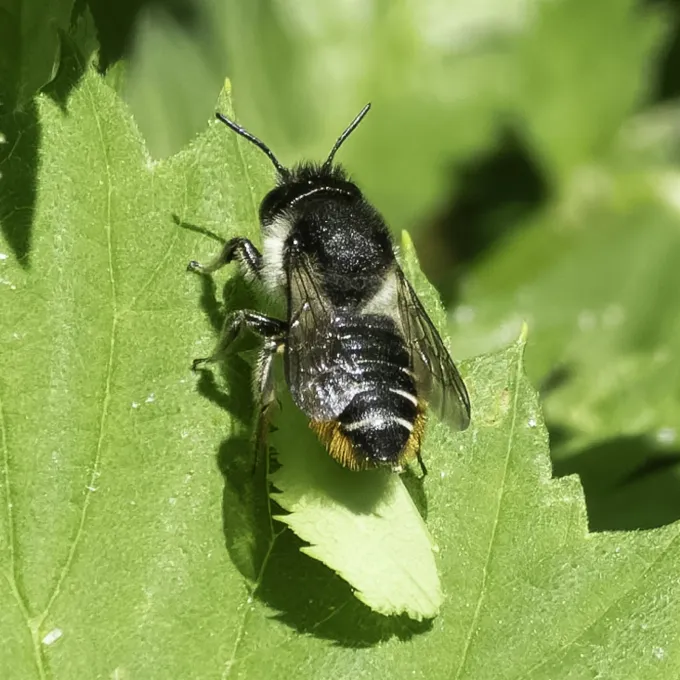
Description
How to identify
The leafcutter bee (Megachile centuncularis) is a solitary insect belonging to the Megachilidae family. Unlike social honey bees, they do not live in hives and are generally non-aggressive toward humans.
These bees are typically 10–12 mm long and are recognized by their dark coloration and the pollen-carrying hairs on their abdomens. They have robust mandibles adapted for cutting plant tissue.
The life cycle begins in spring when adults emerge. Females spend their time building individual nests in hollow stems, decaying wood, or ground cracks, showing remarkable structural ingenuity.
Biology of the species is focused on the construction of cells for their offspring. They use segments of leaves as nesting material, gluing them together with secretions to create protective partitions.
While often labeled as a pest, the leafcutter bee is a highly efficient pollinator. Their presence is usually a sign of a healthy garden ecosystem, so drastic eradication measures are rarely necessary.
What it damages
Leafcutter bees favor specific plants, including roses, bougainvillea, wisteria, and legumes. They select leaves with the right texture and thickness to suit their nesting requirements.
The damage caused is purely mechanical. By cutting neat, circular or oval pieces from the leaf margins, they reduce the surface area available for photosynthesis, though rarely to a fatal degree.
In ornamental gardens, the primary issue is aesthetic. A severe infestation can leave rose bushes or decorative shrubs looking tattered, which reduces their visual appeal for gardeners.
Young plants or those in highly stressed conditions may be more susceptible to the impact of leaf loss. However, for established shrubs, the removal of small leaf patches is generally harmless.
Unlike sap-sucking insects or defoliating larvae, leafcutter bees do not weaken the plant's immune system or transmit plant diseases, making their impact quite limited.
Signs of infestation
The most distinctive sign is the presence of smooth-edged, circular or oval holes along the edges of leaves. These cuts appear as if they were made with a hole puncher or small scissors.
Damage is typically restricted to the periphery of the leaf. You will not find chewed or serrated edges, as the bee uses precise, deliberate biting motions to harvest the material.
Observant gardeners can often spot the bees in action during warm, sunny days. They land, make a quick cut, and fly away carrying the leaf segment between their legs to their nest site.
Nesting sites can be identified by finding cylindrical tubes or holes in wood that have been plugged with circular leaf fragments, indicating the successful completion of a larval cell.
Lack of any other damage, such as leaf yellowing, browning, or sticky residues, helps distinguish leafcutter bee activity from fungal infections or other insect infestations.
Control measures
The most effective strategy is to avoid the use of chemical pesticides, as these will kill valuable pollinators. Integrated pest management focuses on tolerance rather than eradication.
For highly valued specimen plants, placing fine-mesh garden netting over the leaves during the bee's active period (usually early summer) provides a complete physical barrier.
Repellents such as garlic spray or horticultural oils might discourage the bees from selecting your specific plants. However, these applications need frequent re-coating after rain.
Providing alternative nesting sites, such as bee hotels, at the perimeter of the garden can help draw the bees away from the most sensitive ornamental flowerbeds.
Accepting minor leaf damage is often the best management practice. The ecological benefit of having leafcutter bees in the garden usually outweighs the minor cosmetic impact on the foliage.
Taxonomy
- Latin name
- Megachile centuncularis
- Order
- Hymenoptera
- Family
- Megachilidae
- EPPO code
- MEGCCE
Discussion
No discussions yet — be the first.