
Marumba
Marumba
Description
How to identify
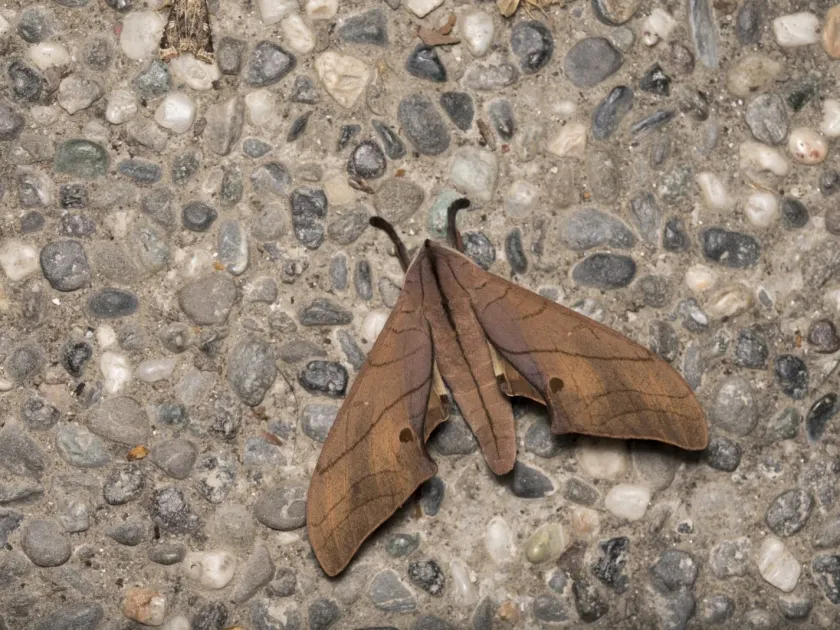
The genus Marumba belongs to the family Sphingidae (hawkmoths), order Lepidoptera. These are large nocturnal moths distinguished by their specific wing shape with serrated edges, often resembling dry leaves for camouflage.
Adult individuals possess a robust body, typical of the family, with a wingspan ranging from 80 to 120 mm. Their coloration is predominantly ochre, brown, or grayish-brown, providing excellent concealment against tree bark during the daytime.
Marumba caterpillars are typical for hawkmoths: they are large, fleshy, and possess a prominent horn-like projection on the posterior end of the body. The caterpillar is often colored green with diagonal light-colored stripes on the sides, making them difficult to spot among the foliage.
Pupae of this pest usually have a brown coloration and develop in the soil or forest litter. They are characterized by high survival rates due to their dense protective covers, which shield them from desiccation and mechanical damage during the winter period.
To identify the species, it is important to pay attention to the structure of the caudal horn and the pattern on the caterpillar's head. The genus is biologically linked to specific host plants, which limits their distribution area to certain shelterbelts and gardens.
What it damages
The pest primarily affects deciduous trees, including members of the Fagaceae, Salicaceae, and Rosaceae families. The caterpillars pose a particular threat to young saplings in nurseries and ornamental plantings.
In natural habitats, Marumba feeds on the leaves of linden, oak, poplar, and various fruit tree species. The feeding intensity depends on the age of the caterpillar, with the final larval stages causing the most significant damage to the green mass.
During mass outbreaks, this pest can cause severe defoliation of individual branches or even entire trees. This leads to weakened photosynthesis, reduced wood growth, and increased susceptibility of plants to secondary infections.
Damage to the leaf blade starts from the edges and gradually spreads to the entire area, leaving only the coarse veins behind. In severe cases, the skeletonization of leaves leads to premature leaf drop and the stunting of tree development.
The economic impact of Marumba is generally considered moderate, but in favorable climatic conditions, local population surges require mandatory monitoring and timely intervention.
When it appears
The flight of adult Marumba moths typically occurs in the warmer months, starting from late spring until mid-summer. The activity period of adults is limited to nighttime, as they remain stationary during the day.
Eggs are laid by females on the underside of host plant leaves. Embryonic development is rapid, and after 10–14 days, the first larvae emerge and begin active feeding.
The development of caterpillars spans the summer months, passing through several molting stages. The pest's maximum activity occurs in July and August, when ambient temperatures facilitate intensive insect metabolism.
Pupation takes place in the soil layer in late summer or early autumn, where the pest remains to overwinter. The life cycle is adapted to the region's climatic conditions, ensuring synchronization of caterpillar emergence with the plant vegetation period.
Observing the phenology of the species allows for the forecasting of control measure timings. Monitoring the appearance of moths using light traps is the primary method for determining the onset of the risk period.
Signs of infestation
The first sign of Marumba presence is the existence of partially consumed leaf blades. Often, caterpillar droppings (frass) are found on leaves, appearing as large dark granules accumulating under the damaged branches.
A thorough inspection of the canopy allows for the detection of the caterpillars themselves, which, thanks to their camouflage, can remain unnoticed by an observer for a long time. Searching should be conducted during morning or evening hours.
Changes in canopy shape and the appearance of "bare" areas on the tree indicate the development of the pest population. In young plants, the growth of terminal shoots is stunted due to damage to the leaf apparatus.
Damage to the leaf cuticle and characteristic chewing marks from the mouthparts help distinguish Marumba activity from damage by other pests, such as leaf miners or mites.
- Chewed leaf margins
- Large droppings beneath the canopy
- Caterpillars on the underside of leaves
- Premature yellowing and leaf fall
- Overall reduction in tree vitality
Control measures
Methods for controlling Marumba include agrotechnical, biological, and chemical approaches. In private gardens and tree nurseries, manual collection of caterpillars during their active feeding phase is effective if the trees are of manageable size.
The use of biological insecticides based on entomopathogenic bacteria (e.g., Bacillus thuringiensis) shows high efficacy against young larvae. These products are safe for the environment and beneficial insect populations.
In cases of mass infestation, the use of systemic or contact insecticides with a broad spectrum of action is justified. Applications should be performed in the evening when caterpillar activity on the leaf surface is at its peak.
Agrotechnical measures include tilling the soil around the tree base in the autumn, which helps destroy pupae overwintering in the ground. It is also necessary to maintain the overall health of the trees to boost their immunity.
Creating conditions for natural predators, such as birds and predatory insects, also helps suppress the pest population below the economic injury threshold throughout the entire growing season.
Taxonomy
- Latin name
- Marumba
- Order
- Lepidoptera (butterflies)
- Family
- Sphingidae
- EPPO code
- MARBSP
Discussion
No discussions yet — be the first.