
Sugarcane spittlebug
Mahanarva liturata
Description
How to identify
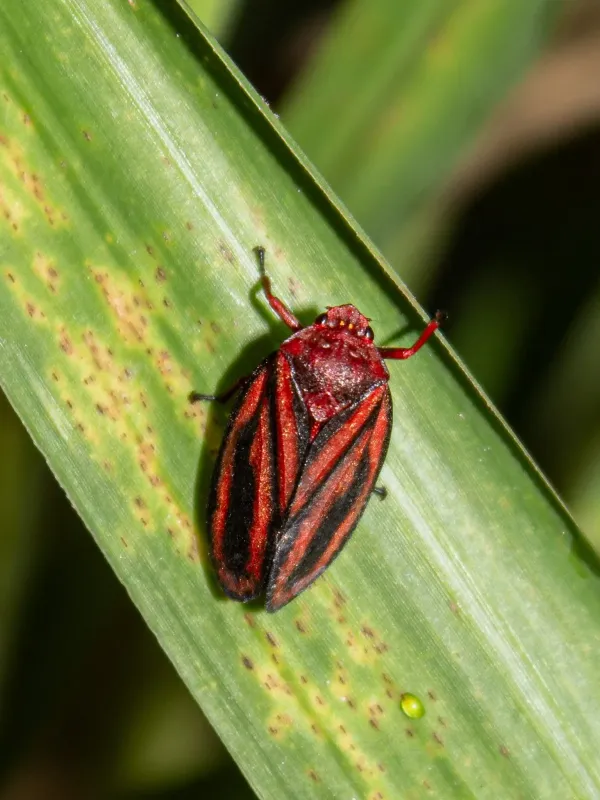
The sugarcane spittlebug (Mahanarva liturata) is a member of the order Hemiptera and the family Cercopidae. The adult insects are characterized by their dark coloration, often featuring vibrant yellow or orange stripes on their wings, which act as a warning signal to potential predators.
The nymphs are best known for producing a white, frothy substance that covers them entirely. This "spittle" is not merely protective against desiccation and predators; it also creates a microenvironment that facilitates the feeding process of the immature insects.
Adults possess specialized hind legs adapted for jumping, allowing them to escape quickly when threatened. They are highly active and move throughout the canopy of the sugarcane, seeking out the most succulent plant tissues to extract sap.
The life cycle is closely synchronized with environmental humidity. Females lay eggs in the soil near the base of the sugarcane or within the accumulation of dry leaf trash left behind after harvest, ensuring the next generation survives until the wet season.
Mahanarva liturata displays a high reproductive potential, and under optimal warm and humid conditions, they can complete multiple generations within a single growing season.
What it damages
The primary crop damaged by Mahanarva liturata is sugarcane. Both adults and nymphs feed on the xylem sap, which causes severe physiological stress and reduces the overall vigor of the sugarcane plant.
Besides commercial sugarcane, these pests can inhabit various wild grasses. These wild hosts serve as reservoirs that maintain pest populations during periods when the main crop is absent or during the early stages of the crop cycle.
Feeding damage significantly reduces the photosynthesis rate and impedes the accumulation of sucrose in the stalks, directly impacting the industrial quality of the harvest. Yield reductions can be catastrophic if the pest is left unmanaged.
The constant withdrawal of sap leads to leaf yellowing, wilting, and in severe cases, the death of tillers. This weakens the entire plant and makes it susceptible to opportunistic fungal and bacterial diseases.
Economic losses are cumulative, manifesting as a decrease in biomass production and a reduction in the purity of the juice extracted during the milling process at sugar plants.
When it appears
The population dynamics of the sugarcane spittlebug are heavily influenced by rainfall patterns. The emergence of nymphs typically occurs at the onset of the rainy season, when conditions become favorable for their development.
The peak activity of the adults is observed during the wet months, as stable warmth and high humidity provide the necessary environment for mating and egg-laying processes throughout the landscape.
In the dry season, the insect enters a resting phase, usually as eggs that are highly resistant to dehydration. This allows the population to survive long periods of drought until the next environmental trigger occurs.
Agronomists monitor weather data to predict the emergence waves of nymphs. Accurate timing is crucial because the insect is most vulnerable to control measures during the early nymphal stages.
Managing the timing of cultivation and potential pesticide applications relative to the monsoon-like rainfall patterns is a fundamental aspect of successful spittlebug control.
Signs of infestation
The most visible sign of infestation is the presence of white spittle masses at the base of the sugarcane stalks. These masses are easily spotted during routine field scouting and indicate active nymphal presence.
Visible chlorosis (yellowing) and subsequent browning of leaves from the tips inwards serve as primary indicators of sap loss. The plants appear sickly and may show stunted height compared to healthy fields.
The sudden jumping of adult insects when the field is disturbed is a clear sign of high population density. This behavior makes it easy for field scouts to estimate the scale of the infestation.
Stunted internode development is a long-term symptom of persistent feeding. When sugarcane is unable to grow at its natural rate, it reflects the severe disruption of its vascular system caused by the spittlebug.
Necrotic lesions or small spots on the leaves at the site of insect feeding punctures can also occur, indicating that the insect has been actively extracting nutrients from those specific plant tissues.
Control measures
Effective management of Mahanarva liturata involves an Integrated Pest Management (IPM) approach. This includes the strategic use of chemical, biological, and cultural practices to maintain the pest population below economic damage thresholds.
Biological control has become a cornerstone of management, specifically the use of entomopathogenic fungi such as Metarhizium anisopliae. This biological agent targets nymphs effectively without leaving chemical residues.
Cultural practices, such as the efficient removal of crop residues (trash) after harvest, are essential. By reducing the available sites for egg-laying, growers can significantly decrease the initial pest pressure for the next season.
Systematic scouting and monitoring are necessary to identify the exact timing for intervention. Decisions to apply insecticides should be based on the number of nymphs detected per row segment.
- Application of systemic insecticides directed at the base of the plants.
- Use of resistant or tolerant sugarcane varieties where available.
- Strict control of weeds that may provide alternative food sources for the pests.
Taxonomy
- Latin name
- Mahanarva liturata
- Order
- Hemiptera (bugs, aphids, leafhoppers)
- Family
- Cercopidae
- EPPO code
- TOMALI
Discussion
No discussions yet — be the first.