
Mahanarva
Mahanarva
Description
How to identify
The genus Mahanarva belongs to the Cercopidae family, commonly known as spittlebugs, within the order Hemiptera. These insects are distinguished by the froth produced by their nymphs.
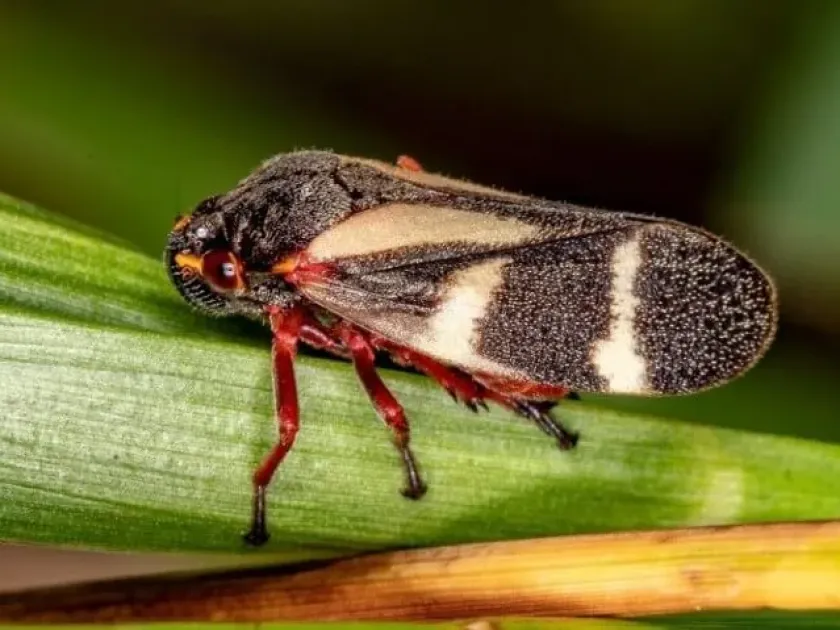
Adult Mahanarva are medium-sized hoppers with robust bodies, often possessing bright warning colors to deter predators in their natural habitats.
Nymphs are rarely seen exposed because they live inside a white, frothy secretion on the stems or roots of their host plants, protecting them from desiccation.
Identifying the species requires close examination of wing venation and male genitalia structure, as color patterns can be highly variable within the same species.
With their powerful hind legs, these insects are capable of sudden, rapid jumps, making them difficult to capture or monitor without specialized equipment.
What it damages
Mahanarva is a primary pest of sugarcane, capable of causing devastating losses in yields by draining essential sap from the vascular tissues of the plant.
Beyond sugarcane, these insects pose a significant threat to various grass species, severely impacting productivity in managed pastures and livestock feed production.
By feeding on xylem sap, the insect disrupts the plant's metabolic functions, leading to stunted growth, wilting, and reduced biomass accumulation.
Persistent feeding by large populations can lead to the yellowing and necrosis of leaves, effectively weakening the plant's ability to resist environmental stress.
In addition to direct damage, the feeding sites serve as entry points for secondary fungal and bacterial pathogens, exacerbating the overall decline of the crop.
When it appears
The life cycle and population dynamics of Mahanarva are heavily influenced by ambient temperature and relative humidity, often peaking during rainy seasons.
These insects progress through several stages, with the speed of their development strongly correlated to the availability of succulent host plant material.
Under favorable climatic conditions, multiple generations can emerge within a single growing season, leading to rapid exponential population growth.
Eggs are typically deposited in soil crevices or plant debris, where they enter a dormant state, waiting for the return of favorable moisture conditions.
The emergence of the first instar nymphs usually occurs simultaneously with the onset of the wet season, marking the start of the primary infestation period.
Signs of infestation
The most reliable field indicator of a Mahanarva infestation is the presence of white, bubble-like froth on the lower stems or the root collar of the plants.
Plants infested with Mahanarva exhibit symptoms similar to drought stress, including leaf rolling, tip burning, and an overall decrease in vigor.
- Characteristic froth clusters at the base of the plant.
- Yellowish chlorotic streaks appearing on foliage.
- Significant reduction in plant height and stem diameter.
- Increased wilting even when soil moisture is adequate.
- Presence of adults on the upper parts of the canopy.
In pastures, infestations may result in patches of brown, dying grass that contrast sharply with the healthy green surrounding areas.
Control measures
Biological control using entomopathogenic fungi, specifically Metarhizium anisopliae, remains one of the most sustainable methods for managing Mahanarva.
Integrated pest management strategies include regular removal of dry plant debris to eliminate egg-laying sites and break the insect's life cycle.
Selective use of insecticides is recommended only when monitoring shows population levels reaching economic injury thresholds to protect beneficial insects.
Breeding and planting sugarcane varieties that demonstrate natural resistance to spittlebug colonization is a critical long-term strategy for farmers.
Promoting a healthy soil and plant ecosystem helps plants recover faster from moderate insect pressure and reduces the need for heavy chemical intervention.
Taxonomy
- Latin name
- Mahanarva
- Order
- Hemiptera (bugs, aphids, leafhoppers)
- Family
- Cercopidae
- EPPO code
- MAHASP
Discussion
No discussions yet — be the first.