

Description
How to identify
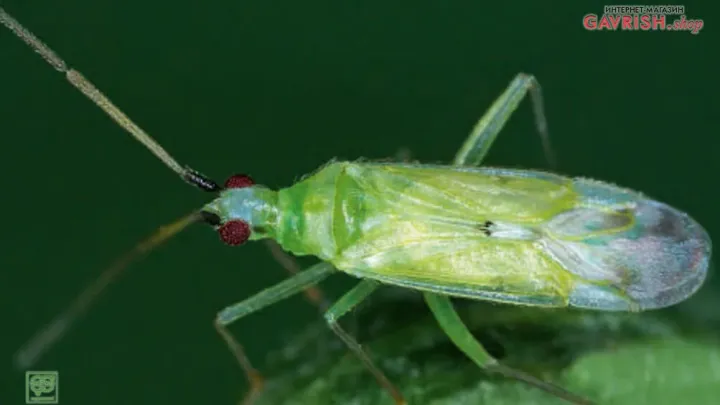
Macrolophus (Macrolophus pygmaeus) belongs to the order Hemiptera and the family Miridae. It is a small insect, measuring 3–4 mm in length, with a slender green body and long legs.
A distinctive feature of adults is their long antennae and specific coloration: a light body with dark spots at the base of the antennae. The insect's eyes have a reddish tint.
The nymphs of Macrolophus look very similar to the adults but differ in smaller size and the absence of fully developed wings. They are also light green, which allows them to effectively camouflage themselves on leaves.
The life cycle includes an egg stage, five nymphal instars, and the adult stage. Females lay their eggs directly into the leaf tissue, usually along the veins, making them difficult to target with many contact insecticides.
Under optimal greenhouse conditions (20–25°C), the complete development cycle from egg to adult takes about 3–4 weeks. It is important to understand that in the absence of animal prey, adults may start feeding on plant sap.
What it damages
Contrary to common misconceptions, Macrolophus is primarily a predator, not a typical pest. Its main specialization is the control of whiteflies, aphids, spider mites, and thrips.
However, agronomists classify it as a potentially harmful object if the population density in the greenhouse becomes uncontrollable in the absence of prey. In such cases, the bugs start sucking sap from leaves and fruits.
Damage manifests as microscopic necrotic spots caused by piercing the leaf epidermis. In cases of high infestation and food shortage, damage may be visible on young fruits, which reduces the marketability of the produce.
Solanaceous crops such as tomatoes, eggplants, and sweet peppers grown in greenhouses suffer most from the "plant" feeding behavior of Macrolophus. On ornamental plants, puncture marks can also reduce aesthetic value.
The damage caused by Macrolophus on an industrial scale is minimal compared to the benefits it provides as a whitefly population regulator. Controlling its population is only necessary to prevent damage to sensitive fruits.
When it appears
The activity of this entomophage directly depends on the greenhouse microclimate. In heated facilities, Macrolophus can reproduce almost year-round if temperatures are maintained above 15–18°C.
Spring is the peak period for introducing the predator into greenhouses to control the first wave of whiteflies. During this period, the insect is most active and voracious.
The summer period is characterized by the maximum reproduction rate due to high temperatures. At this time, it is necessary to strictly monitor population density to avoid the bug shifting its diet to plant tissues.
In autumn, insect activity gradually decreases along with shorter daylight hours and lower nighttime temperatures in the greenhouse. During winter, development slows down significantly without additional lighting.
When planning plant protection, it is important to consider that Macrolophus is sensitive to sudden changes in humidity. Dry air in the greenhouse can negatively affect the survival of early-instar nymphs.
Signs of infestation
The first sign of Macrolophus presence is small light-colored dots on the leaf blade, which can be mistaken for traces of spider mite or other sucking pests.
The bug itself can be detected by carefully inspecting the tops of the plants or the underside of the leaves. Adults are very agile and quickly hide on the underside of the leaf when disturbed.
The presence of empty egg shells within leaf tissues (visible only under a magnifying glass) indicates active population reproduction within the greenhouse block.
The presence of the predator is also indicated by specific excrement in the form of small black dots, which can be noticed on leaves if the entomophage population reaches a high density.
If necrosis begins to appear on young tomato ovaries, it is a signal that the food base (whitefly) is exhausted and the bugs have switched to a plant-based diet.
Control measures
The primary control method is maintaining balance: it is necessary to avoid the complete eradication of all pests so that Macrolophus retains an alternative food source.
In cases of excessive bug reproduction, it is recommended to limit nitrogen fertilizers that stimulate excessive vegetative growth, as this growth attracts the bugs for sap feeding.
Using biological insecticides based on fungi (e.g., Beauveria bassiana) can help reduce the Macrolophus population if it becomes a problem.
Avoid using broad-spectrum chemical pesticides. Many modern products have long residual effects and are fatal to this entomophage, making the greenhouse vulnerable to whitefly outbreaks.
- Conduct regular monitoring using sticky traps.
- Maintain optimal air humidity (60–70%).
- If pest numbers are low, supplement the predators with specialized surrogate food (e.g., Sitotroga eggs).
Content graph
Connections · Macrolophus
Most often together:
Marketplace
Products · 1
Biology
Taxonomy
- Latin name
- Macrolophus
- Order
- Hemiptera (bugs, aphids, leafhoppers)
- Family
- Miridae
- EPPO code
- MACLSP
Community
Discussion
No discussions yet — be the first.