
Adelphocoris seticornis
Adelphocoris seticornis
Description
How to identify
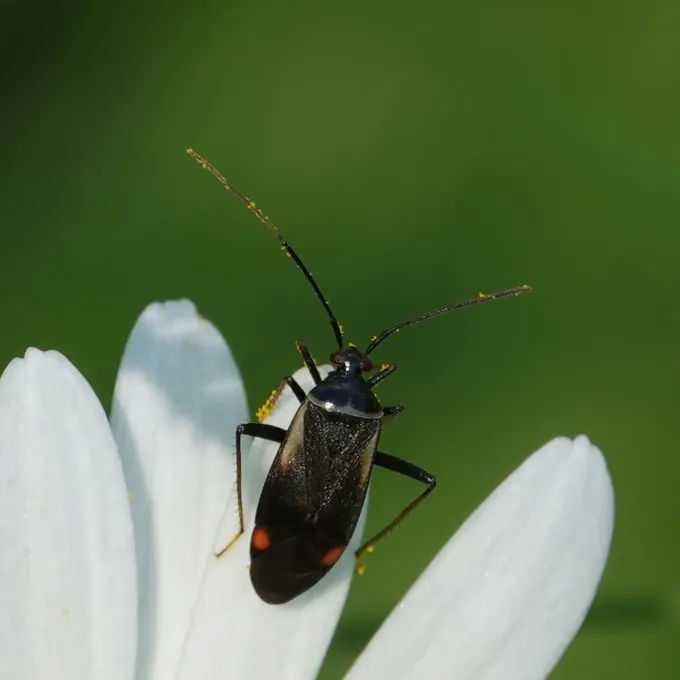
Adelphocoris seticornis is a species of plant bug belonging to the Miridae family and the Hemiptera order. Adult insects reach 7–9 mm in length and possess an elongated body with yellowish-brown or reddish-brown coloration.
A distinctive feature of this species is the dense hair covering on its body and the specific morphology of its antennae. Males are generally darker than females, and the wing membranes feature two clear, distinct cells.
Nymphs resemble adults in appearance but are significantly smaller and lack fully developed wings. Their coloration ranges from light green to yellow, providing effective camouflage among the foliage of host plants.
In the field, identification is performed by inspecting vegetation during morning or evening hours. Agronomists often use sweep nets to accurately assess population densities across crop fields.
The insect undergoes incomplete metamorphosis, consisting of egg, nymph (five instars), and adult stages. Overwintering typically occurs in the egg stage, which females deposit into the stems of host plants.
What it damages
This species is a polyphagous pest, primarily causing economic damage to legumes such as alfalfa, sainfoin, and clover. It can also be found on various weeds and occasionally on vegetable crops.
The most significant damage is observed in seed production fields of perennial grasses. The bugs extract sap from reproductive organs: buds, flowers, and young pods, leading to abscission and yield loss.
Feeding on leaf tissues causes deformation and the appearance of necrotic spots. Heavily infested plants show stunted growth and decreased photosynthetic activity, which reduces overall plant health.
The saliva of the pest contains enzymes that cause tissue necrosis around the feeding site. This severely degrades the quality of the vegetative mass and reduces the nutritional value of hay.
The economic threshold for intervention depends on the specific crop and its growth stage. For alfalfa seed crops, the threshold is typically 1–2 individuals per sweep during the budding phase.
When it appears
Adult activity usually begins in late May or early June, coinciding with the rapid growth phase of perennial grasses. Peak population levels occur throughout June and July.
There is typically one generation per growing season; however, under favorable climate conditions, a partial second generation may emerge. Reproduction continues until the onset of autumn temperatures.
The activity of these bugs is closely linked to ambient temperature. Moderately warm and humid weather conditions are optimal for population growth and rapid development of the species.
Migratory activity increases significantly after the harvesting or mowing of alfalfa. In these periods, pests relocate en masse to neighboring fields or surrounding vegetation.
By early August, population numbers naturally begin to decline as adults lay eggs in plant tissues and complete their life cycle.
Signs of infestation
The primary symptom of an infestation is the massive shedding of flower buds and pods, which is often misattributed to drought or other environmental stresses.
Small chlorotic spots appear on the leaf surfaces, which eventually develop into light-colored blotches, and in cases of severe infestation, result in pinholes and tissue degradation.
Visual inspection of inflorescences reveals deformed, blackened flowers that fail to open and dry out prematurely, directly impacting the final seed yield.
Feeding on stems often results in curved or twisted shoots, which hinders the transportation of essential nutrients throughout the plant structure.
The presence of the pest is easily confirmed by shaking plant parts over a collection tray. Bugs are quite mobile but tend to drop to the ground and hide when threatened.
Control measures
Effective management strategies include proper crop rotation and spatial isolation of seed fields from forage production areas. Controlling weed populations is essential to limit alternative hosts.
Agronomic practices, such as timely mowing at optimal growth stages, help deprive the pest of both its food source and its egg-laying sites, reducing population density.
Chemical control with insecticides is recommended only when the economic threshold is exceeded. Systemic and contact-based products are most effective during the budding stage.
Biological control focuses on conserving natural enemies, such as parasitic wasps (Mymaridae), which naturally limit the population growth of these plant bugs.
Insecticide applications must be strictly regulated to avoid harming beneficial pollinators; spraying during the flowering period is generally prohibited.
Taxonomy
- Latin name
- Adelphocoris seticornis
- Order
- Hemiptera (bugs, aphids, leafhoppers)
- Family
- Miridae
- EPPO code
- ADPHSE
Discussion
No discussions yet — be the first.