
Hummingbird hawk-moth
Macroglossum bombylans
Description
How to identify
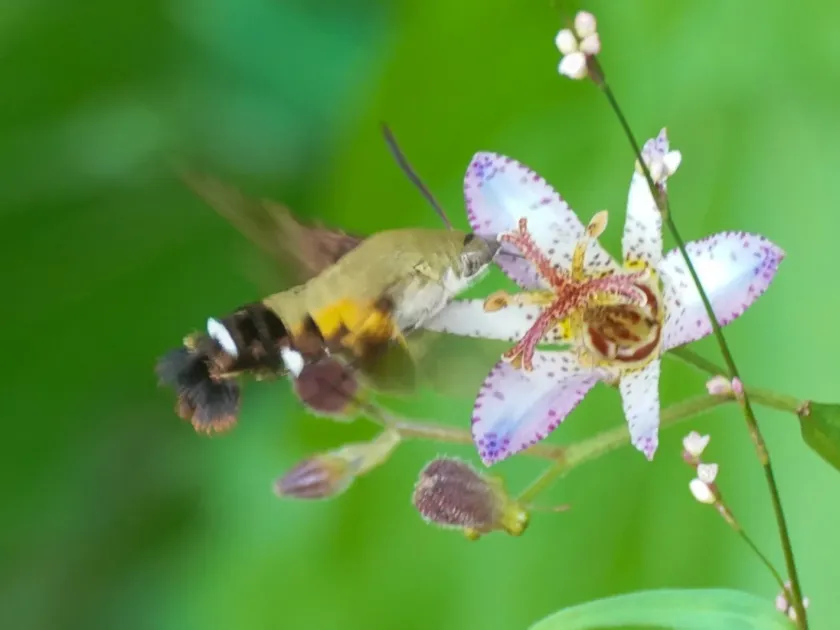
The Hummingbird hawk-moth (Macroglossum bombylans) is a species of moth belonging to the Sphingidae family. It is widely recognized for its mimicry of bumblebees, characterized by a furry, robust body and specific wing patterns.
Unlike many other hawk-moths, this species is diurnal, meaning it is active during the day, commonly seen hovering over flowers to feed on nectar using its elongated proboscis.
The life cycle undergoes complete metamorphosis, consisting of the egg, larva (caterpillar), pupa, and adult stages. The caterpillars are often distinct in appearance, adapted to camouflage within foliage.
Adults are known for their exceptional flight agility, capable of rapid acceleration and precise hovering, which makes them highly effective pollinators but also potential vectors for reproductive cycles on host plants.
Overwintering typically occurs in the pupal stage, buried in the soil or protected within leaf litter, where they remain dormant until favorable spring temperatures trigger emergence.
What it damages
The primary agricultural damage is caused by the larval stage. Caterpillars consume the leaves of host plants, which can include various herbaceous plants and shrubs.
While they have a preference for the Rubiaceae family, such as bedstraw, they can occasionally feed on ornamental plants, leading to a loss of aesthetic quality and plant vigor.
Heavy infestation by these larvae leads to significant defoliation, which hampers the photosynthetic capacity of the plant and retards overall growth and development.
In cases of severe outbreaks, young shoots and buds may also be targeted, potentially affecting the flowering cycle of ornamental varieties in the garden.
The presence of larvae is usually localized, yet their rapid growth rate allows them to consume significant amounts of biomass in a relatively short period.
Signs of infestation
Signs of infestation include irregular holes in the leaves and missing leaf margins, often starting from the lower parts of the plant and moving upwards.
The presence of frass (caterpillar droppings) on the leaves or the soil surface beneath the plants is a clear indicator of feeding activity.
The caterpillars themselves may be spotted resting on the underside of leaves or along stems, where their coloration often blends with the host plant structure.
Increased activity of adult moths around the garden during sunny days often precedes the hatching of caterpillars, serving as an early warning for monitoring.
Visible thinning of the foliage or stunted growth in specific areas of the garden are indicators that larvae have established themselves and are actively feeding.
Control measures
For home gardens, manual removal of caterpillars is a highly recommended and environmentally friendly method, especially during the early morning hours.
Biological control agents, such as Bacillus thuringiensis based products, are effective at targeting larvae while remaining safe for the surrounding environment and beneficial insects.
Sanitation practices, such as removing host weeds (like bedstraw) near the garden, help significantly reduce the local population of the moth.
Applying light traps or pheromone monitoring can help track adult activity, allowing for timely intervention before large-scale egg-laying occurs.
- Monitor plants frequently during the peak growing season.
- Clear away debris and till the soil to disturb overwintering pupae.
- Maintain plant health to improve tolerance to moderate defoliation.
- Use selective insecticides only if absolutely necessary to preserve pollinator populations.
Taxonomy
- Latin name
- Macroglossum bombylans
- Order
- Lepidoptera (butterflies)
- Family
- Sphingidae
- EPPO code
- MACGBO
Discussion
No discussions yet — be the first.