
Hummingbird hawk-moth
Macroglossum
Description
How to identify
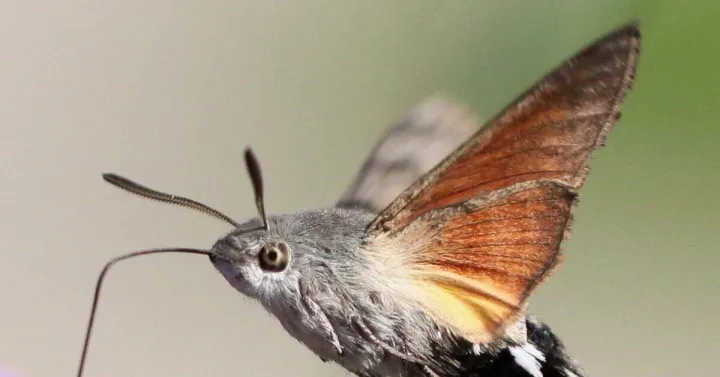
The hummingbird hawk-moth (Macroglossum stellatarum) is a diurnal moth belonging to the family Sphingidae. It is widely known for its remarkable ability to hover in front of flowers while feeding.
The adult moth has a wingspan of 40–50 mm. Its forewings are mottled grey-brown, providing excellent camouflage against bark, while its hindwings are bright orange, appearing during flight.
The abdomen is broad and features a distinctive fan of scales at the tail end, which the moth uses for stabilization and maneuvering while hovering mid-air.
The larvae are typically green with white lateral stripes and a characteristic horn on the rear segment. They pupate within a loose cocoon formed amongst ground debris or leaf litter.
As a day-flying insect, it is most active in warm, sunny conditions. Its unique flight pattern makes it one of the most recognizable insects in summer gardens.
What it damages
The hummingbird hawk-moth is not classified as a plant pest. In professional agriculture, it does not inflict damage on fruit, vegetable, or cereal crops.
Adult moths feed exclusively on nectar from various flowers, acting as pollinators. They do not consume plant tissues, nor do they damage buds or fruits during their feeding process.
The larvae feed primarily on wild herbaceous plants, most notably bedstraw (Galium) and common chickweed. They rarely, if ever, impact cultivated plant species.
Economic damage to agricultural enterprises is non-existent. There is no need for protective measures or insecticide applications to manage this species.
Instead of being viewed as a nuisance, this moth should be considered a beneficial visitor that contributes to the pollination of flowering plants in the landscape.
When it appears
This species is highly migratory. In temperate zones, it often produces two generations per year, with activity peaking during the warmest summer months.
Adults are typically spotted from late spring through early autumn. Migration patterns mean that population numbers can vary significantly from one year to the next.
Eggs are laid individually on the host plants. The larval stage lasts approximately one month, depending on the ambient temperature and the availability of food sources.
Pupation occurs in the soil or under layers of leaf litter. While some individuals may attempt to overwinter, many migrate southward to escape harsh winter climates.
Continuous observations show that the moth is most prevalent in areas with high floral diversity, as it requires constant access to nectar sources throughout its lifecycle.
Control measures
No control measures are necessary for the hummingbird hawk-moth, as it is a harmless and ecologically valuable member of the garden ecosystem.
If populations of larvae are noted on weeds like bedstraw, simple mechanical removal of these weeds is sufficient to reduce their presence without resorting to chemicals.
The use of broad-spectrum insecticides should be strictly avoided to protect pollinators and other beneficial insects that occupy the same environment.
Farmers and gardeners are encouraged to maintain nectar-rich zones to support the species, as it poses zero threat to commercial crop health or yield.
Maintaining a healthy balance of local biodiversity is the best approach to managing garden visitors, ensuring the resilience of the horticultural environment.
Taxonomy
- Latin name
- Macroglossum
- Order
- Lepidoptera (butterflies)
- Family
- Sphingidae
- EPPO code
- MACGSP
Discussion
No discussions yet — be the first.