
Ship-timber beetle
Lymexylon navale
Description
How to identify
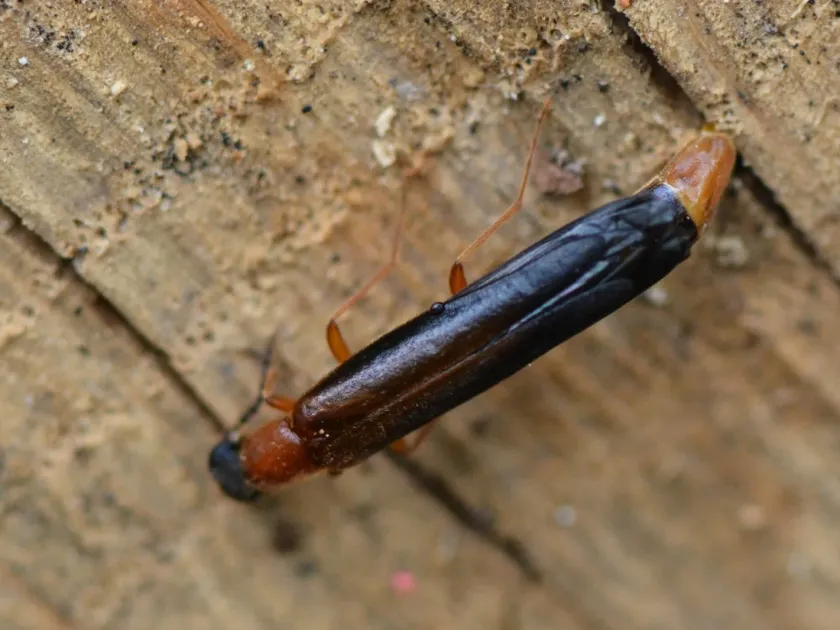
The ship-timber beetle (Lymexylon navale) belongs to the order Coleoptera and the family Lymexylidae. The adult beetle has an elongated body ranging from 6 to 15 mm in length, with a yellowish-brown or dark-brown coloration.
Males and females exhibit sexual dimorphism: males possess comb-like antennae and less developed mandibles. The body of the beetle is covered in fine, dense hairs, giving it a characteristic matte appearance.
The larvae, which reach 12–15 mm in length, are cylindrical, whitish, and have a unique morphology of the prothorax. They spend their entire developmental period hidden deep within wood.
Their life cycle is dependent on symbiotic fungi, which the larvae transport in specialized organs. These fungi soften the wood, making it digestible for the larvae, which cannot thrive on wood alone.
This species typically thrives in humid environments, frequently infesting weakened living trees or lumber stored in damp conditions.
What it damages
Primary hosts include various hardwood species, such as oak, beech, hornbeam, elm, and chestnut. The pest attacks both stressed standing trees and processed timber in storage.
In the timber industry, this beetle is regarded as a major technical pest. Its tunnels penetrate deeply into the heartwood, significantly reducing the quality, structural integrity, and commercial value of the wood.
High levels of damage are commonly observed when logs are stored for long periods in poorly managed log yards, particularly in river floodplains or areas with high soil moisture.
The damage is twofold: structural destruction from larval galleries and the introduction of fungal decay which the larvae cultivate within the wood tunnels.
In construction and historical shipbuilding, infested timbers often become unsuitable for use, as the extensive interior damage can render structural members unsafe.
When it appears
Adult flight usually occurs during the summer months, peaking in June and July. During this time, the beetles mate and lay eggs in bark crevices or surface fissures.
The total life cycle typically lasts one to two years, depending on local climatic factors and the availability of suitable host wood. Higher temperatures generally accelerate the larval development process.
Larvae are most active during the warmer months, during which time they tunnel extensively through the timber, producing a characteristic fine sawdust or "frass."
Overwintering occurs at the larval stage deep within the woody material, providing protection against harsh winter temperatures and external biological threats.
Spring activity resumes in synchronization with the start of tree sap flow, which creates an optimal internal environment for the new generation of larvae.
Signs of infestation
The primary sign of an active infestation is the presence of fine wood dust (frass) accumulating below exit holes, expelled by emerging adult beetles.
Visual inspections of trunks or lumber often reveal numerous small, circular exit holes approximately 1–2 mm in diameter, which may be scattered across the surface.
The internal state of infested timber shows narrow, winding galleries that are often stained dark, indicating the growth of the symbiotic fungus introduced by the larvae.
Tapping on infested timber may yield a hollow sound, indicating significant internal wood loss caused by the larval mining activity.
Symptoms in standing trees can include localized bark discoloration, thinning canopy, or premature leaf drop, which often signal that the tree is already compromised by the beetle.
Control measures
Effective protection starts with timely debarking of logs, as larvae prefer the bark layer for egg-laying and initial penetration into the wood.
Proper storage management is critical: timber must be stored on dry, well-ventilated, and elevated sites to minimize moisture content and reduce the beetle's attraction.
Chemical control measures involve applying contact or systemic insecticides to log stacks or high-value timber in areas where the pest is known to be active during the flight season.
Sanitation practices, including the prompt removal of weakened or infested trees from forest stands, help lower the overall population pressure and prevent spread.
- Application of wood preservatives and antiseptics.
- Drying wood to moisture levels below the threshold preferred by the pest.
- Monitoring adult activity using pheromone-baited traps.
- Encouraging biological control through the preservation of natural predators.
Taxonomy
- Latin name
- Lymexylon navale
- Order
- Coleoptera (beetles)
- Family
- Lymexylidae
- EPPO code
- LYMENA
Discussion
No discussions yet — be the first.