
Wood-boring beetle
Hylecoetus dermestoides
Description
How to identify
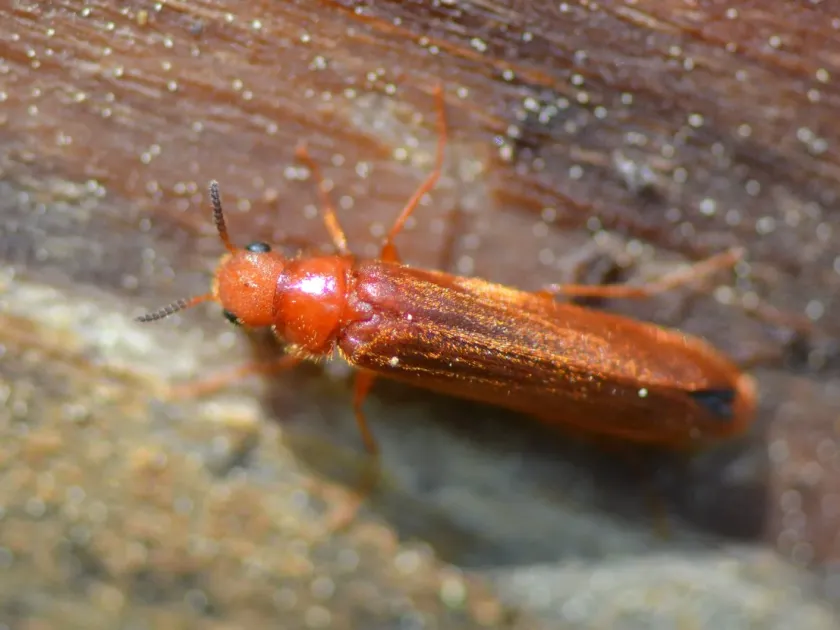
The wood-boring beetle (Hylecoetus dermestoides) is a member of the Lymexylidae family. Adult beetles measure between 6 and 18 mm in length, with an elongated body shape ranging from dark brown to black in color.
Sexual dimorphism is distinct in this species, as males possess prominent pectinate antennae, whereas females are generally larger with a more robust abdominal structure.
Larvae are typically white or yellowish, reaching lengths up to 25 mm, and possess a characteristic thickening in the thoracic region, which aids in their movement within the wooden tunnels.
The life cycle of this beetle typically lasts one to two years, significantly influenced by local temperature and the moisture content of the wood in which the larvae develop.
As a technical pest, this insect is notoriously difficult to control due to its cryptic behavior, as it spends most of its life cycle deep inside the wood tissue.
What it damages
This beetle primarily attacks deciduous trees, with a strong preference for oak, beech, birch, linden, and alder species. Occasionally, it may also infest weakened coniferous timber.
Rather than consuming the wood itself, the larvae cultivate ambrosia fungi within their galleries, which provides their main nutritional source during the developmental stage.
Larval tunnels penetrate deep into the sapwood and heartwood, which causes significant structural damage and disrupts the transport of water and nutrients, eventually leading to tree mortality.
The economic impact on forestry is significant, as infested timber loses its structural integrity and market value, becoming unsuitable for high-quality carpentry or construction.
In ornamental gardens or managed parks, even healthy trees can be colonized if they are stressed by environmental factors, making regular monitoring essential for maintenance.
When it appears
The adult flight period typically commences in early spring, usually between April and June, depending on the warming of forest environments and daylight hours.
During this flight phase, females actively search for suitable hosts to deposit eggs, often favoring existing cracks or previous wounds in the bark to facilitate larval entry.
Once hatched, larvae immediately bore into the tree, creating long, winding galleries where they remain active throughout the summer and autumn seasons.
Overwintering occurs within the tree trunks, where larvae are protected from freezing temperatures. They complete their development and pupation cycle when temperatures rise again in the spring.
Unseasonably warm weather can lead to staggered emergence of new generations, requiring forest managers to remain vigilant throughout the late spring and summer months.
Signs of infestation
The most prominent sign of infestation is the presence of fine, light-colored sawdust, often referred to as frass, accumulating at the base of the tree or on bark crevices.
Entry holes are typically small, circular, and about 2 mm in diameter. These are often accompanied by fungal stains on the bark as a result of the insect's symbiotic relationship with fungi.
Progressive crown dieback, yellowing foliage, or the premature loss of leaves are late-stage indicators that the interior wood has been severely compromised by larval galleries.
Careful inspection of the trunk may reveal discolored patches or bark that sounds hollow when tapped, indicating that the wood has been heavily excavated by the beetle larvae.
When the bark is partially removed, the characteristic galleries or fungal patches become visible, confirming the presence of the pest population within the host tree.
Control measures
The primary control strategy involves the immediate removal and sanitation of infested timber to prevent the further spread of the population to healthy trees in the vicinity.
Effective forest management practices, such as removing fallen timber, deadwood, and severely stressed trees, are crucial in reducing the available breeding sites for the beetles.
Pheromone traps are used to monitor adult beetle activity levels, allowing managers to time interventions correctly and assess the density of the local pest population.
Chemical control, including systemic insecticides or trunk injections, is generally reserved for high-value trees in parks or protected areas where mechanical removal is not feasible.
- Maintain high forest hygiene by clearing debris and wind-damaged trees.
- Encourage natural predators like woodpeckers to inhabit the area.
- Apply protective barriers on trunk surfaces during the peak flight season.
Taxonomy
- Latin name
- Hylecoetus dermestoides
- Order
- Coleoptera (beetles)
- Family
- Lymexylidae
- EPPO code
- HYLCDE
Discussion
No discussions yet — be the first.