
Ship-timber beetle
Hylecoetus
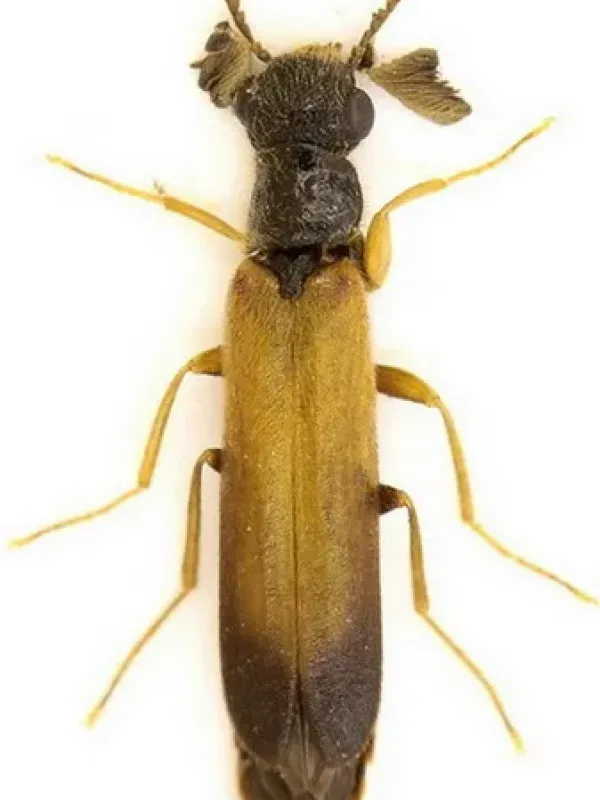
Description
How to identify
The ship-timber beetle (Hylecoetus dermestoides) is a member of the Lymexylidae family. Adult beetles typically range from 6 to 18 mm in length, possessing an elongated, cylindrical body with coloration varying from brown to black.
A key identifying feature of the male is the presence of large, fan-like maxillary palps. These distinct structures are used to differentiate them from females during field inspections.
Larvae are characterized by a whitish, elongated body. At the posterior end, they possess a distinct, horn-like projection which serves as a specialized tool for pushing out frass from their tunnels.
The beetle exhibits a symbiotic relationship with specific fungi. Females inoculate the wood with fungal spores, which subsequently grow within the tunnels to serve as the primary food source for the larvae.
The lifecycle begins with the adult stage during the spring months. During this period, swarming occurs, and females seek suitable host trees to deposit eggs in bark crevices or previous exit holes.
What it damages
This pest targets a wide range of broad-leaved tree species, including oak, beech, birch, and alder. It is particularly destructive to freshly felled timber left in forests or stored at sawmills.
Larvae bore deep, complex tunnels into the wood, which severely degrades the structural integrity and market value of the timber, rendering it unsuitable for high-quality carpentry.
When infesting living but weakened trees, the larvae accelerate the decay process. Their galleries facilitate the entry of secondary wood-rotting fungi and other wood-boring pests.
The internal tunnels can extend deep into the heartwood, causing significant damage that is often not visible from the outside until substantial structural decay has occurred.
Economic losses in the timber industry are significant, as infested logs suffer from decreased grading, leading to waste and reduced utility in construction and furniture making.
Signs of infestation
A primary indicator of infestation is the presence of fine, light-colored frass (sawdust) found around the base of the tree or within the bark fissures, pushed out by the larvae.
External inspection reveals small, circular entry holes roughly 2 mm in diameter. These holes are often clustered together, particularly in areas with bark damage or structural defects.
Upon cutting into the wood, the galleries appear dark in color due to the growth of the symbiotic fungus. This fungal staining is a hallmark of this species' activity inside the wood.
In living trees, symptoms of infestation may manifest as premature wilting or foliage discoloration, although these signs often appear only after the infestation has reached advanced stages.
The cross-section of an infested log reveals a network of branching tunnels that radiate towards the center, often covering a large volume of the log's interior space.
Control measures
The most effective management strategy is the timely removal and processing of freshly felled logs from the forest before the adult beetle's flight season begins in early spring.
Sanitation measures, including the removal of deadwood, storm-damaged trees, and fallen logs, are essential to minimize the available breeding habitat for the population.
In industrial timber yards, maintaining high moisture content through water sprinkling (wet storage) can prevent the beetles from successfully colonizing the timber.
For high-value wood, preventative chemical treatments using contact insecticides can be applied to surfaces to deter females from laying eggs during the peak flight season.
Promoting forest health by encouraging natural predators and parasitoids is a long-term approach to maintaining pest population densities below economic injury levels.
Taxonomy
- Latin name
- Hylecoetus
- Order
- Coleoptera (beetles)
- Family
- Lymexylidae
- EPPO code
- HYLCSP
Discussion
No discussions yet — be the first.