
Timberworm beetle
Hylecoetus cossis
Description
How to identify
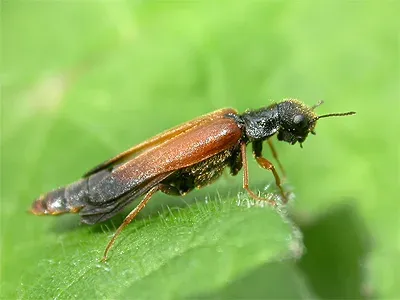
The timberworm beetle (Hylecoetus dermestoides) belongs to the Lymexylidae family of the order Coleoptera. The adult beetles typically measure between 6 to 18 mm in length.
The species exhibits sexual dimorphism, where males are often distinguished by their darker color and comb-like structures on their front legs used for mating.
The body color ranges from reddish-brown to almost black, with fine hair covering, giving the beetle a distinct matte appearance compared to typical bark beetles.
The larvae are cylindrical, white in color, and have a dark, well-developed head, capable of moving efficiently through the galleries they bore in wood.
Because they are nocturnal and secretive, these beetles are rarely seen, making their identification based on external signs crucial for forest health monitoring.
What it damages
This pest is polyphagous, primarily attacking weakened deciduous trees such as oak, beech, birch, alder, and aspen, though they can impact conifers under stress.
Unlike true bark beetles, the larvae do not feed directly on the wood itself but graze on specialized ambrosia fungi introduced by the female during oviposition.
The larvae tunnel deep into the sapwood and heartwood, which causes severe technical damage to the timber, reducing its economic value for construction and furniture.
In outbreaks, even trees that appear relatively healthy can be colonized if they are under physiological stress from drought or environmental changes.
The structural damage caused by the tunnels leads to weakened timber, susceptibility to secondary rot, and eventual physiological decline of the entire tree.
When it appears
Adult beetles emerge in early spring, typically between April and May, depending on the thermal regime of the forest region.
The peak flight season corresponds with the start of sap flow in deciduous trees, which is when the host trees are most vulnerable to initial colonization.
After mating, females burrow into the bark and wood to lay eggs in crevices, carefully inoculating the wood with fungal spores to ensure larval food.
Larval development generally lasts for one year, although in colder northern climates, this cycle may extend to two or more years.
Pupation takes place within the timber, and the new generation of adults chews its way out through small exit holes in late summer or early autumn.
Signs of infestation
The most visible sign of an infestation is the presence of fine, light-colored boring dust found at the base of the trunk or caught in bark fissures.
Small, circular entrance holes, roughly 2-3 mm in diameter, are visible on the bark surface and lead directly into the inner wood layers.
Staining caused by sap flowing from entrance holes may appear on the bark, often darkening over time as fungi colonize the wounded tissue.
Crown symptoms include premature yellowing of leaves, thinning of the foliage canopy, and general signs of tree stress or partial dieback.
Cutting into a section of infested wood will reveal deep, radial galleries stained black or blue by the fungal mycelium growing inside the tunnels.
Control measures
Sanitation logging, which involves the rapid removal and destruction of infested trees, remains the primary method for preventing large-scale outbreaks.
Eliminating logging residues and damaged logs from the forest floor is essential, as these serve as the primary breeding grounds for the population.
Pheromone traps are highly effective when deployed during the peak flight period to monitor and control beetle population density.
For high-value ornamental trees or orchards, systemic insecticide treatments can provide a barrier against beetle entry and larval colonization.
- Maintaining forest density to ensure natural resilience
- Monitoring bark surface for boring dust during spring
- Proper timing of timber harvesting to avoid flight peaks
Taxonomy
- Latin name
- Hylecoetus cossis
- Order
- Coleoptera (beetles)
- Family
- Lymexylidae
- EPPO code
- HYLCCO
Discussion
No discussions yet — be the first.