
Powderpost beetle
Lyctus pubescens
Description
How to identify
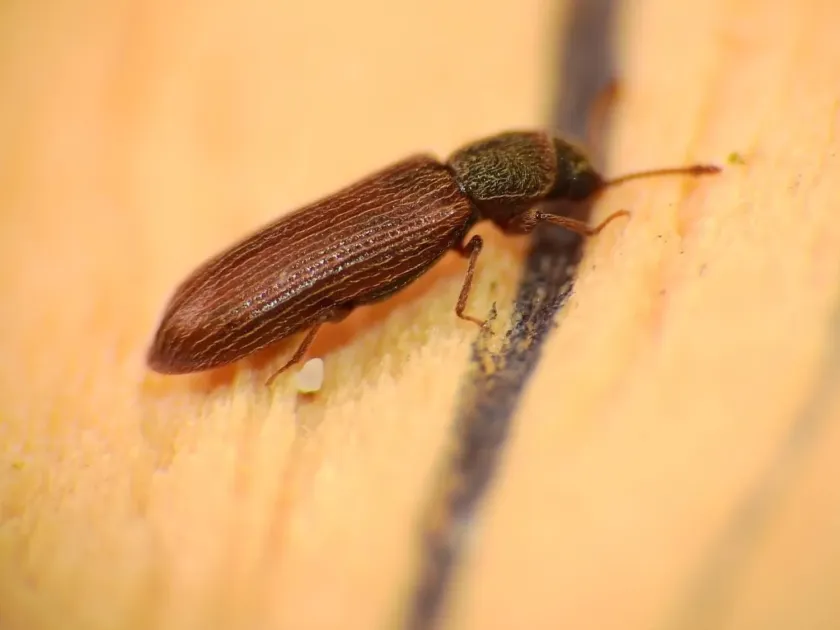
The powderpost beetle (Lyctus pubescens) is a small wood-boring insect belonging to the family Bostrichidae. Adults typically measure between 3 and 5 mm in length and are characterized by a reddish-brown to dark brown coloration.
The name "pubescens" refers to the fine, dense hairs covering their elytra (wing covers). They possess a distinctively shaped pronotum that looks like a hood, which partially conceals the beetle's head when viewed from above.
The larvae of this species are creamy-white, C-shaped, and possess strong mandibles. They are the stage responsible for the extensive internal damage to timber, spending most of their life cycle mining through the wood.
The life cycle of the powderpost beetle generally lasts about one year, though it is highly dependent on environmental factors like humidity and ambient temperature. They thrive in climates where the wood moisture content is stable.
Adult females seek out wood with high starch content to deposit their eggs. They use their ovipositors to insert eggs directly into the open pores or cracks of the timber surface.
What it damages
These beetles are specialized pests that primarily target hardwood species, such as oak, ash, beech, and walnut. They rarely attack softwood because it lacks the starch necessary for the development of their larvae.
They are notorious for infesting furniture, flooring, cabinetry, musical instruments, and stored lumber. Infestations usually occur in wood with a moisture content between 8 and 20 percent.
Larval feeding creates intricate tunnels through the wood grain, often reducing the structural integrity of the material to a hollow shell filled with fine debris. The exterior often shows little sign of damage until the beetles emerge.
Damage caused by these insects can be catastrophic for the furniture industry and historical wood restoration. A single contaminated item can easily spread the infestation to other wooden surfaces in a home or warehouse.
If left untreated, structural timber infested by Lyctus pubescens can eventually lose its load-bearing capacity, leading to expensive repairs or total replacement of the wood elements.
Signs of infestation
The most prominent sign of an active infestation is the presence of small, circular exit holes on the surface of the wood. These holes, measuring about 1–1.5 mm, are created by adults emerging from the interior.
Around these exit holes, you will find fine, powder-like dust known as "frass." This dust is consistent in texture, resembling flour or talcum powder, which distinguishes it from the coarser sawdust left by other wood-boring insects.
Visible surface damage might include slight depressions or cracks where the underlying structure has been consumed. In many cases, the wood may sound hollow when tapped, indicating extensive tunneling.
Adult beetles are often attracted to light sources during their emergence period, typically in late spring or summer. Seeing small beetles near windows or furniture is a strong indicator of an active population nearby.
Regular visual inspections, especially of stored hardwood, are essential. Focus on spotting fresh piles of fine dust, as this is the most reliable indicator of recent larval activity inside the wood.
Control measures
Preventive measures are the first line of defense. Ensuring that all timber is properly dried, finished, and sealed with varnish or paint prevents female beetles from accessing the wood pores to lay their eggs.
If an infestation is detected, infected items should be isolated and removed immediately. In many cases, destruction by burning is the most effective way to eliminate the beetles and prevent further spread.
Chemical control involving insecticides formulated for wood penetration can be effective for localized infestations. These treatments should be applied to all surfaces of the affected object.
For large-scale or high-value items, fumigation is considered the gold standard. This process kills the insects in all life stages—eggs, larvae, pupae, and adults—within the core of the wood without damaging the finish.
Monitoring is crucial for long-term management. Keep storage areas clean and well-ventilated, and perform annual inspections of hardwood furniture and structural elements to catch potential problems before they escalate.
Taxonomy
- Latin name
- Lyctus pubescens
- Order
- Coleoptera (beetles)
- Family
- Lyctidae
- EPPO code
- LYCTPU
Discussion
No discussions yet — be the first.