
Lordithon lunulatus
Lordithon lunulatus
Description
How to identify
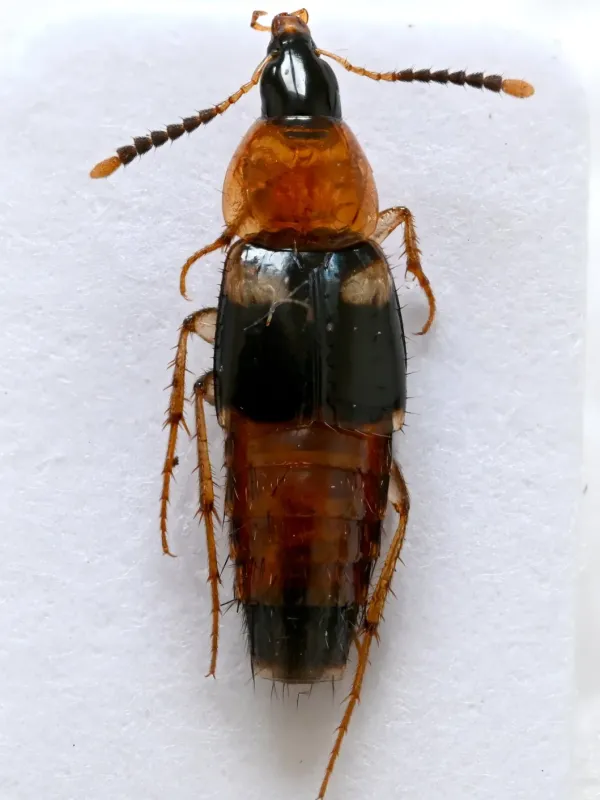
Lordithon lunulatus is a species belonging to the Staphylinidae family (rove beetles), commonly found in forest litter and on mushroom fruiting bodies. Adult beetles exhibit the characteristic elongated body shape with shortened elytra typical of the family.
The coloration of the beetle ranges from dark brown to almost black, often featuring yellowish spots on the elytra, which provides effective camouflage on mushroom surfaces. The adult size is approximately 5-7 mm.
The head is relatively large, equipped with well-developed mandibles designed for feeding on soft fungal tissues or smaller organisms. The antennae are club-shaped, which serves as a key diagnostic feature for species identification.
The larvae lead a cryptic lifestyle, living within mushroom substrates. They have an elongated, highly sclerotized body in specific segments, paired with developed legs for active movement through the mycelium.
This species is a typical representative of mycetophilous coleopterans, which determines its biological association with decaying organic matter and specialized mushroom farms.
What it damages
The primary damage caused by Lordithon lunulatus involves the destruction of fruiting bodies in cultivated mushrooms, such as oyster or button mushrooms, under intensive growing conditions.
Beetles and their larvae bore tunnels within the mushroom flesh, leading to premature decay and loss of marketability. Damaged mushrooms quickly lose moisture and become unfit for sale.
The active feeding of the pest promotes the development of secondary infections, including molds and bacterial rots, which spread throughout the blocks or beds.
In large mushroom production facilities, a rove beetle infestation can lead to total loss of a harvest wave if timely sanitary measures are not implemented.
Beyond direct damage, beetles act as mechanical vectors for pathogenic spore-forming microorganisms, transporting them between healthy and infected zones within the cultivation facility.
When it appears
The activity season of Lordithon lunulatus is closely tied to the temperature and humidity regimes required for mushroom development, including those in artificial settings.
In nature, the population peak occurs during the warm season, from late spring to early autumn, coinciding with the active growth of wild mushrooms.
In indoor environments (mushroom houses), reproduction can occur year-round if sanitary standards and temperature regimes are not strictly maintained.
Adults are most active during nighttime, making them difficult to detect visually during the day, which complicates population monitoring.
The developmental cycle from egg to adult is highly dependent on substrate temperature; higher temperatures accelerate development, causing population spikes within weeks.
Signs of infestation
The first sign of infestation is the presence of small holes on the surface of mushroom caps, through which larvae penetrate the tissue.
When cutting through a fruiting body, dark tunnels and excrement trails are clearly visible, indicating the presence of rove beetle larvae.
Detecting adult beetles on the substrate surface or on the mushrooms themselves during night inspections is a definitive indicator of a pest presence.
A foul, rotting odor emerging from mushroom blocks, even if the surface appears healthy, often signals a hidden infestation within the mushroom's internal structure.
A decrease in tissue density and premature darkening of the mushroom during harvest are critical indicators of high-level infestation.
Control measures
The primary method of control is the maintenance of strict hygiene within mushroom cultivation facilities, including the disinfection of all surfaces and equipment.
The use of light traps allows for a significant reduction in the population of adult beetles that exhibit positive phototaxis at night.
- Regular and complete harvesting of all fruiting bodies to prevent the creation of a food source for new generations.
- Heat treatment (pasteurization) of the substrate prior to inoculation to eliminate pest eggs and larvae.
- Installation of insect-proof screens on ventilation ducts to prevent the migration of beetles from outside.
In cases of severe infestation, the application of specialized biological products based on entomopathogenic nematodes is permitted to effectively destroy larvae within the substrate.
Chemical control is limited due to the nature of edible mushroom production, so the emphasis remains on agrotechnical practices and physical barriers.
Taxonomy
- Latin name
- Lordithon lunulatus
- Order
- Coleoptera (beetles)
- Family
- Staphylinidae
- EPPO code
- LORDLU
Discussion
No discussions yet — be the first.