
Yellow slug
Limacus flavus
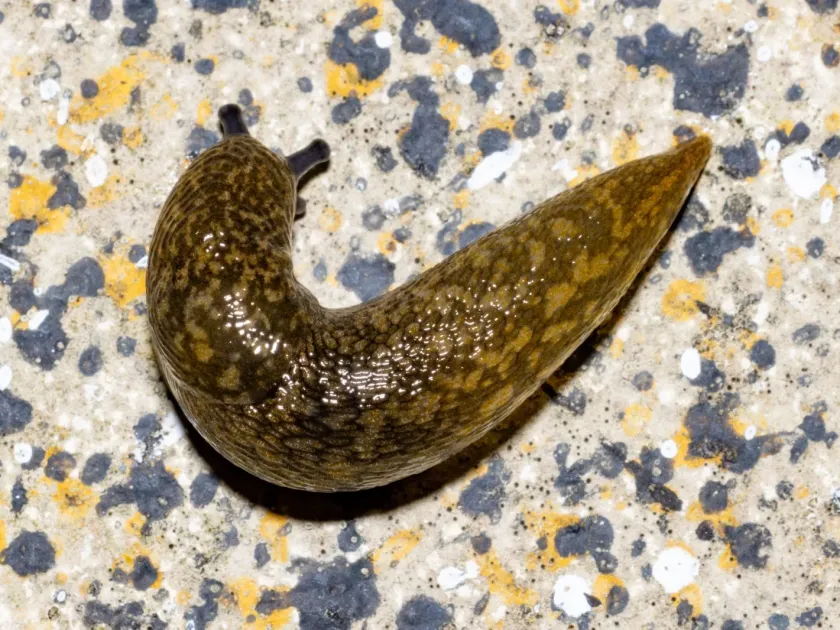
Description
How to identify
The yellow slug (Limacus flavus) belongs to the order Stylommatophora and the family Limacidae. It is a medium to large-sized mollusk, typically reaching 7 to 15 cm in length when fully active.
The body coloration ranges from yellowish-grey to greenish-yellow, often marked with distinctive yellowish spots. A key identifying feature is the presence of yellow mucus, which is secreted when the slug is disturbed or threatened.
It possesses a distinct mantle that covers about a third of its body length. The tentacles often show a subtle bluish hue, providing a quick visual reference for distinguishing it from other common slug species.
These slugs are primarily nocturnal and highly moisture-dependent. They prefer dark, humid environments such as basements, cellars, greenhouses, and dense foliage, where they can avoid desiccation.
Being hermaphroditic, each individual can reproduce, laying eggs in clusters within moist soil or organic debris. This reproductive strategy allows them to colonize new areas rapidly when environmental conditions are optimal.
What it damages
The yellow slug is a significant polyphagous pest that consumes a wide variety of plant materials. It is particularly damaging to vegetables, strawberries, and ornamental plants in both garden and greenhouse settings.
Commonly attacked crops include lettuce, cabbage, cucumbers, and tomatoes. In greenhouses, they can devastate young seedlings overnight, causing total loss of early-stage plant development.
Damage is characterized by irregular, ragged holes in leaves and stems, caused by the slug's radula. This scraping process leaves large, unsightly gaps in plant tissue, reducing both the vigor and market value of the crop.
Beyond direct consumption, the slime left behind by slugs serves as a vector for various plant pathogens. It promotes the growth of bacteria and fungi, leading to rot and rapid decay of the affected vegetation.
They are notorious pests in storage facilities, where they feed on stored root vegetables like potatoes, carrots, and onions. They burrow deep into the produce, leaving cavities that quickly become infected with rot, ruining entire batches of harvest.
When it appears
Activity usually begins in early spring as temperatures consistently remain above 5-7 degrees Celsius. Moist spring weather is perfect for their emergence from winter hideouts and the commencement of their feeding cycle.
During the summer months, activity levels are strictly dictated by humidity. If the weather turns dry, they retreat into the soil or shaded crevices. Rainfall, however, triggers an immediate return to surface activity.
The peak of damage occurs in late summer and autumn when plants are succulent and evenings become cooler and more humid. During this period, the slugs move extensively across garden beds, seeking food sources.
As temperatures drop, they seek refuge for overwintering. They burrow into the soil or hide in sheltered spots such as compost heaps or building foundations, where they can survive the winter in a state of reduced activity.
In temperature-controlled environments like greenhouses or indoor cellars, they may remain active year-round. These artificial environments provide a constant supply of food and warmth, leading to continuous breeding cycles.
Signs of infestation
The most reliable sign of a yellow slug infestation is the presence of silvery, dried mucus trails on soil, leaves, or greenhouse structures. These trails are often visible in the early morning.
Ragged holes or missing sections of foliage at the base of plants are primary indicators of grazing. Unlike insect damage, which might be more surgical, slug damage often involves substantial portions of tissue being scraped away.
If you find deep, irregular pits in your fruits or vegetables, particularly those touching the ground, it is a clear sign that slugs have been feeding. In many cases, the slugs can be found nearby during the day.
Sudden wilting of young plants without evidence of soil-borne diseases suggests that slugs may have girdled the stem near the soil level, cutting off the plant's nutrient transport system.
A musty or decaying odor in your storage area, combined with slimy residues on containers, strongly indicates a slug infestation. This environment is ideal for their survival and continued destruction of stored goods.
Control measures
Cultural control is the first line of defense. Tilling the soil in autumn exposes eggs and overwintering slugs to frost and predators. Regularly clearing away garden debris and weeds removes their essential daytime hiding spots.
Physical barriers can be effective in smaller gardens. Sprinkling abrasive materials like wood ash, lime, or grit around the base of vulnerable plants discourages movement, as slugs are sensitive to these materials.
Manual collection in the evening or using simple traps—such as boards or moist cardboard placed in the garden—can significantly reduce the population. These traps should be inspected and emptied daily.
Chemical control using metaldehyde-based molluscicides is effective for large infestations. These must be applied carefully, ensuring they are placed away from the edible parts of the plants and out of reach of pets and wildlife.
Biological control methods, such as encouraging natural predators like hedgehogs, toads, and ground beetles, provide a sustainable approach. Additionally, parasitic nematodes (Phasmarhabditis hermaphrodita) can be applied to the soil to safely reduce slug numbers.
Taxonomy
- Latin name
- Limacus flavus
- Order
- Molluscs
- Family
- Limacidae
- EPPO code
- LIMXFL
Discussion
No discussions yet — be the first.