
Pacific banana slug
Ariolimax columbianus
Description
How to identify
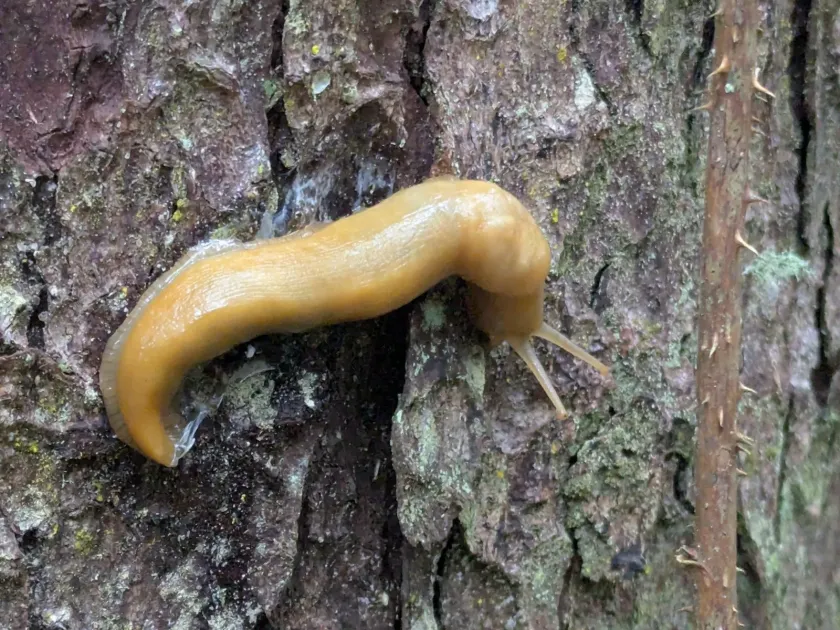
The Pacific banana slug (Ariolimax columbianus) is a prominent gastropod mollusk belonging to the Arionidae family, widely recognized for its size and distinct appearance.
The body coloration ranges from bright yellow to greenish-brown, sometimes featuring dark spots, which earned it the common name due to its resemblance to a ripe banana.
These creatures can grow up to 25 centimeters in length, making them one of the largest species of terrestrial slugs found in the Pacific Northwest.
They possess a thick mantle with a single breathing hole (pneumostome) located on the right side and are coated in a layer of mucus that helps retain moisture.
The life cycle involves being hermaphroditic, where they lay clutches of translucent eggs in damp areas such as rotting logs or soil, allowing for rapid colonization in suitable environments.
What it damages
As opportunistic polyphagous pests, banana slugs consume a wide variety of plant tissues, frequently causing severe damage to agricultural and horticultural crops.
They are particularly fond of succulent plant parts, such as young leaves of lettuce, hostas, strawberries, and various nursery seedlings, often destroying them entirely.
By using their radula, a tooth-like tongue, they scrape plant tissue, leaving behind ragged holes and significant aesthetic damage that devalues the produce.
Beyond direct consumption, the slime trails they leave behind serve as a medium for pathogens, potentially leading to bacterial rot and fungal growth on the damaged plants.
In high populations, these slugs can devastate entire vegetable patches, proving to be a major nuisance for both home gardeners and commercial growers.
When it appears
The activity of the Pacific banana slug is heavily dependent on ambient humidity, with peak activity occurring during the rainy seasons or periods of high fog.
During dry and hot days, they retreat to cool, damp microhabitats such as under logs, dense mulch, or deep within garden debris to prevent dehydration.
Spring and autumn are considered the most active seasons for feeding, as the soil remains moist and temperatures are optimal for their nocturnal movements.
They are strictly nocturnal or crepuscular, coming out primarily at night to feed when the risk of drying out is significantly reduced.
If environmental conditions remain consistently arid, slugs will enter a dormant stage, burying themselves deep underground to wait for better conditions.
Signs of infestation
The most telltale sign of an infestation is the presence of shiny, dried mucus trails on surfaces like sidewalks, pots, and plant stems.
Feeding damage is characterized by large, irregular holes in the leaves, often with tattered edges where the slugs have scraped away the leaf epidermis.
One may also find deep gouges in fruits or vegetables that are resting near or touching the ground, as the slug targets soft and succulent tissues.
Egg masses, appearing as clustered, milky-white or clear gelatinous spheres, are often hidden under piles of organic matter or soil debris.
Accumulated dark fecal pellets at the base of plants serve as another clear indication of a resident slug population feeding in the immediate vicinity.
Control measures
Management of the Pacific banana slug requires an integrated approach that combines cultural, mechanical, and chemical control methods to be effective.
Cultural control is essential: removing debris, wood piles, and weeds around the garden reduces the favorable habitats that slugs require during the day.
Mechanical barriers such as crushed eggshells, coarse gravel, or copper tape can be placed around sensitive plants to discourage the slugs from crossing.
Chemical control can be achieved using mollusks-specific baits, particularly those containing iron phosphate, which is safer for domestic pets and wildlife than traditional metaldehyde.
- Handpicking slugs during evening hours and disposing of them in soapy water.
- Implementing drip irrigation to keep the foliage and surface area drier.
- Encouraging the presence of natural predators like ground beetles, frogs, and toads in the garden.
Taxonomy
- Latin name
- Ariolimax columbianus
- Order
- Molluscs
- Family
- Limacidae
- EPPO code
- ARIXCO
Discussion
No discussions yet — be the first.