
Pacific banana slug
Ariolimax
Description
How to identify
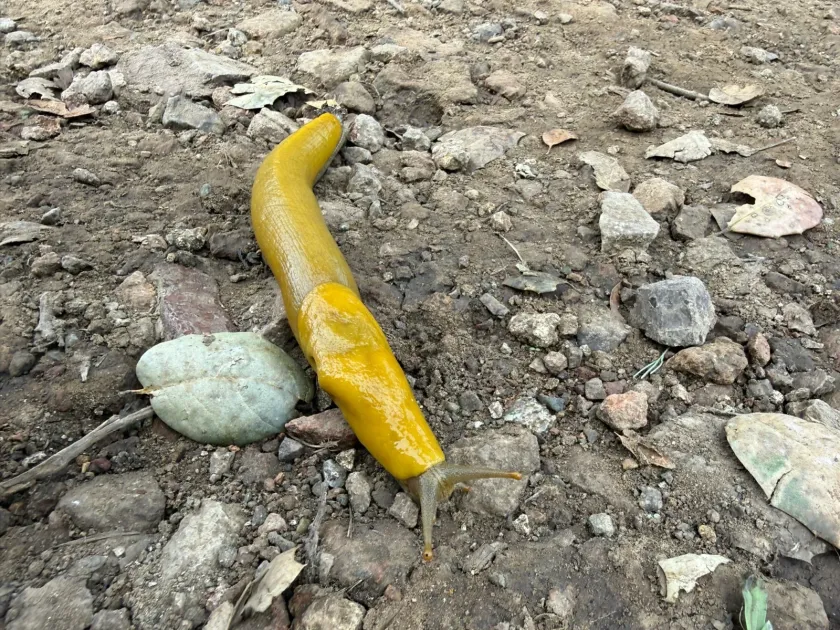
The Pacific banana slug (Ariolimax) belongs to the Arionidae family and the order Stylommatophora. It is among the largest terrestrial gastropods globally, reaching lengths of up to 25 centimeters.
Its common name derives from its resemblance to a ripe banana, with skin tones ranging from bright yellow to olive, brown, or even black with dark spots.
A distinctive trait of this slug is its ability to secrete thick mucus, which turns into a protective gel when it contacts water, shielding the animal from predators and desiccation.
The sensory system consists of two pairs of tentacles: the upper pair bears light-sensitive eyespots, while the lower pair is used for touch and chemical detection.
Biologically, these slugs are hermaphroditic, which enhances their reproductive success and allows them to colonize new environments rapidly when conditions are favorable.
What it damages
This pest is a generalist feeder that causes significant damage to various crops and ornamental plants, especially in cool, moist, and shaded environments.
Major damage occurs on young vegetable seedlings, including lettuce, cabbage, beans, and strawberries, as the slugs can consume entire plants in a short period.
Beyond foliage, these mollusks damage underground plant parts, flower bulbs, and any fruit that rests directly on the soil surface.
Their feeding activity ruins the market value of produce and creates open wounds on plants that often lead to fungal and bacterial infections.
In orchards, they may feed on buds and bark of young trees, which hinders growth and reduces overall tree health during the spring season.
When it appears
Peak activity for Ariolimax occurs during the wet spring and autumn months, when both soil and atmospheric humidity are at their highest.
During hot, dry periods, slugs enter a state of estivation, retreating into moist soil, deep mulch, or rock crevices to prevent moisture loss.
The lifecycle includes laying eggs in damp, sheltered areas, from which juveniles emerge after a few weeks of development.
Slugs typically reach sexual maturity within one year, and in optimal ecological conditions, they can live for three to five years.
They are primarily nocturnal, though they may emerge during overcast or rainy days when the risk of skin dehydration is significantly reduced.
Signs of infestation
The most reliable sign of a slug infestation is the presence of shiny, silvery trails of dried mucus left on soil, walkways, or plant foliage.
Leaves display large, irregular holes, often with a lace-like appearance as the slugs consume the leaf tissue between the primary veins.
The sudden disappearance of young vegetable starts overnight is a strong indicator of a major slug feeding event in the garden.
Morning inspection of the garden often reveals the slugs themselves hiding under wooden boards, mulch, or dense weed patches.
Damage to fruits appears as deep, crater-like holes, often contaminated with fecal matter, making the produce unusable for fresh consumption.
Control measures
Effective management begins with cultural practices: keeping the garden weed-free and cultivating the soil reduces hiding spots and disrupts their habitat.
Physical barriers such as copper tape, crushed eggshells, or diatomaceous earth can deter slugs from entering vulnerable flower beds and vegetable plots.
Beer traps or specialized yeast-based bait stations are highly effective for catching adult slugs without relying on synthetic chemical treatments.
If chemical control is necessary, iron phosphate-based molluscicides are preferred over metaldehyde because they are safer for pets and wildlife.
Encouraging natural predators, such as toads, hedgehogs, birds, and ground beetles, helps maintain the slug population at a manageable level naturally.
Taxonomy
- Latin name
- Ariolimax
- Order
- Molluscs
- Family
- Limacidae
- EPPO code
- ARIXSP
Discussion
No discussions yet — be the first.