
White prominent
Leucodonta bicoloria
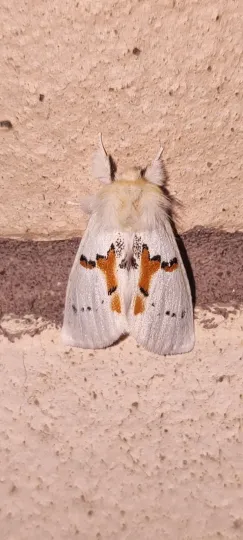
Description
How to identify
The White prominent (Leucodonta bicoloria) is a nocturnal moth belonging to the family Notodontidae, order Lepidoptera. The adult moth has a wingspan of approximately 40–50 mm, with white forewings featuring distinctive yellowish-brown markings.
The larvae of this species are notable for their appearance, which aids in camouflage on foliage. The caterpillar's body is green with yellowish stripes, often displaying characteristic dorsal humps typical of the Notodontidae family.
The insect undergoes complete metamorphosis: egg, larva, pupa, and imago. The species overwinters as a pupa inside a dense cocoon, usually found in leaf litter or crevices in the bark of host trees.
As nocturnal insects, these moths are rarely seen during the day. The mass emergence of adults typically occurs at the beginning of the summer season.
The species is widely distributed across Europe and temperate Asia, primarily inhabiting deciduous forests where its preferred host trees are abundant.
What it damages
The primary food source for White prominent caterpillars is various species of birch (Betula), and occasionally alder (Alnus). It is a specialized pest closely associated with these specific tree species.
The larvae cause damage by actively feeding on leaves during the summer months. They graze on the leaf blade, starting from the edges or creating holes, which can lead to partial or total defoliation when population densities are high.
Mass outbreaks can significantly weaken trees. In natural forest ecosystems, this rarely leads to tree mortality, but in nurseries or young plantations, severe defoliation can cause significant growth retardation.
Trees weakened by repeated defoliation become more susceptible to secondary pests, such as bark beetles, or infections by fungal pathogens.
The economic impact of this species is generally low due to its low density in stable ecosystems, but damage can be substantial in outbreak hotspots.
When it appears
The flight of the first generation occurs from May to June. During this time, females lay eggs on the undersides of birch leaves, either in clusters or individually.
Caterpillars emerge in June and July and remain active throughout the summer. Their period of maximum feeding intensity occurs during the second half of the summer season.
Pupation takes place in late summer or early autumn. The pupae remain in a state of diapause until the following spring, ensuring the species survives the winter.
The developmental cycle is typically univoltine (one generation per year) in most regions. Local climatic conditions significantly influence the timing of larval emergence and developmental rates.
Monitoring for this pest is recommended during the first half of summer, when caterpillar damage to the leaf canopy becomes noticeable.
Signs of infestation
The first visual sign of a White prominent infestation is the presence of irregular grazing marks on birch leaves. Larvae often leave skeletonized areas on the leaf blades.
Inspecting the undersides of leaves may reveal the larvae themselves or their frass (small dark pellets), which accumulate on lower leaves or within silk webbing.
In cases of heavy infestation, a thinning of the tree crown becomes apparent when compared to healthy neighboring trees.
The presence of fine silk threads, which caterpillars use to bind leaf edges together for shelter, is another key diagnostic sign.
Searching for cocoons in bark crevices near the base of the trunk during autumn helps estimate the potential population for the following year.
Control measures
For control in nurseries and ornamental plantings, biological preparations based on Bacillus thuringiensis are effective against early-instar larvae.
In cases of large-scale forest damage, the use of contact-stomach insecticides permitted in forestry practices may be justified.
Cultural methods play a vital role: maintaining high biodiversity in forest stands encourages natural enemies, such as parasitic wasps and predatory bugs, to thrive.
Removing leaf litter and cleaning trunks of old bark in late autumn helps destroy overwintering pupae and reduces the population size for the coming year.
Chemical protection should be applied strictly during the mass emergence of caterpillars, as older larvae show increased resistance to standard treatments.
Taxonomy
- Latin name
- Leucodonta bicoloria
- Order
- Lepidoptera (butterflies)
- Family
- Notodontidae
- EPPO code
- LEUDBI
Discussion
No discussions yet — be the first.