
Four-spotted spittlebug
Lepyronia quadrangularis
Description
How to identify
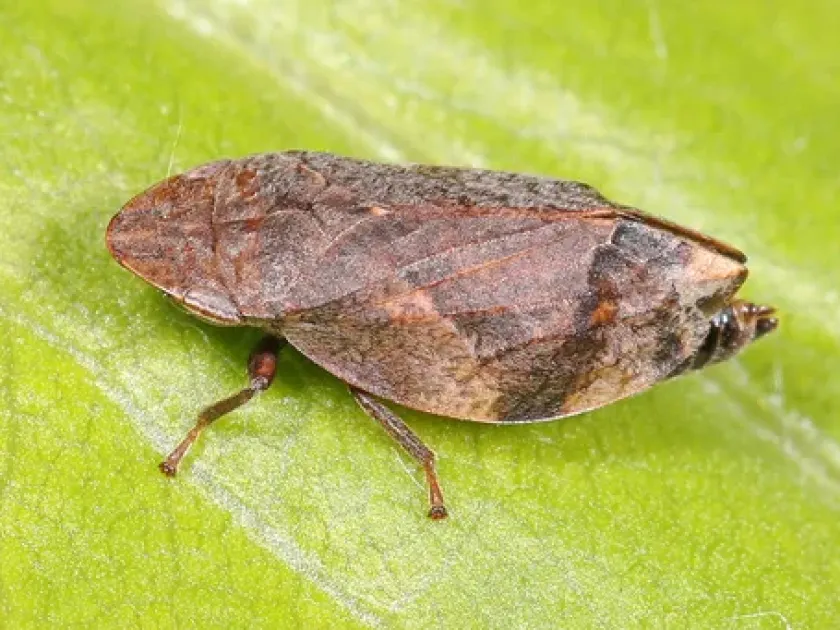
The Four-spotted spittlebug (Lepyronia quadrangularis) is a hemipteran insect belonging to the family Aphrophoridae. It is widely recognized by its wedge-shaped head and the distinct four-spotted pattern on its forewings, which gives the species its common name.
Adults typically measure between 7 and 10 millimeters in length. Their coloration ranges from tan to dark brown, serving as camouflage against the stems of various host plants. This cryptic coloration makes them difficult to spot during routine field inspections.
The immature stages, known as nymphs, are distinct for their ability to produce a frothy white foam. This "spittle" acts as a protective shield, hiding the nymphs from predators and protecting them from environmental stressors like direct sunlight and desiccation.
The life cycle involves incomplete metamorphosis, moving from eggs to nymphs and finally to the adult stage. Overwintering occurs primarily in the egg stage, often deposited within plant stems or debris, providing a robust survival strategy against harsh winter temperatures.
Population growth is highly dependent on humidity and temperature. In optimal conditions, the nymphs develop rapidly during the spring and early summer, leading to significant colonization of nearby vegetation within a short timeframe.
What it damages
The Four-spotted spittlebug feeds on a broad array of host plants, including cereal grains, legumes, and various pasture grasses. By piercing plant tissues with their specialized mouthparts, they drain essential nutrients, which weakens the host.
Common agricultural impacts include stunted growth of alfalfa, clover, and wheat crops. Severe infestations reduce the vigor of the plant, leading to decreased yields and poorer forage quality due to the loss of sap and plant energy.
As the insects feed, they may cause leaf chlorosis and distortion. The areas where the nymphs cluster often exhibit signs of necrosis as the plant reacts to the feeding injury, further compromising the plant's photosynthetic capacity.
Crucially, these insects can act as vectors for various plant pathogens. The transmission of viruses and phytoplasmas during feeding can be far more damaging to a farm's bottom line than the physical damage caused by the insects themselves.
Monitoring the density of nymphs in the lower canopy is essential, as high populations can lead to widespread crop decline. The economic impact is often most severe during dry spells when the plant's ability to recover from sap loss is diminished.
Signs of infestation
The most visible sign of infestation is the presence of frothy, white spittle masses on the stems, leaf axils, or flower buds. This foam is the definitive indicator of spittlebug activity in a field.
Affected plants often display signs of wilting, yellowing, and leaf curling. In some cases, the plant may exhibit abnormal twisting or bending of the stems, reflecting a systemic reaction to the stress caused by the feeding insects.
To identify the pest accurately, one must look deep within the plant canopy. Nymphs are rarely found on the surface and are usually tucked away within their foam, which must be carefully examined to confirm the presence of the pest.
Adult spittlebugs are extremely agile and possess strong jumping legs. When a field is disturbed, adults often jump or fly away immediately, which can lead to an underestimation of their actual numbers if the observer is not quick or careful.
Secondary signs include the presence of honeydew-like deposits or fecal spots on the leaves, which may also attract ants or promote the growth of sooty mold if the infestation remains uncontrolled for an extended period.
Control measures
Cultural control is the most effective starting point, involving the removal of weeds around field margins that serve as alternative hosts and overwintering sites for the insects.
Crop rotation and maintaining a healthy distance between pasture fields and susceptible cereal crops can prevent the migration of spittlebugs and limit the spread of the population across larger areas.
Chemical control via systemic insecticides may be necessary if monitoring reveals that population levels have crossed the economic injury threshold. Applications should be timed carefully to coincide with the peak of nymph emergence.
Natural predators, including spiders, damsel bugs, and parasitic wasps, play a significant role in limiting spittlebug populations. Promoting a diverse ecosystem can naturally regulate the number of pests without intensive chemical inputs.
- Regular mowing of field edges to eliminate breeding grounds.
- Maintaining proper crop rotation cycles.
- Using systemic insecticides at the nymphal stage if needed.
- Monitoring pest counts using sweep nets for early detection.
Taxonomy
- Latin name
- Lepyronia quadrangularis
- Order
- Hemiptera (bugs, aphids, leafhoppers)
- Family
- Aphrophoridae
- EPPO code
- LEPOQU
Discussion
No discussions yet — be the first.