
Leptogaster cylindrica
Leptogaster cylindrica
Description
How to identify
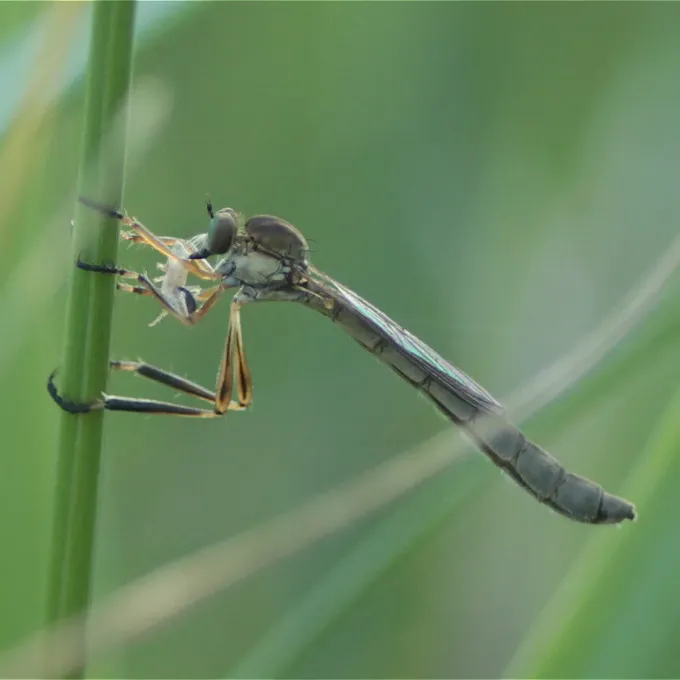
Leptogaster cylindrica is a member of the Asilidae family, commonly known as robber flies. They are distinguished by their exceptionally slender, elongated, and cylindrical bodies which make them look like small twigs or stalks.
The coloration of these insects typically ranges from yellowish-brown to dark brown, providing excellent camouflage against dry grass stems where they frequently perch while hunting.
Adults reach an average body length of 10–15 mm. Their wings are narrow and transparent, and their legs are long and spiny, specifically adapted for grabbing and holding onto prey mid-flight.
Their head features a sharp, sclerotized proboscis, a hallmark of robber flies, used to pierce the exoskeleton of their victims and inject paralyzing digestive enzymes.
Larvae are soil-dwellers, often found in decaying organic matter. They are predatory in nature, feeding on small soil-borne invertebrates, which adds to their role as natural biological regulators.
What it damages
From an agronomic perspective, Leptogaster cylindrica is generally considered a beneficial insect rather than a pest. As predators, they feed on various flying insects.
They consume small flies, mosquitoes, and aphids. By doing so, they help in reducing the population of potential crop pests or annoying insects in the agricultural landscape.
The potential for harm arises only if their predatory activity impacts beneficial species like pollinators (bees) or other helpful parasitoids during peak agricultural seasons.
However, no direct physical damage to plant tissues, such as roots, leaves, or stems, occurs because these insects lack the anatomical parts required to feed on plant matter.
In most farming scenarios, their presence is a positive indicator of a healthy and balanced ecosystem, so no direct "damage" is attributed to them in crop production.
When it appears
Adult Leptogaster cylindrica are typically active during the summer months, with sightings most common from June through August across temperate regions.
They prefer warm, sunny weather conditions. During the day, they remain stationary on tall grasses or weeds, waiting for a suitable victim to fly by before launching a quick ambush attack.
The lifecycle includes complete metamorphosis: egg, larva, pupa, and adult. The overwintering stage is usually the larva, which hides deep within the soil profile.
Pupation occurs in the soil as temperatures rise in spring, followed by the emergence of adults, which have a relatively short lifespan dedicated to mating and hunting.
The seasonal occurrence is heavily influenced by local microclimates and the availability of prey populations within the field or the surrounding hedge rows.
Control measures
There is no standard protocol for controlling Leptogaster cylindrica because they are not recognized as primary crop pests. Efforts to eliminate them are discouraged.
Broad-spectrum insecticide applications often eliminate robber flies, which may lead to secondary pest outbreaks since these predators are no longer present to control smaller insect populations.
If management is required for specific delicate environments, promoting habitat complexity around fields can help maintain a balance where robber flies thrive alongside beneficial pollinators.
Integrated Pest Management (IPM) strategies emphasize the preservation of natural enemies, which includes protecting robber flies as part of the agricultural biodiversity.
Sustainable agricultural practices that reduce chemical inputs are the most effective way to maintain these beneficial insects as natural allies in crop production systems.
Taxonomy
- Latin name
- Leptogaster cylindrica
- Order
- Diptera (flies)
- Family
- Asilidae
- EPPO code
- LPGRCY
Discussion
No discussions yet — be the first.