
Leptogaster
Leptogaster
Description
How to identify
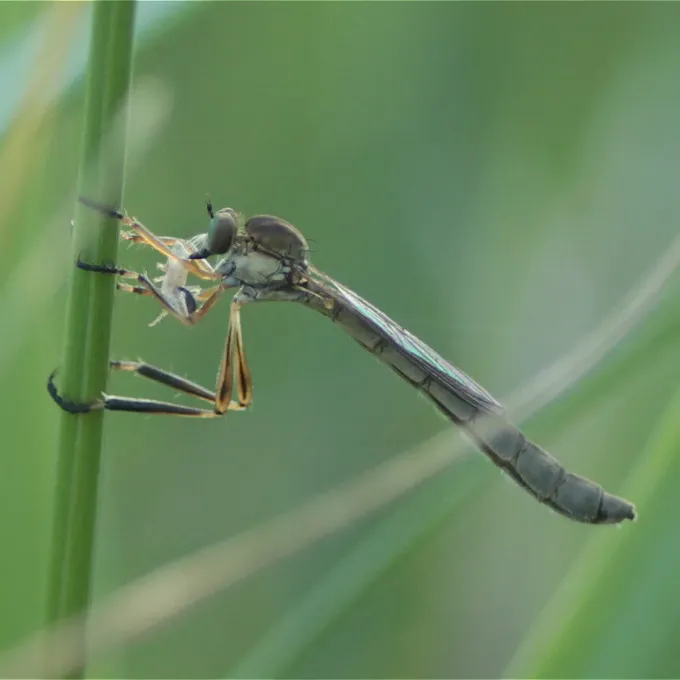
The genus Leptogaster belongs to the Asilidae family (robber flies) within the order Diptera. These flies are easily distinguished by their long, slender bodies and thin legs, often resembling thread-waisted wasps or ichneumonids.
Adults typically measure between 10 and 20 millimeters. Their coloration ranges from yellowish-brown to dark brown or black, helping them blend perfectly into their environment of grasses and crop stems.
The head is equipped with a strong proboscis for piercing prey and large, prominent eyes. This anatomical feature provides excellent vision for spotting prey while the fly is in flight or resting on a leaf.
Their wings are generally transparent and rest flat along the abdomen when not in flight. Unlike many other robber flies, they lack dense bristles, giving them a sleek and streamlined appearance.
Identification at the species level requires microscopic examination of the wing venation patterns and the terminalia of the males, which is a task usually performed by specialists.
What it damages
It is critical to state that Leptogaster are not agricultural pests. They do not cause damage to plant tissues, fruits, or roots, as they are strictly predatory in their adult stage.
These robber flies serve as beneficial entomophages in field crops, orchards, and pastures. They feed on a variety of smaller insects, including leafhoppers, aphids, and midges.
By consuming harmful phytophagous insects, they provide natural biological pest control, which reduces the reliance on chemical insecticides in managed agricultural systems.
In many regions, they act as important regulators of pest populations, preventing the outbreaks of species that might otherwise damage cereal crops or orchard leaves.
Agronomists view their presence as a sign of a balanced ecosystem where natural predators are effectively managing potential threats to the harvest.
When it appears
The active flight period for adult Leptogaster typically spans the warm summer months, generally from early June through late August, depending on the climatic zone.
The life cycle involves egg, larval, pupal, and adult stages. The larvae live in the soil or decaying organic matter, where they also act as predators of small soil-dwelling invertebrates.
Pupation occurs within the soil profile, from which the adult fly emerges. Once emerged, the primary goal of the adult is to hunt and reproduce, contributing to the next generation of pest controllers.
The intensity of their activity is closely correlated with temperature and humidity. Warm, stable weather conditions favor their metabolic rates and hunting success in agricultural landscapes.
Their seasonal occurrence often aligns with the peak infestation periods of many common crop pests, allowing these beneficial flies to exploit an abundant food supply.
Control measures
No control measures are necessary for Leptogaster; instead, conservation efforts should be focused on protecting these beneficial predators to maintain healthy crop environments.
Indiscriminate use of broad-spectrum insecticides should be avoided to prevent the unintended killing of these natural allies, which would lead to a loss of biological control services.
Maintaining non-crop areas such as hedgerows and field margins provides vital habitats for these flies, ensuring they have places to rest and hunt throughout the growing season.
Integrated Pest Management (IPM) strategies emphasize the preservation of predatory populations like robber flies to minimize chemical inputs and promote sustainable farming practices.
Farmers are encouraged to monitor the presence of these flies as a benchmark for local ecosystem health, which can lead to better-informed decisions regarding the necessity of chemical treatments.
Taxonomy
- Latin name
- Leptogaster
- Order
- Diptera (flies)
- Family
- Asilidae
- EPPO code
- LPGRSP
Discussion
No discussions yet — be the first.