
Lathrobium fulvipenne
Lathrobium fulvipenne
Description
How to identify
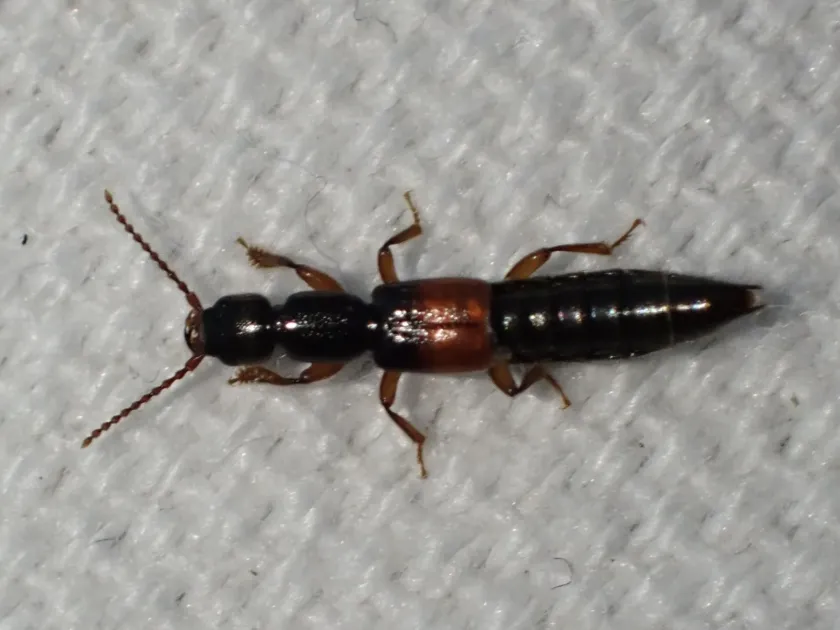
Lathrobium fulvipenne is a member of the Staphylinidae family, commonly known as rove beetles. These insects are easily recognized by their elongated bodies and shortened elytra, which leave much of the abdomen exposed.
Adult beetles typically measure between 7 and 9 millimeters in length. Their coloration is predominantly dark brown to black, with the elytra exhibiting a distinct reddish-brown tint, which is a key diagnostic feature for this species.
The head is broad with well-developed mandibles. These mouthparts are adapted for both predatory behavior and the consumption of organic matter in the soil environment. Their antennae are long and filiform, aiding in sensory navigation through soil pores.
Larvae have a campodeiform structure, meaning they are mobile with distinct legs and a protective cuticle. They are generally lighter in color than the adults and live in the upper layers of the soil.
While definitive identification of Staphylinidae species often requires expert analysis of genital morphology, field identification is possible through observing their characteristic movement, size, and presence in damp environments.
What it damages
While many rove beetles are beneficial predators, Lathrobium fulvipenne can exhibit phytophagous behavior, causing damage to the underground parts of developing crops. Young seedlings are particularly susceptible to their activity.
The primary damage occurs during germination and the early stages of root development. Beetles and larvae chew on the seeds, radicles, and young stems, leading to stunted growth or total plant failure in severe cases.
Damaged tissue becomes a prime entry point for secondary pathogens, such as soil-borne fungi and bacteria. This often complicates diagnosis, as the symptoms of the subsequent rot are more visible than the initial insect damage.
The pest is most destructive in fields with high organic content and excessive moisture. These conditions provide an optimal microhabitat for their survival and feeding activities.
Due to their cryptic, soil-dwelling nature, infestations are often discovered only after significant damage has been done to the crop stand, making preventive monitoring crucial for management.
When it appears
The activity cycle of Lathrobium fulvipenne is highly dependent on soil moisture and ambient temperature. Their peak activity usually occurs in the spring, as the soil warms up and provides favorable conditions for emerging from overwintering.
During dry summer months, the beetles tend to retreat deeper into the soil profile where humidity remains higher. They are less active on the surface unless irrigation or heavy rainfall occurs.
A secondary peak in activity is often noted during the autumn. During this time, the beetles actively feed and seek out suitable sites, such as dense crop residue or damp soil patches, to prepare for the winter months.
Overwintering takes place in the larval or adult stages within the soil or beneath accumulated plant debris. This makes post-harvest tillage an important factor in managing their population levels.
Early-sown crops are at the highest risk, as the timing of spring emergence often coincides with the critical stage of seed germination and seedling establishment.
Control measures
Managing Lathrobium fulvipenne requires a multi-faceted approach, emphasizing cultural practices that disrupt the pest's life cycle combined with targeted chemical interventions when necessary.
- Deep autumn tillage to destroy overwintering sites and expose insects to predators.
- Crop rotation to break the pest cycle and improve soil health.
- Sanitation by removing crop residues that provide refuge for the beetles.
- Soil moisture management to reduce excessive dampness in fields.
Seed treatment with systemic insecticides is the most effective method for protecting young seedlings. This provides a chemical barrier that protects the seed and root system during the first few weeks of development.
In cases of high infestation, soil-applied granular insecticides during planting can provide longer-lasting protection. These applications must be timed correctly to ensure the active ingredient is present when the pest is most active.
Taxonomy
- Latin name
- Lathrobium fulvipenne
- Order
- Coleoptera (beetles)
- Family
- Staphylinidae
- EPPO code
- LATOFU
Discussion
No discussions yet — be the first.