
Larra anathema
Larra anathema
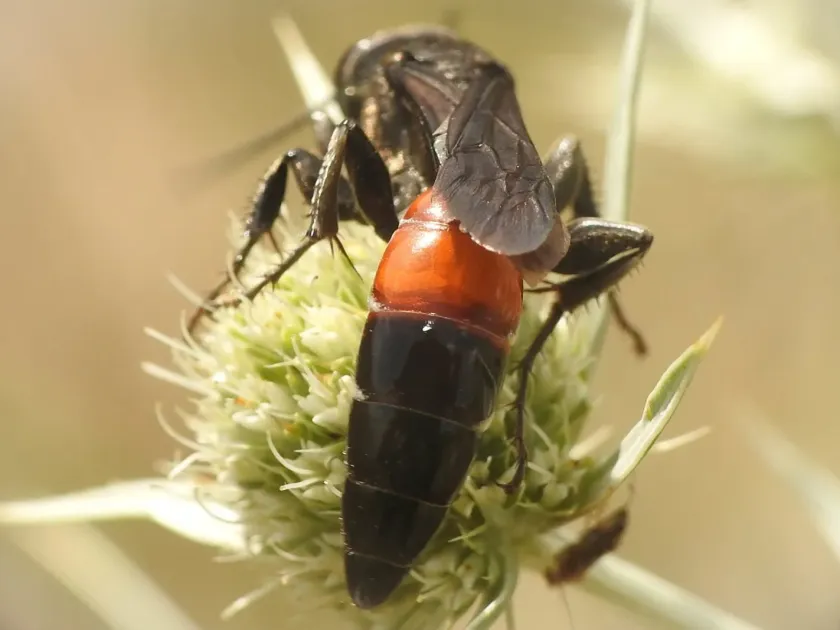
Description
How to identify
Larra anathema is a species of sand wasp belonging to the family Crabronidae. These wasps are known for their distinct black appearance and agile flight patterns used for hunting and territorial patrol.
Adult wasps typically measure between 15 and 20 mm in length. They are characterized by a slender build and powerful mandibles, which are essential for digging into the soil to locate and subdue their specific prey.
The life cycle involves an egg stage, a larval stage that acts as a parasitoid, a pupal stage, and the adult wasp. The female spends significant time searching for hosts to ensure the survival of her offspring.
After finding a suitable host, the wasp paralyzes it and attaches an egg to its body. The emerging larva then feeds on the internal tissues of the host, which is usually a mole cricket.
These wasps are highly specialized, and their presence in agricultural landscapes is a clear biological indicator of mole cricket infestations in the soil.
What it damages
The primary target of Larra anathema is the mole cricket (Gryllotalpa gryllotalpa). The wasp does not damage plants directly, but it is inextricably linked to the damage caused by its host species.
Mole crickets cause severe damage to agricultural crops by burrowing through the soil, severing roots of seedlings, and consuming seeds, often leading to total crop failure in affected beds.
Damage is most prevalent in well-drained, loose soil environments where both the mole crickets and the wasps thrive, creating a cycle of infestation and parasitism.
While the wasp is not an agricultural pest, its density is directly tied to the presence of high-density mole cricket populations that farmers struggle to manage.
Indirectly, the presence of these wasps signals that the agricultural area has a high level of soil activity from mole crickets, requiring immediate intervention to protect young vegetable crops.
Control measures
Control efforts should focus on managing the mole cricket population rather than eradicating the wasp, as Larra anathema acts as a natural biological control agent.
Deep plowing or soil cultivation during autumn is an effective way to disturb mole cricket nests, reducing the host population and subsequently decreasing the wasp's activity in the area.
Integrated Pest Management (IPM) practices should be employed to minimize the use of broad-spectrum insecticides that could accidentally kill beneficial parasitoid wasps.
Trapping techniques, such as using bait stations or organic debris piles, effectively remove mole crickets from the fields, creating a cleaner environment for crop development.
Maintaining a clean field by removing flowering weeds can also help manage the wasp population, as adults feed on nectar to sustain their daily activity levels.
Taxonomy
- Latin name
- Larra anathema
- Order
- Hymenoptera
- Family
- Crabronidae
- EPPO code
- LARRAN
Discussion
No discussions yet — be the first.