
Yellow robber fly
Laphria flava
Description
How to identify
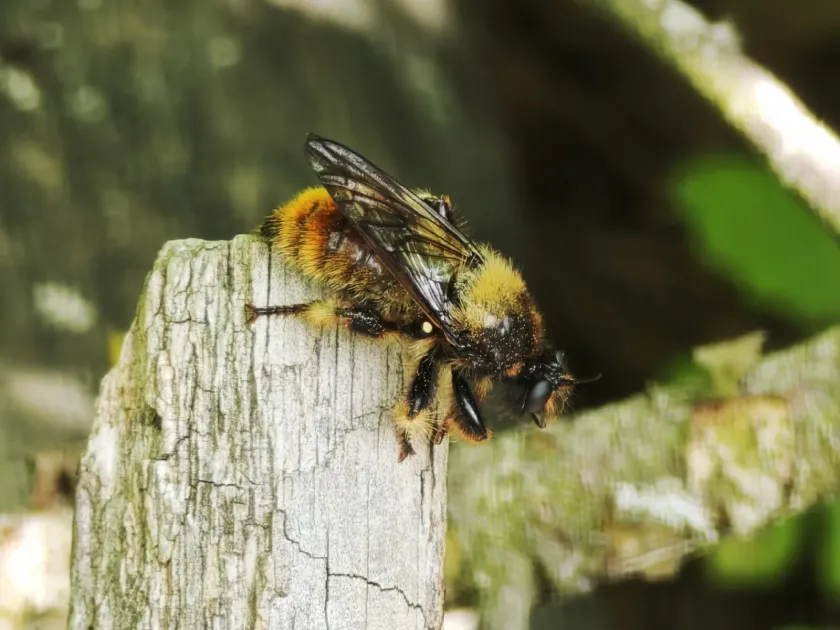
The yellow robber fly (Laphria flava) is a distinctive member of the Asilidae family, known for its strong resemblance to a bumblebee.
The body is densely covered with yellow-golden hairs, which serves as a mimicry mechanism to avoid potential predators while hunting.
Adult insects reach a body size of approximately 15 to 25 millimeters and are equipped with a strong, piercing proboscis.
They possess a highly mobile head with large, efficient compound eyes that allow them to spot and catch prey while in flight.
Their flight is rapid and agile, enabling them to pursue various winged insects with high precision in different environments.
What it damages
The yellow robber fly is not a direct pest to crops, as it feeds exclusively on other insects rather than plant tissues.
Its primary negative impact is observed in the apiculture sector, where these flies act as predators of honey bees.
By capturing bees in flight, these predators can reduce the number of foraging workers, which indirectly affects pollination efficiency.
However, the larvae of the robber fly are beneficial in a sense, as they dwell in decaying wood or soil, preying on other insect larvae.
Given their role in the ecosystem, they are generally not considered major agricultural pests requiring large-scale control measures.
When it appears
Adults of Laphria flava typically emerge during the summer months, with the highest activity recorded from June through August.
The entire life cycle of this species can last between one to two years, primarily depending on the environmental temperature and humidity.
The larval stage develops within the soil or rotten organic matter, where it thrives by consuming larvae of other ground-dwelling insects.
Adults prefer sunny, warm weather for hunting and mating, often settling on trunks or open patches to monitor their hunting territory.
After completing their reproductive cycle, the adult flies die, leaving the next generation to overwinter in their larval forms.
Control measures
There are no standardized chemical control measures against the yellow robber fly because it is often considered a beneficial predator.
For apiary protection, the most effective management strategy involves relocating hives to areas with less activity of predatory insects.
Removing piles of decaying wood near hives can limit the availability of breeding sites for the larvae of these flies.
Applying insecticides to control these flies is strongly discouraged, as it poses a significant risk to the bee populations being protected.
Promoting a balanced local ecosystem is the best long-term approach to keep the population of any predatory species within natural limits.
Taxonomy
- Latin name
- Laphria flava
- Order
- Diptera (flies)
- Family
- Asilidae
- EPPO code
- LAPRFL
Discussion
No discussions yet — be the first.