
Robber fly
Laphria
Description
How to identify
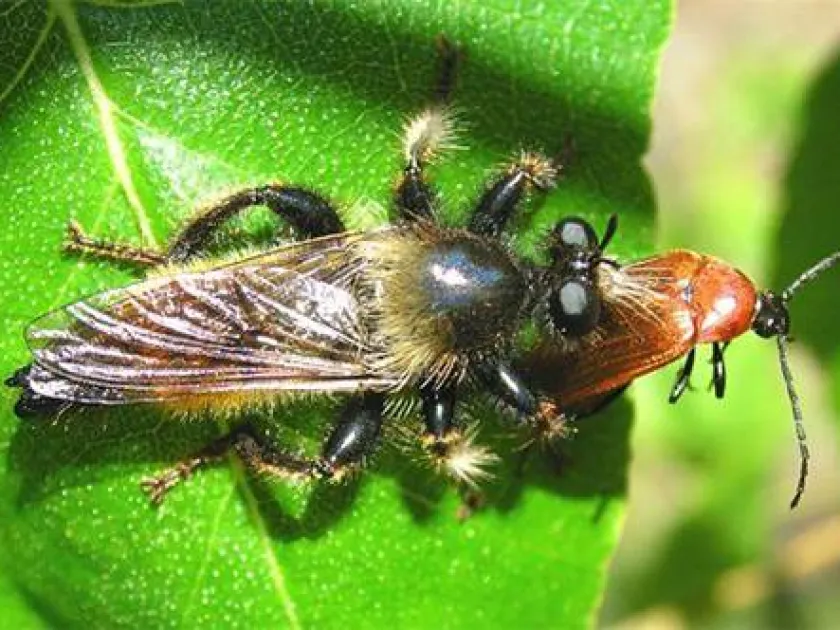
Robber flies (genus Laphria) belong to the family Asilidae within the order Diptera. These are large, often hairy flies that frequently mimic bees or bumblebees, a prime example of Batesian mimicry.
Adults possess a powerful, rigid proboscis designed to pierce the cuticle of their prey. They have a robust body, a mobile head with large compound eyes, providing exceptional vision for hunting in flight.
The larvae of robber flies develop in soil or decaying wood. They are elongated and equipped with well-developed mouthparts, adapted for feeding on both organic matter and small soil-dwelling invertebrates.
The coloration of the adults ranges from black to yellowish-brown, often with dense hair. They are found in sunny clearings, forest edges, and open garden areas, where they wait for prey while perched on branches or leaves.
It is crucial to understand that the robber fly is not a crop pest in the traditional sense; it is a beneficial entomophage, though high populations may prey upon pollinators, requiring balanced management.
What it damages
The primary impact of robber flies is their predatory activity towards bees, bumblebees, and other beneficial insects. They actively hunt pollinators, which can reduce the effectiveness of natural pollination in crops.
They attack a wide spectrum of insects: beetles, flies, orthopterans, and even smaller representatives of their own order. In gardens, they often "ambush" prey near flowering plants that attract pollinators.
Robber flies do not directly damage vegetative parts of plants (leaves, roots, or fruits). Their harm is indirect, influencing the biological diversity of the site's entomofauna.
Larvae living in the soil can act as both saprophages and predators. In rare cases, they may damage the roots of weakened plants, but they generally prefer the larvae of other soil-dwelling insects.
An economic threshold for robber flies has not been established, as their role as beneficial entomophages that destroy other pests often offsets the damage caused to pollinator populations.
When it appears
Adult robber fly activity occurs during the warmest months of the year. Peak numbers are observed in June and July when insects are most active in searching for food and mating partners.
Early in the season, during spring, the larval stages develop in the soil or decaying wood. At this time, they are virtually invisible to the agronomist and have no significant impact on the environment.
With the onset of steady heat, adults emerge from their pupation sites. Their life cycle is closely tied to temperature; activity decreases significantly during cold snaps, and they seek shelter.
By late August, the adult population gradually declines. Robber flies prefer sunny days and rarely fly in overcast or rainy weather, which is important to consider when planning management measures.
The life cycle of the species can last from one to three years, depending on the climatic zone and the availability of food sources for the larvae in the soil.
Signs of infestation
The main sign of robber fly presence is the observation of large, buzzing insects making rapid, darting flights between plants. They often perch on sunny parts of plant canopies.
Upon visual inspection, one may find empty chitinous shells of prey—robber flies inject enzymes to liquefy the internal tissues of their victims, leaving behind only the dry husk.
A decrease in bee and bumblebee activity in an area where these predatory flies are abundant may indirectly indicate a high concentration of robber flies, which may require further assessment.
Sometimes, larvae can be discovered when digging the soil in root zones or during the removal of old, rotting wood. They appear as whitish or yellowish elongated grubs with a visible head.
There are no direct injuries to crops, so looking for gnawing marks on leaves or fruits is pointless. Efforts should be focused on identifying the predator during its hunting process.
Control measures
Specialized chemical control against robber flies is not recommended. They are beneficial entomophages that also eliminate many harmful flies, beetles, and moths that damage crops.
The best control method is maintaining an agricultural balance. Regular removal of old, rotting wood and garden debris deprives larvae of sites for development and overwintering.
If the robber fly population becomes critical and threatens apiaries, mechanical capture methods using traps can be employed, or access to bee-pollinated crops can be restricted.
Utilizing selective plant protection methods that avoid killing beneficial insects helps restore natural balance and lowers predatory fly numbers without the need for broad-spectrum insecticides.
- Practice crop rotation and soil cultivation.
- Clear plant debris and rotting wood regularly.
- Maintain insect biodiversity in the garden.
Taxonomy
- Latin name
- Laphria
- Order
- Diptera (flies)
- Family
- Asilidae
- EPPO code
- LAPRSP
Discussion
No discussions yet — be the first.