
Poplar hawk-moth
Laothoe populi
Description
How to identify
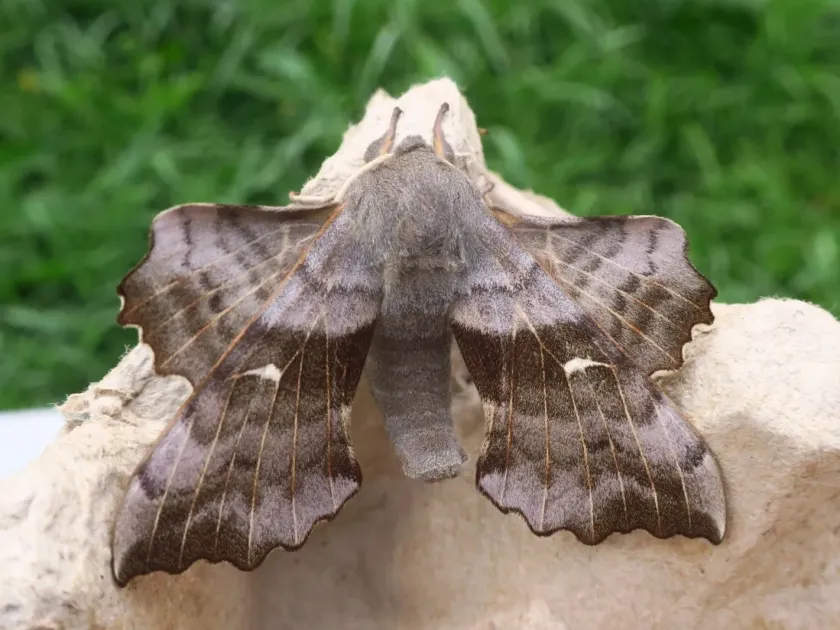
The adult Poplar hawk-moth is a large moth with a wingspan of up to 90 millimeters. Its forewings have a jagged, leaf-like edge, providing excellent camouflage against tree bark and foliage.
The forewings are typically grayish-brown or olive-colored with darker transverse bands. A key feature is the bright red patch at the base of the hindwings, revealed when the moth is threatened to startle predators.
The larvae, or caterpillars, reach lengths of 70–80 millimeters. They are vibrant green with diagonal pale lateral stripes and a distinct bluish horn at the posterior end, which is a hallmark of this Sphingidae species.
The pupa is smooth, dark brown, and measures about 40–50 millimeters. It overwinters in the soil, encased in a firm earthen cell that provides protection from freezing temperatures throughout the winter months.
Taxonomically, this species belongs to the order Lepidoptera and the family Sphingidae. It is a nocturnal insect, and as an adult, it does not feed because its proboscis is fully reduced.
What it damages
The primary host plants for this pest are members of the Salicaceae family, particularly poplars and willows. It causes significant damage to both wild stands and ornamental trees in urban landscapes.
The caterpillars are highly voracious and feed on the leaf blade, often leaving only the main vein remaining. This defoliation reduces the tree's ability to photosynthesize, weakening its overall health.
Young saplings in nurseries are particularly vulnerable. Heavy infestation can lead to total defoliation, causing growth stagnation and making the plants more susceptible to environmental stress and diseases.
Repeated annual damage can significantly stunt the growth of mature trees, reducing their aesthetic value in city parks and private gardens. Therefore, monitoring is essential for large-scale landscaping.
While the Poplar hawk-moth is not a major agricultural pest like some others, it is considered a significant threat to woodland nurseries and urban tree health in regions where it is prevalent.
When it appears
Adult moths emerge between May and August, depending on the local climate. Being nocturnal, they remain hidden during the day and are rarely seen unless they are disturbed on tree trunks.
Eggs are laid individually on the undersides of leaves of the host tree. The lifecycle typically consists of one generation per year, though warmer regions may support a partial second generation.
The larval stage occurs from June to September. During this period, the caterpillars feed actively, growing rapidly as they consume large amounts of biomass to prepare for their transition to the pupal stage.
Pupation occurs in the soil during autumn. The moth enters a diapause state as a pupa, remaining in the earth until the spring, when the cycle begins anew with the emergence of adult moths.
Because the adult moths do not feed, the management of this species is entirely focused on monitoring and controlling the larval population during the active summer months when they are present.
Signs of infestation
The most common sign of infestation is the presence of large, cylindrical frass (droppings) on the ground under the tree canopy. These are easily seen on pavement or bare soil beneath infested branches.
Defoliated leaves are a clear indicator of feeding activity. You will observe leaves that have been eaten from the edges inward, eventually leaving only the rigid midribs visible on the twigs.
If you inspect the branches closely during the evening hours, you may spot the large, green caterpillars. Their size and distinct horn make them relatively easy to identify upon close inspection.
During autumn, you might notice disturbances in the soil layer around the base of the trees as larvae move down to burrow and create their pupation chambers for the winter.
In cases of severe infestation, the cumulative sound of feeding caterpillars can sometimes be heard at night, sounding like a light rustling of foliage caused by the movement and consumption.
Control measures
For small-scale infestations in home gardens, manual collection of caterpillars is an effective and non-toxic method. This is best done in the evening when the larvae are actively feeding.
Biological control using Bacillus thuringiensis (Bt) is highly effective against young larvae. This method is preferred as it is safe for beneficial insects and the surrounding environment.
In professional forestry or large nursery settings, contact or systemic insecticides may be used if the population reaches economic injury levels. Always follow local regulations regarding timing and safety.
- Tilling the soil around tree bases in autumn to expose and kill overwintering pupae.
- Encouraging bird populations, which naturally predate on hawk-moth larvae.
- Using pheromone traps or light traps for monitoring the timing of adult emergence.
Maintaining tree vitality through proper irrigation and pruning is the best long-term strategy. Healthy trees are significantly more resilient to damage and can recover more quickly from light infestations.
Taxonomy
- Latin name
- Laothoe populi
- Order
- Lepidoptera (butterflies)
- Family
- Sphingidae
- EPPO code
- AMORPO
Discussion
No discussions yet — be the first.