
Poplar hawk-moth
Laothoe
Description
How to identify
The Poplar hawk-moth (Laothoe populi) is a large moth belonging to the family Sphingidae. Its most striking feature is the irregular, scalloped shape of its wings, which, when the moth is resting, perfectly mimics a withered, curled leaf to provide camouflage.
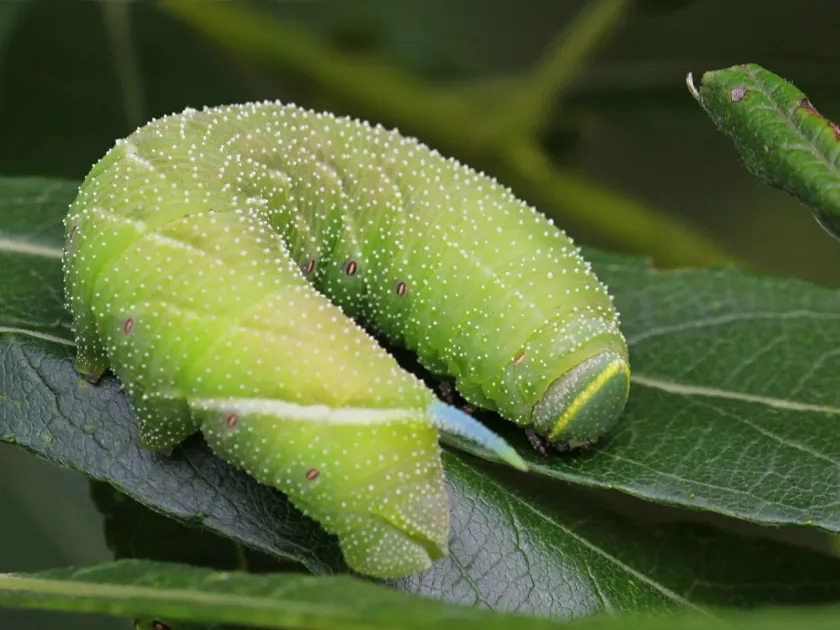
The caterpillars are quite large, growing up to 7–8 cm in length. They are typically bright green with diagonal light stripes on their sides and a distinctive horn-like projection on the posterior end, which is a key trait for species recognition.
Taxonomically, this species is part of the subfamily Smerinthinae. Adult moths do not feed, as they lack functional mouthparts, and their short lifespan is devoted entirely to finding a mate and reproducing.
The pupa is dark brown and smooth, allowing it to survive the winter hidden in the soil or leaf litter beneath the host tree, waiting for the warmer temperatures of the next spring.
The wingspan of an adult moth typically ranges between 70 mm and 100 mm. The coloration is highly variable, usually blending shades of grey and brown, which makes them nearly invisible when resting on tree trunks during the day.
What it damages
The primary damage is caused by the caterpillars, which are voracious eaters. They feed on the foliage of various woody plants, significantly reducing the leaf surface area and affecting the tree's health.
The preferred host plants include species of poplar and willow. However, the larvae are also known to infest apple trees, aspen, and other deciduous trees, posing a potential nuisance to fruit orchards and ornamental gardens.
Heavy infestations can lead to partial or total defoliation of branches. This significantly impacts the tree's photosynthetic capability, leading to reduced growth rates and weakened overall vigor.
Young trees in nurseries are particularly vulnerable to this type of damage, as the loss of significant foliage can affect their development, winter hardiness, and survival rates during the following season.
While mass outbreaks that cause complete tree death are relatively rare, local concentrations of caterpillars can cause noticeable aesthetic and physiological damage that requires proper monitoring and management.
When it appears
Adult moths are typically on the wing from May to June. In warmer climates, a second generation may emerge and remain active throughout July and August, extending the potential risk period.
The caterpillar feeding stage occurs throughout the summer months, roughly from June to September. This is the critical period for monitoring, as larvae grow rapidly and consume large quantities of foliage.
The life cycle involves complete metamorphosis: egg, larva, pupa, and adult. Eggs are laid singly on the underside of host plant leaves, making them quite difficult to spot during early inspections.
The species overwinters in the pupal stage within the soil. Adult emergence in the spring is well-timed to coincide with the budding of host trees, ensuring that the next generation has immediate access to food.
Light traps are highly effective for detecting the presence of adult moths in an area, as they are strongly attracted to artificial light sources during their nocturnal flights.
Signs of infestation
The most common sign of an infestation is the presence of eaten leaves, often showing characteristic ragged edges or large holes. Caterpillars often consume the blade while leaving the midribs intact.
Droppings (frass) found on the ground or on lower leaves are a clear indicator that caterpillars are feeding high up in the canopy. These pellets are relatively large and dark, making them easily visible.
Although caterpillars are camouflaged, they can be located by inspecting branches carefully. Searching the ground beneath the tree for frass is a useful shortcut for identifying an active infestation.
Signs of significant damage include branch thinning, visible yellowing of leaf tissues, and occasionally premature leaf drop caused by the caterpillars' extensive feeding patterns.
In cases of heavy infestation, one may observe a dense network of silk threads or frass accumulation at the base of the tree or on leaf surfaces, signaling high population levels.
Control measures
In small gardens, manual collection of caterpillars is the most straightforward and effective method of control. Due to their large size, they are easy to hand-pick and remove from host plants.
For more extensive infestations, biological control agents such as Bacillus thuringiensis sprays are recommended. These are highly effective against larvae while remaining safe for the surrounding ecosystem and beneficial insects.
Chemical intervention with contact insecticides may be necessary in commercial settings if the population threshold is exceeded. These applications must be timed to coincide with the early larval stages for maximum effect.
Cultivating the soil around the base of the trees in late autumn or early spring can destroy or expose overwintering pupae, making them vulnerable to frost and predation by birds.
- Hand-picking of larvae from foliage.
- Use of biological insecticides.
- Autumn tillage of the soil beneath host trees.
- Monitoring using light traps for adult populations.
- Encouraging natural bird predators in the orchard.
Taxonomy
- Latin name
- Laothoe
- Order
- Lepidoptera (butterflies)
- Family
- Sphingidae
- EPPO code
- LAOTSP
Discussion
No discussions yet — be the first.