
Elm buprestid beetle
Lamprodila nobilissima
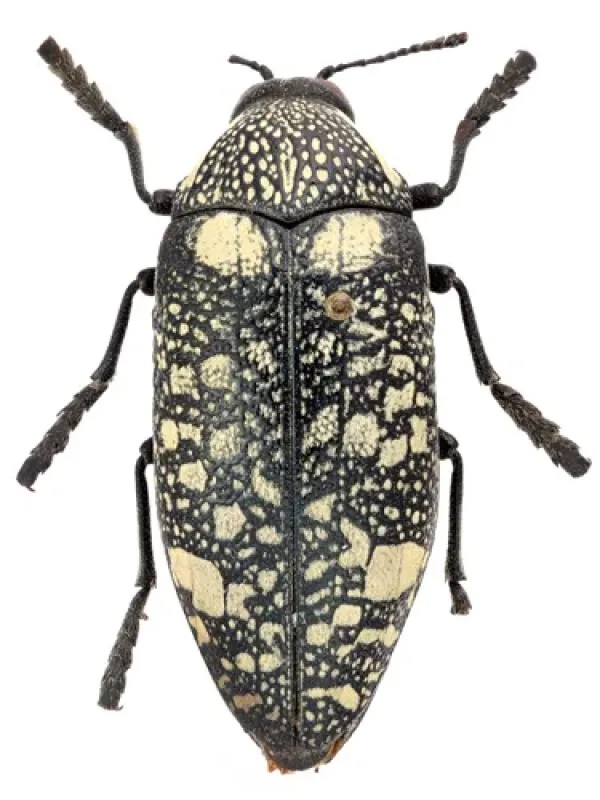
Description
How to identify
The elm buprestid beetle (Lamprodila nobilissima) belongs to the family Buprestidae, order Coleoptera. Adult beetles are known for their striking metallic sheen on their elytra, exhibiting vibrant green and gold colors that shimmer in the sunlight.
Adult beetles typically feature an elongated and slightly flattened body shape. They measure approximately 10 to 15 millimeters in length. The head and pronotum often possess a coppery or bronze tint, which is a distinctive characteristic for identifying this specific species.
The larvae of this beetle are legless and white, characterized by an enlarged prothorax. This physical adaptation allows them to move efficiently through tree tissues, where they spend most of their life cycle creating complex galleries under the bark.
These insects are elusive, making early detection difficult. Their activity is primarily concentrated during the spring and summer months, when they emerge to mate and disperse throughout forest or urban landscapes.
Biologically, this species is well-adapted to surviving on stressed trees, but under high population densities, it can also infest seemingly healthy trees, eventually leading to severe decline.
What it damages
The primary hosts for this pest are trees of the genus Ulmus (elms). The beetle particularly targets trees that are already weakened by environmental stress, mechanical injury, or existing diseases such as Dutch elm disease.
The larvae are responsible for the primary damage as they tunnel through the cambium layer and sapwood. This activity disrupts the transport of water and essential nutrients from the roots to the canopy, causing branches to wither and die.
Massive infestation of the trunk by larvae leads to tissue necrosis and loss of tree vitality. Without intervention, an infested tree can succumb and die within a few growing seasons due to the cumulative structural and physiological damage.
Beyond direct damage, the larval tunnels provide entry points for secondary pathogens, such as fungi and bacteria. This further complicates the plant's health and requires urgent management interventions.
In urban settings, this pest poses a significant threat to decorative elm plantings. Since elms are often key landscape elements, the loss of these trees significantly impacts the local ecosystem and aesthetic value of parks and avenues.
When it appears
Adult beetle flight occurs during the warmer months, typically between May and July. During this time, the beetles feed on leaves and search for suitable egg-laying sites on the bark of host trees.
The larval development period can vary, lasting from one to two years depending on local climate conditions. The larvae overwinter deep within the trunk, protected from low temperatures and predators by the woody tissue.
In spring, as temperatures rise, the larvae complete their development and pupate. Shortly thereafter, new adult beetles emerge, creating characteristic exit holes in the bark.
The peak activity of adult beetles coincides with the period of rapid elm growth. Consequently, monitoring during this window is crucial for identifying potential threats and initiating control measures.
Climate change, specifically prolonged droughts, is a significant factor in increasing pest populations, as drought-stressed trees become significantly more susceptible to successful colonization.
Signs of infestation
The most reliable early indicator of infestation is the emergence of small, elliptical holes on the trunk. These are the exit points created by the adults and are often overlooked until the population increases.
Carefully peeling back a section of the bark may reveal broad, winding tunnels filled with frass. This is definitive evidence that larvae are actively feeding within the tree's vital tissues.
The canopy often displays the first signs of stress, such as premature yellowing and shedding of leaves on individual branches, which indicates an internal disruption of the tree's circulatory system.
In cases of severe infestation, patches of dead or loose bark may be observed, sometimes accompanied by sap flow, which is a defensive reaction to the internal physical trauma.
Pheromone traps are highly effective for detecting the presence of the beetle early in the season, allowing for proactive management before visible damage to the trunk becomes irreversible.
Control measures
Management of the elm buprestid beetle relies on a combination of silvicultural practices and direct control measures. A proactive approach is essential for maintaining tree health and minimizing infestation success.
- Perform regular sanitary pruning and remove heavily infested trees before the new generation of beetles emerges.
- Provide adequate supplemental watering for elms, especially during drought conditions, to strengthen their physiological resistance.
- Apply systemic insecticides, either through trunk injections or canopy spraying, to target larvae and prevent further colonization.
- Use contact insecticides on the bark during the adult flight period to provide a chemical barrier against egg-laying.
- Encourage natural predators, such as woodpeckers and beneficial parasitic wasps, to help regulate pest populations in parkland environments.
Taxonomy
- Latin name
- Lamprodila nobilissima
- Order
- Coleoptera (beetles)
- Family
- Buprestidae
- EPPO code
- LAMRBE
Discussion
No discussions yet — be the first.