
Cypress buprestid
Lamprodila festiva
Description
How to identify
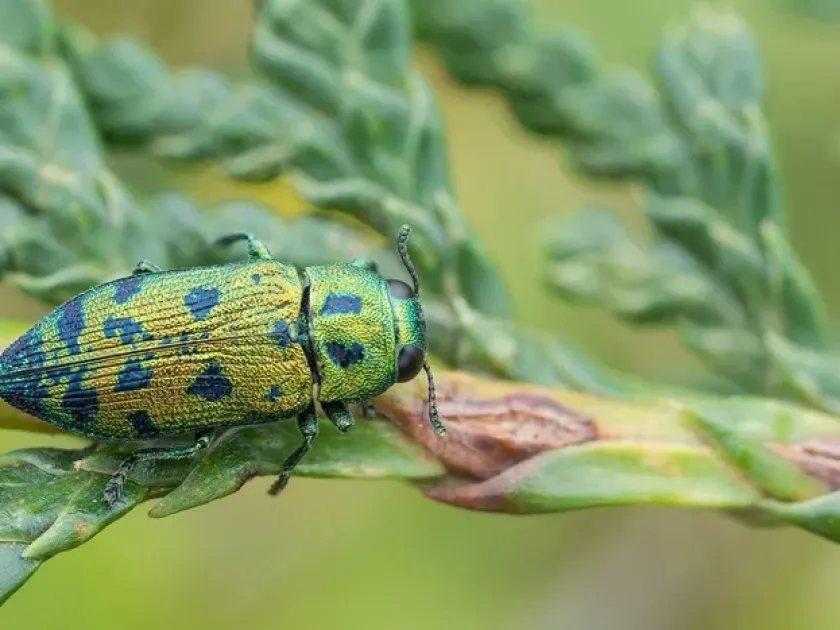
The cypress buprestid (Lamprodila festiva) is a destructive wood-boring beetle belonging to the Buprestidae family. The adult beetle is small, typically 7–11 mm in length, with an elongated body that displays a striking metallic green to copper iridescence.
The larvae are legless, yellowish-white in color, and feature a widened thorax. They live exclusively beneath the bark of host trees, where they excavate winding galleries that disrupt the tree's vital transport systems.
Adult beetles are highly mobile and strong fliers, particularly active on warm, sunny days. They are known for targeting stressed or weakened coniferous plants in both urban and rural landscapes.
The life cycle and population dynamics of this beetle are closely tied to climatic conditions. Hot and dry summers are particularly favorable for their rapid expansion and infestation cycles.
Considered a major threat to ornamental conifers, the cypress buprestid can quickly cause extensive damage, turning healthy landscapes into areas of dying and discolored foliage.
What it damages
The primary hosts for this pest include various species of the Cupressaceae family, most notably cypress (Cupressus), juniper (Juniperus), thuja (Thuja), and false cypress (Chamaecyparis).
The larvae feed on the cambium and phloem layers, creating serpentine tunnels that effectively girdle the tree. This damage prevents the transport of water and nutrients from the roots to the upper canopy.
Trees that are already under stress—due to drought, poor soil quality, or mechanical damage—are significantly more susceptible to successful colonization by the beetle.
In dense plantings, the infestation spreads rapidly from tree to tree. Once the damage to the conductive tissue becomes severe, the tree loses the ability to recover and begins to die off.
The impact of this pest is often compounded by the fact that external signs of infestation are subtle during the early stages, delaying intervention until the damage is nearly irreversible.
When it appears
The emergence of adult beetles typically occurs from late spring, starting in May, and continues through July, depending on local temperature profiles.
Females search for suitable host plants, laying eggs directly into bark crevices or existing wounds. The reproductive capacity of the species allows for a significant build-up of the population in a relatively short time.
Larval development takes place within the tree, lasting from one to two years depending on the climate. The larvae spend their entire developmental phase feeding and growing protected by the bark.
Overwintering occurs in the larval stage within the wood or bark layers. As spring temperatures rise, the larvae resume feeding before eventually transforming into pupae and preparing for emergence.
The adult exit from the tree occurs in the spring, leaving behind characteristic emergence holes that serve as a diagnostic indicator of the beetle's presence.
Signs of infestation
One of the earliest indicators of an infestation is the discoloration of needles, which may turn yellow or reddish-brown on individual branches before spreading to the rest of the tree.
Upon closer inspection, small, oval-shaped exit holes can be seen on the bark. These are the remnants of the exit points used by the adult beetles after completing their cycle.
Removing a section of the bark in affected areas will reveal meandering tunnels tightly packed with frass (larval waste), which is a definitive sign of buprestid activity.
Trees may exhibit general signs of decline, such as slowed growth, drooping of the canopy, and loss of turgor in the needles during the hottest parts of the day.
- Needle yellowing or browning on specific branches.
- Oval-shaped exit holes on the tree trunk.
- Loosening or peeling bark on affected limbs.
- Accumulation of sawdust-like frass under the bark.
- Gradual but steady death of the tree canopy.
Control measures
Preventative care is the most effective defense. Maintaining tree health through proper irrigation and nutrient management helps trees resist infestation by making them less attractive to the beetles.
Severely infested trees should be removed and destroyed immediately. Burning the infested wood is often recommended to stop the life cycle and prevent the emergence of new adults.
Insecticide treatments should be timed with the peak adult activity in the spring and early summer to prevent egg-laying. Contact and systemic insecticides are commonly used in this application.
While systemic insecticides can be beneficial, their efficacy is limited once the larvae are deep within the wood, which is why early detection and proactive monitoring are crucial.
Monitoring for adult presence using pheromone traps can help arborists and gardeners determine the exact timing for spray applications, significantly increasing the success rate of control efforts.
Taxonomy
- Latin name
- Lamprodila festiva
- Order
- Coleoptera (beetles)
- Family
- Buprestidae
- EPPO code
- POELFE
Discussion
No discussions yet — be the first.